


By Adam Kelliher
The short answer: citrine is the transparent pale-yellow to brownish-orange variety of quartz. Natural citrine is rare. Most of the citrine on the market started as amethyst and was heated until the colour shifted to gold. That heated material is still genuine quartz, and it is still called citrine. The honest line is disclosure, not "fake."[1][2][3]
Iron on the move
Citrine is quartz (SiO2), hardness 7, refractive index 1.544–1.553, specific gravity about 2.66.[1] The colour change is chemistry. Iron in the quartz lattice moves to a different site when the stone is heated, and some of it can precipitate as tiny iron-oxide particles. In heating experiments, amethyst stayed violet below about 420 °C, passed through a green (prasiolite) stage around 420–440 °C, and turned citrine above about 440 °C. The authors suggested about 560 °C as a useful temperature for making citrine, and darker starting amethyst changed colour more richly.[4][5] Giant amethyst geodes from Brazil are often heated into citrine "cathedrals."[1]
Ametrine — amethyst and citrine colours in one crystal — occurs naturally in Bolivia.[1] That is a different story from a heated geode. What there is not, is a simple at-home test that proves a yellow quartz's colour came from the ground unheated. Nassau, writing in Gems & Gemology, concluded there were no known tests to separate some naturally coloured amethyst-citrine quartz from material heated or irradiated by people.[6] Lab methods can help separate natural quartz from synthetic quartz. They do not, by themselves, settle heated versus unheated colour.[7]

What we stock, and what I won't claim
Provenance — where a piece was dug, and how it was treated — is the useful part of the label. I will not call a citrine naturally coloured unless that has been confirmed. That includes material from British Columbia.
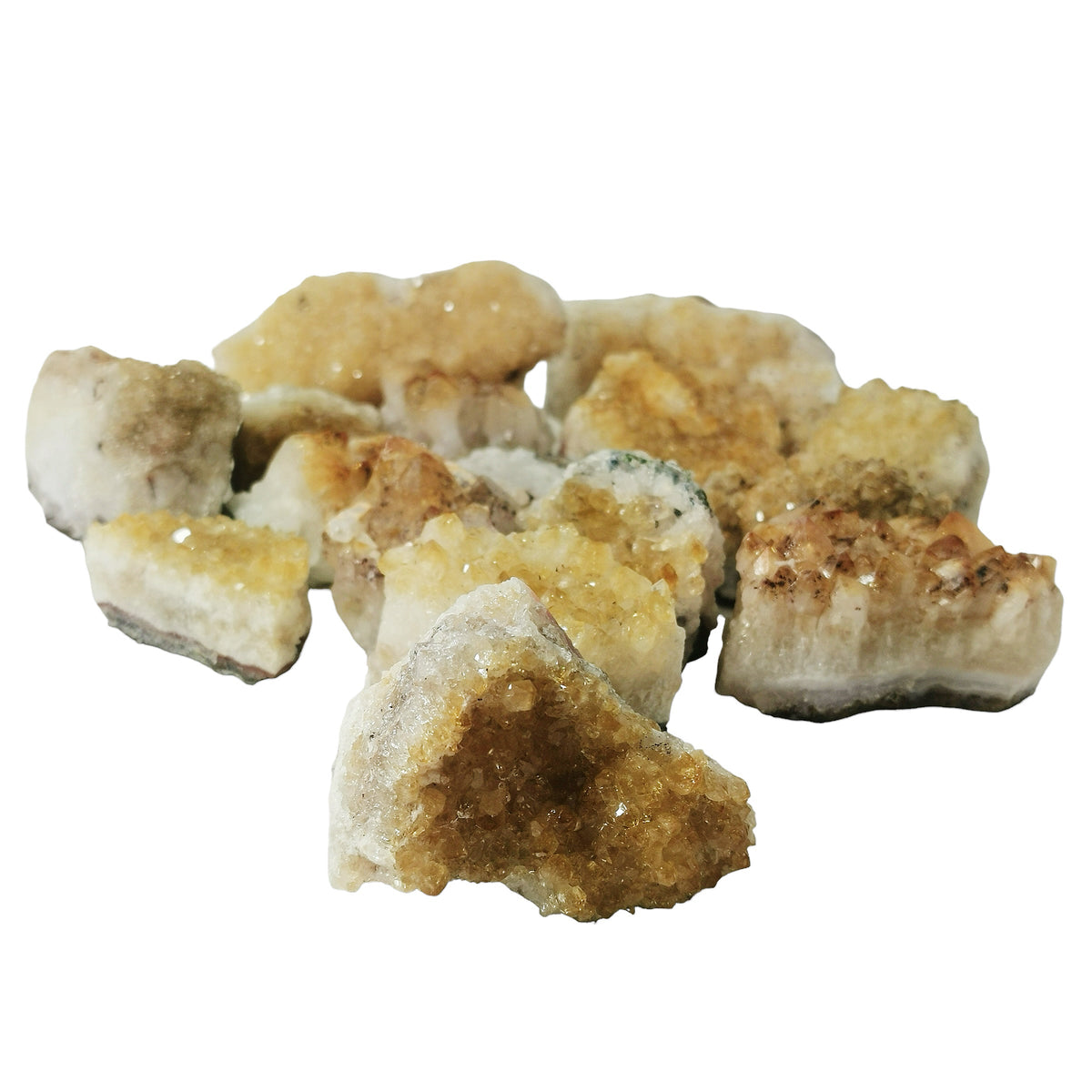
We stock heated citrine druzy from Brazil, labelled as heated, plus citrine chips and pieces labelled natural, such as a citrine cluster from Morocco and Kundalini citrine. The labels are the starting point, not a laboratory certificate. Citrine is fairly durable, though abrupt temperature changes can fracture it.[8]
For the broader treatment-and-imitation picture, see Dyed, Glass and Lab-Made.
See what's new: browse our newest arrivals for the latest pieces added to the shop.
Sources
- GIA. Citrine Gemstone (encyclopedia: About, Heat, Geodes, Ametrine, Facts).
- GIA. Is citrine treated? (FAQ).
- GIA. Citrine Description.
- Study on the effect of heat treatment on amethyst color and the cause of coloration. Scientific Reports 10 (2020).
- Optical and Paramagnetic Properties of Iron Centers in Quartz. J. Chem. Phys. 44(5): 1741 (1966).
- Nassau, K. 1981. Artificially Induced Color in Amethyst-Citrine Quartz. Gems & Gemology, Spring 1981.
- GIA. Using LA-ICP-MS Analysis for the Separation of Natural and Synthetic Amethyst and Citrine.
- GIA. Citrine buyer's guide (Durability).