


By Adam Kelliher
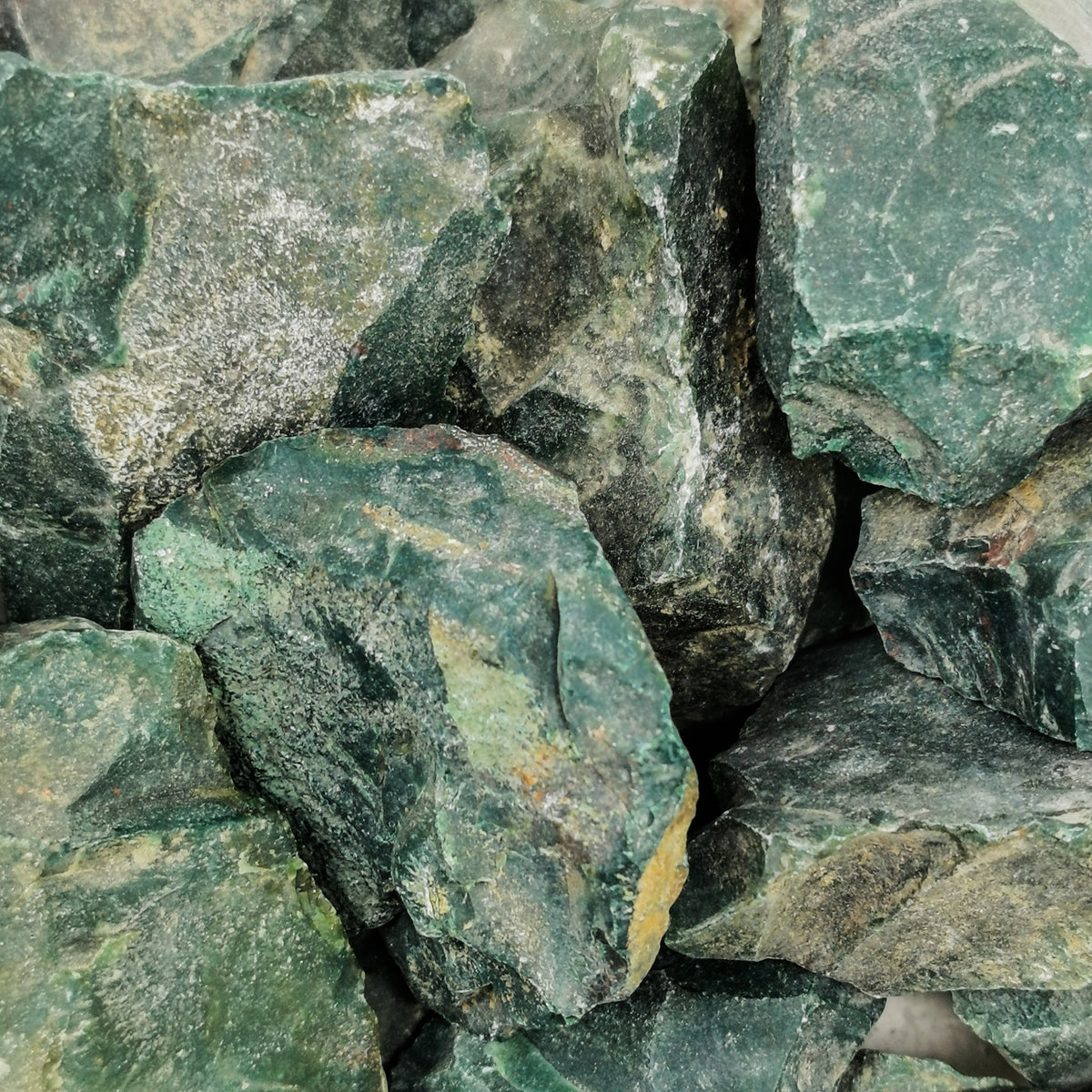
The short answer: bloodstone, also called heliotrope, is dark green chalcedony (microcrystalline quartz) dotted with red spots of iron oxide, mainly hematite. Most of what's on the market today comes from India, classically the Deccan Traps of the Kathiawar Peninsula, where silica filled cavities and fractures in basalt. The green colour comes from tiny mineral inclusions, not from the quartz itself; which green mineral dominates in Indian material isn't settled.[1][2][3]
The name trips people up, because "bloodstone" has also been used for hematite, which is a different mineral altogether.
Green chalcedony, red hematite
GIA describes bloodstone as a chalcedony variety, traditionally semi-translucent to opaque dark green with red iron-oxide inclusions, especially hematite, hardness about 6.5–7, usually cut as cabochons.[3] GemRocks puts hardness at 6–7 and specific gravity around 2.6, and notes that some people also apply "bloodstone" to hematite.[2] A listing called bloodstone shouldn't borrow hematite's formula or properties.
The red is the settled part: hematite, or hematite-red iron oxide.[1][3] The green is inclusion colour. A mineralogy review reports that Heaney and colleagues attributed it to tiny particles of chlorite or hornblende needles, and that another study vaguely linked Fe2+ and copper compounds to the dark green.[1] GemRocks notes that plasma — green chalcedony without the red spots — owes at least some of its green to actinolite.[2] I won't pick a winner for the Indian material; the honest line is "green from inclusions, red from hematite."
Translucent pieces read as chalcedony; fully opaque ones get called jasper. The split is subjective. "Green chalcedony with red hematite spots" covers both. For the family names, see Agate vs Jasper vs Chalcedony.

Deccan cavities, and a name from Pliny
Most commercial bloodstone is from India, with other sources including Brazil, China, Australia, South Africa and the United States.[1][3] The best-known Indian material is from the Deccan Traps of the Kathiawar Peninsula, the same volcanic province that produced a lot of India's agate and carnelian: silica-rich fluids filling basalt cavities and fractures, later found as nodules and river pebbles.[2][3]
The other name, heliotrope, comes from the Greek for "to turn the sun". Pliny wrote that the stone, thrown into water, turned the sun's reflection blood-red. He also mocked the claim that it made the wearer invisible.[1][3] GIA lists bloodstone as one of the two March birthstones, with aquamarine.[3]
We stock Indian bloodstone rough, plus polished tumbles, mini spheres, mini hearts and worry stones from Gujarat.
See what's new: browse our newest arrivals for the latest pieces added to the shop.
Sources
- Gliozzo, E. 2019. Variations on the silica theme: Classification and provenance from Pliny to current supplies. EMU Notes in Mineralogy Vol. 20, ch. 2.
- Dietrich, R.V. GemRocks: Chalcedony. Central Michigan University.
- GIA. March Birthstones: Aquamarine & Bloodstone.
- King, H.M. Bloodstone. Geology.com (secondary).
- Encyclopædia Britannica (1911), "Bloodstone" (historical naming only).