




Specifications
Description
Locality: Meedensdorf, Bamberg, Bavaria, Germany
Era: Jurassic
Geological Age: 145–201 mya
Ammonites were marine cephalopods with a coiled outer shell, like the modern nautilus. The shell was divided into chambers by walls called septa. The animal lived only in the last chamber and could regulate gas or fluid in the earlier ones to control its buoyancy, much like a submarine. Ammonites died out at the end of the Cretaceous, at about the same time as the dinosaurs.
Using ammonites to date rocks was pioneered in the 1850s by two Germans, Friedrich Quenstedt of Tübingen and his one-time pupil Albert Oppel of Munich, who worked on the ammonites of the Swabian and Franconian Alb in southern Germany. Because ammonites evolved quickly and spread worldwide, they can separate intervals of geological time of less than 200,000 years.
The name comes from the Egyptian god Amun, known to the Greeks as Zeus Ammon and shown with curling ram's horns. Early naturalists compared the coiled shells to serpents, and ammonites became widely known as snakestones. The town of Whitby in North Yorkshire still has three snakestones on its coat of arms.
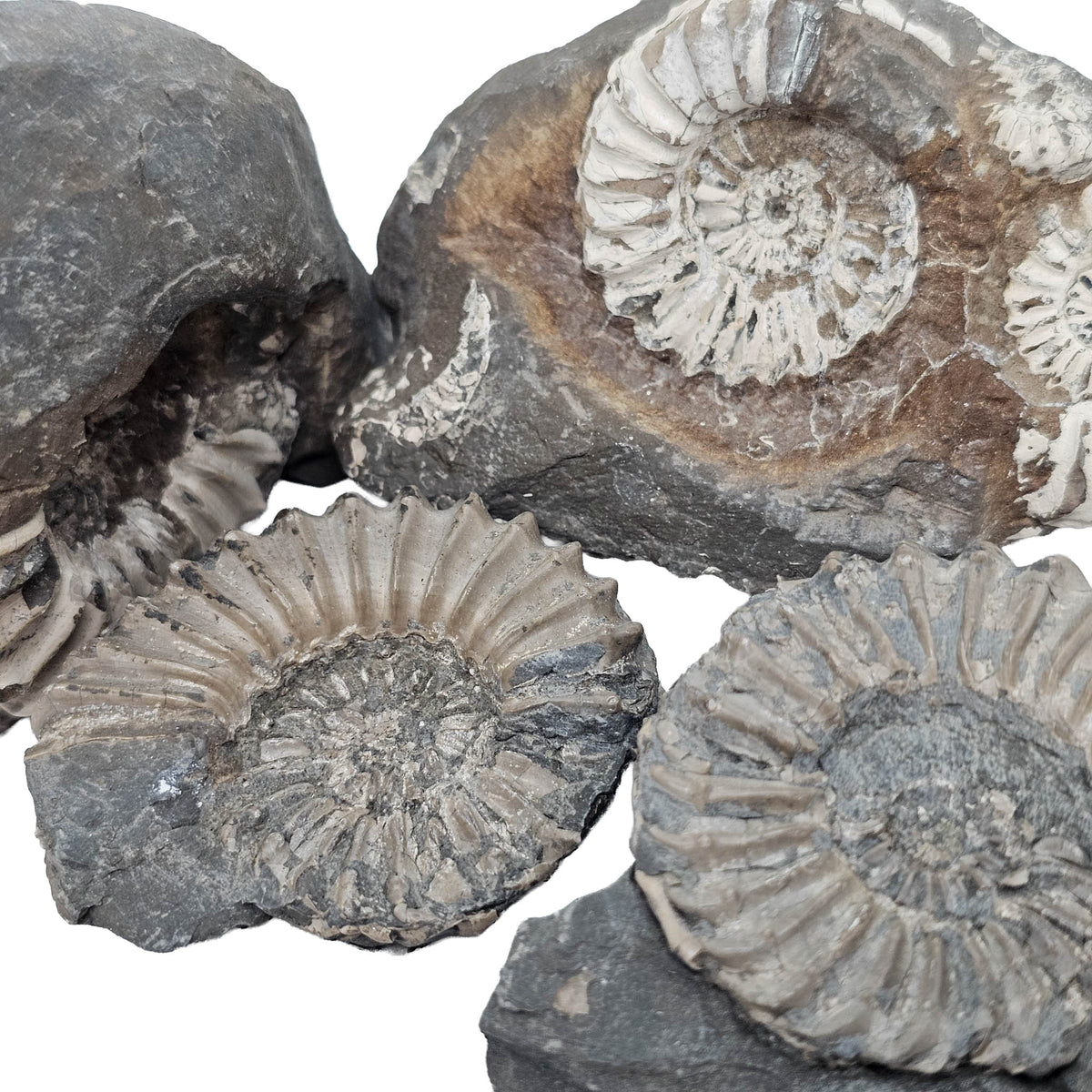
These ammonite fossils from Meedensdorf, Germany show the classic coiled shell form that makes ammonites such recognizable fossils. Because there are multiple specimens in this group, the appearance varies from piece to piece: some are more fully exposed from the surrounding matrix, while others show several ammonites together in one section of stone. That variation gives each specimen its own character, whether you prefer a cleaner, more isolated shell or a busier natural plate with multiple fossil forms visible at once.
Ammonites were extinct marine cephalopods related to modern squid, octopus, and nautilus. Their shells were buried in seafloor sediment and fossilized over immense spans of time, which is why pieces like these can preserve such clear ribbing, spiral structure, and shell outline. Ammonites are especially important in paleontology because they are widely used to help date marine rock layers.
People are often drawn to ammonites because the spiral feels ordered, ancient, and steady. They are commonly associated with continuity, natural cycles, and grounded growth, and many people like them for the sense of age, rhythm, and quiet permanence they bring to a space.
Presentation Qualities: I chose this rather than overall size, because it is what is predominantly affecting the value categories.
Partial
Nearly Complete
Great
Multiple
Quantity: 1pc
We do our best to buy quality products- although not every rock is the same. If you choose to purchase the "staff pick option", we will select the best of the batch for you. Otherwise, it will be at random from the larger batch we have in stock.