


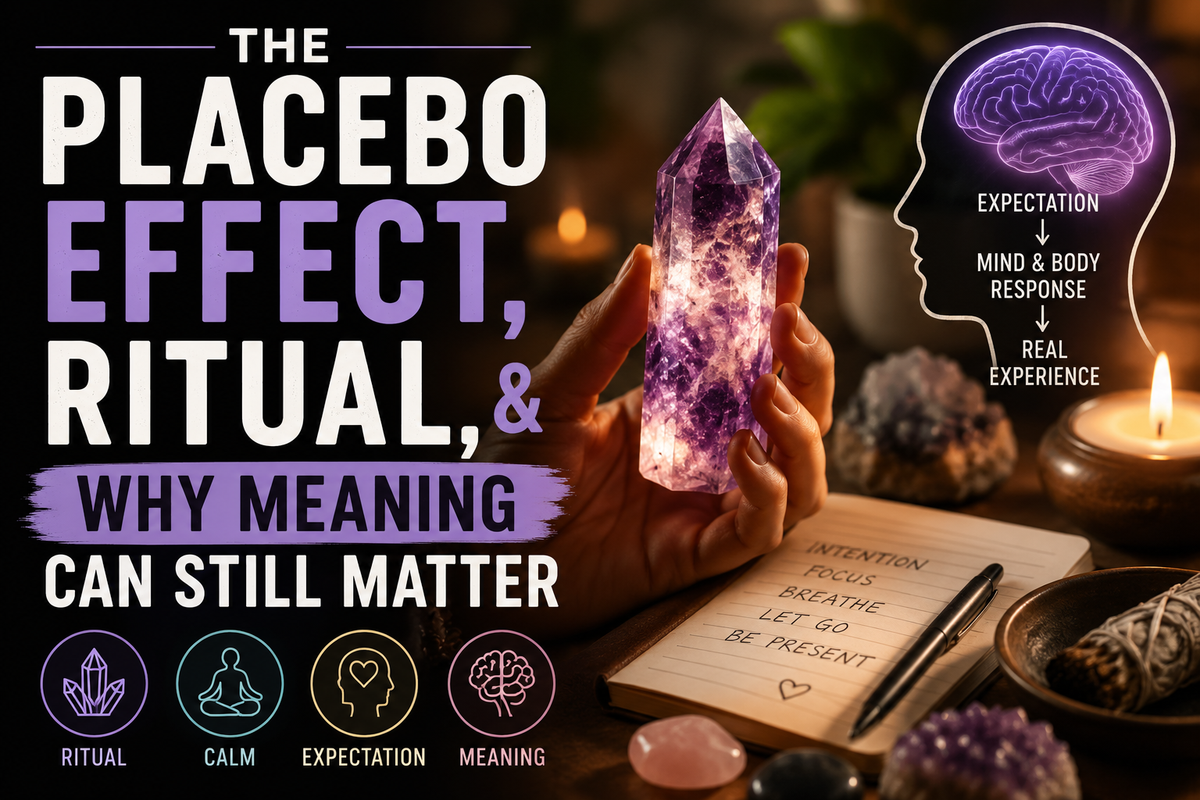
The word placebo is often used as if it means fake, imaginary, or pointless. Someone says a treatment only worked because of the placebo effect, and the implication is that nothing real happened. That is not a very useful way to think about it.
The placebo effect is better understood as a collection of real psychological and physiological responses shaped by expectation, context, conditioning, attention, trust, stress, and behaviour. A person may feel calmer, experience less discomfort, sleep better, or respond differently to a situation because they believe a practice will help, because the practice changes their routine, or because the ritual gives their mind and body a familiar signal.
That does not mean the object involved has the physical properties the person believes it has. It means human beings respond to meaning, expectation, and context in ways that can affect how they feel and behave.
This distinction matters when we talk about crystals. Many crystal practices involve far more than the mineral itself. They involve touch, repetition, symbolism, intention, atmosphere, memory, and expectation. A person may genuinely benefit from the practice while still misunderstanding what caused the benefit.
The useful question is not whether the experience was real. The useful question is what part of the experience produced the result.
Placebo Does Not Mean Nothing Happened
Suppose someone holds a crystal during a stressful moment and begins to feel calmer. It would be lazy to dismiss that by saying it was “just placebo,” as if the person experienced nothing.
Several things may have changed at once. They may have stopped moving, slowed their breathing, focused on the weight and texture of the stone, and given themselves permission to pause. Their attention may have shifted away from the thought that was upsetting them. They may have expected relief, and that expectation may have reduced the intensity of the stress response.
Those are real processes.
Expectation can influence how people interpret pain, anxiety, fatigue, effort, and discomfort. Context can change how safe or threatened someone feels. Repetition can condition the body to respond to a familiar sequence of actions. A ritual can create a structured pause where there would otherwise have been impulsive behaviour.
None of that proves that the mineral itself emitted a healing energy. It does show that a person’s experience can change because of what they expect, notice, and repeatedly practice.
The mind and body are not separate systems operating without influence on one another. Thoughts, beliefs, stress, attention, and behaviour all affect physical experience. That does not mean the mind can cure anything through belief alone, but it does mean the psychology surrounding a treatment or ritual is not irrelevant.

The Crystal Object Can Matter Without Having Special Powers

Objects can become important because of the meaning people attach to them.
A wedding ring does not create the marriage. A medal does not create the achievement. A photograph does not contain the person it depicts. A family heirloom does not need to emit anything in order to affect the person holding it.
The object matters because of what it represents.
Crystals can serve the same function.
Someone may associate rose quartz with self-respect because they bought it during a difficult period. Another person may carry black tourmaline because it reminds them to maintain stronger boundaries. Someone else may place amethyst beside the bed because it has become part of a routine that helps them settle down at night.
In each case, the stone is doing something in the person’s life, but that role may be symbolic, behavioural, and psychological rather than mineralogical.
The crystal may be attractive, tactile, durable, and easy to carry. Those qualities make it useful as a reminder. The person sees it, touches it, and remembers the meaning they assigned to it. That is enough to influence behaviour without requiring the stone to possess an invisible force.
A meaningful object does not become meaningless simply because its effect is psychological. Psychological effects are still part of human life.
Ritual Gives Structure to Attention
A ritual is a repeated action that gives form to an experience.
People often think of ritual only in spiritual or religious terms, but daily life is full of it. A person makes coffee the same way each morning, stretches before training, listens to a particular kind of music before working, reads before bed, or puts on specific clothing before an important meeting.
These habits prepare the mind for what comes next.
A crystal ritual can work the same way. Someone may sit down, hold a stone, breathe slowly, and repeat an intention. If they do that often enough, the sequence itself may become associated with calm.
The body begins to recognize the pattern. The posture, breathing, silence, touch, and expectation start to function together. Eventually, the stone may help trigger the state because it has been repeatedly paired with that state.
This is conditioning.
The stone does not need to emit anything. It becomes part of a learned signal.
The same thing happens with smells, sounds, rooms, clothing, and tools. A certain scent can remind someone of childhood. A song can change mood almost immediately. A workshop apron can shift someone into work mode. A bed can make a person sleepy before they consciously decide to rest.
The response develops because the object or setting has been repeatedly connected with a particular state.
Expectation Can Change How an Experience Feels
Expectation shapes experience more than people usually realize.
If someone expects a practice to help, they may approach it differently. They may relax more easily, notice improvement sooner, tolerate discomfort longer, or interpret a sensation in a less threatening way.
This does not mean expectation can produce any outcome a person wants. It has limits. But it can influence how a situation is felt.
Two people can experience the same physical sensation and interpret it differently. One person feels a rapid heartbeat and thinks they are in danger. Another feels the same thing and interprets it as excitement. The sensation may be similar, but the meaning changes the emotional response.
A person holding a crystal may feel warmth in their hand. One person interprets that as energy. Another interprets it as ordinary body heat. The sensation itself may not be disputed. The explanation is.
Expectation also affects attention. If someone is told that a certain stone promotes calm, they may become more aware of calm moments while using it. They may give less attention to the times they held the same stone and still felt anxious.
Over time, the practice can become more convincing because expectation helps decide what gets noticed and remembered.
A Crystal Can Work as a Behavioural Cue
Attention influences behaviour.
If a crystal keeps an intention visible, it can affect the decisions a person makes throughout the day. Someone may carry a stone associated with patience. Each time they touch it, they remember not to react immediately. They pause before answering, lower their voice, or leave an argument before it gets worse.
At the end of the week, their relationships may feel better.
The improvement is real, but the process is behavioural. The stone worked as a reminder.
This is similar to tying a string around a finger, leaving a note on a desk, wearing a wristband, or setting a reminder on a phone. The object changes what the person remembers at the moment when the reminder matters.
A crystal may be especially effective because it is appealing and tactile. People like handling it. That makes it easier to use repeatedly.
The stone may help direct attention, but the person still has to make the decision.
Ritual Can Interrupt Automatic Reactions

Much of human behaviour happens automatically.
People reach for their phones, answer defensively, spend money, procrastinate, avoid discomfort, or repeat habits before they have fully decided what they are doing.
A ritual can interrupt that momentum.
If someone trains themselves to hold a stone before responding when angry, the action creates a small gap. That gap may only last a few seconds, but a few seconds can be enough to change the outcome.
The practical value is in the interruption.
The stone makes an internal intention physical. Instead of relying on memory alone, the person carries a reminder in their pocket or wears it on their body.
That can be useful.
The important point is that the mineral is not removing anger from the situation. The ritual is giving the person a chance to respond differently.
Meaning Can Change How People Handle Difficulty
Meaning affects how people respond to hardship.
A person who believes an experience has purpose may tolerate it differently from someone who sees the same experience as random and pointless. A ritual can provide structure during periods of chaos. An object connected to grief, recovery, or discipline can help organize emotion.
This is easy to see with inherited or sentimental objects.
Someone may carry a stone that belonged to a parent, partner, or friend. Holding it may bring comfort because it creates a sense of continuity and connection.
That comfort is real.
It does not require the person to prove that the deceased individual is communicating through the mineral. The object may help because it carries history and memory.
Meaning is difficult to measure, but it influences whether someone feels supported, connected, hopeful, ashamed, or capable of continuing. Those states affect behaviour.
A person who feels supported may take better care of themselves. Someone who uses a ritual to mark a new beginning may become more consistent. A person who connects an object with discipline may use it to return to better habits.
The effect comes through interpretation, but interpretation still matters.
Different Claims Need to Be Separated
A lot of confusion comes from blending several different claims together.
One claim is that the crystal caused a measurable physical effect because of a property inside the mineral. That is a scientific claim. It suggests that the stone itself is producing something that can affect the body in a reliable and repeatable way.
Another claim is that the ritual involving the crystal changed the person’s state. That may be explained through breathing, expectation, attention, repetition, or relaxation.
A third claim is that the crystal served as a symbolic cue. The object reminded the person of a goal, boundary, memory, or value.
A fourth claim is that the person interpreted the experience through an existing belief. They felt warmth, tingling, calm, relief, or emotional release and understood those sensations through the language of energy, cleansing, grounding, or protection.
These claims are not interchangeable.
A person can have a meaningful and helpful experience without proving that the mineral produced a special physical force.
This is one of the most important distinctions in the entire subject. The ritual may help, the object may matter, and the person may change, but none of those outcomes automatically proves the explanation attached to the stone.
Expectation Can Also Make People Feel Worse
Expectation does not only create positive effects.
It can also increase fear, stress, and discomfort. This is often called the nocebo effect.
If someone believes an object or situation is harmful, they may become anxious, monitor their body closely, and interpret normal sensations as evidence of danger.
A person told that a crystal is “too powerful” may begin feeling dizzy or tense when holding it. Someone warned that a stone carries negative energy may feel uncomfortable before anything physical has changed.
The symptoms may be genuine, but the cause may be expectation and stress.
This matters because metaphysical systems can create fear as easily as comfort. People may become anxious about touching the wrong stone, combining the wrong minerals, placing an object in the wrong room, or forgetting to cleanse it.
A belief system that helps someone feel calm may be useful. A belief system that makes them fearful, dependent, or constantly vigilant can become harmful.
That is another reason to be careful about how claims are presented.
Placebo Is Not an Excuse for False Medical Claims
The fact that rituals and expectations can help does not justify every claim made about them.
Someone may argue that even if a crystal works through placebo, the claim is harmless because the person still feels better.
That depends on what the person is being encouraged to do.
Using a stone as part of a calming routine is one thing. Using it instead of medical treatment is another.
A crystal beside the bed may be harmless. Telling someone that it can cure cancer, treat infection, replace medication, or remove the need for professional care is not harmless.
The psychological benefit of a ritual does not justify false medical claims.
A person can use a crystal for comfort while still seeing a doctor. They can meditate with a stone while still taking prescribed medication. They can value symbolism without confusing symbolism with treatment.
The problem is not that people find comfort in objects. The problem is when comfort is sold as cure.
Understanding the Mechanism Gives the Person More Control
There is a practical reason to care about the explanation.
If someone believes the stone gave them confidence, then the power sits in the object. If they forget it, lose it, or no longer have access to it, they may feel that the ability is gone.
If they understand that the stone reminded them to breathe, slow down, and trust their preparation, then the ability still belongs to them.
The object helped organize their attention, but they did the work.
They prepared for the meeting. They tolerated the discomfort. They spoke clearly. They made the decision.
This does not mean they need to stop using the stone. They may use it more effectively once they understand its role.
Instead of waiting for the crystal to change them, they can use it as a tool that reminds them how they intend to act.
That creates a healthier relationship with the object because the stone supports agency instead of replacing it.
Ritual Can Support Discipline, but It Cannot Do the Work
People often confuse symbolic preparation with action.
Buying a journal can feel like writing. Buying workout clothes can feel like training. Buying a crystal for abundance can feel like taking a step toward financial improvement.
Sometimes the purchase marks a real commitment, but the symbol becomes useless if it replaces the behaviour it was meant to support.
A person can carry a stone for prosperity, but they still need to manage money, improve their skills, ask for work, control spending, build relationships, or create something people are willing to buy.
They can carry a stone for health, but they still need sleep, nutrition, movement, treatment, and honest habits.
They can carry a stone for love, but they still need communication, boundaries, patience, and better judgment.
The ritual may help keep the goal visible. It cannot complete the work.
This is where meaning, psychology, and personal agency meet. The object can support the process, but the person still has to act.
Why the Explanation Matters
Some people may ask why it matters what caused the improvement if the person feels better.
The explanation matters because it shapes what they do next.
If someone understands that the ritual helped because it slowed their breathing, they can repeat that process in other situations. If they understand that the stone reminded them to act differently, they can create other reminders and routines. If they believe the mineral alone created the effect, they may become dependent on possessing the object.
The same difference becomes much more serious with health claims. If someone understands that a ritual reduces stress, they can use it alongside proper care. If they believe the stone cured the condition, they may avoid treatment the next time something serious happens.
Explanations are not harmless stories added after the experience. They influence behaviour, risk, and future decisions.
A better explanation gives the person more useful information about what can be repeated, controlled, and adapted.
Meaning Does Not Need to Pretend to Be Science
Science is designed to test claims about the observable world. It asks whether an effect can be measured, repeated, compared, and separated from other explanations.
Meaning operates differently.
Meaning is personal, cultural, emotional, and symbolic. It can affect someone deeply without behaving like a physical force.
A family heirloom can matter without emitting anything. A ritual can provide stability without changing the chemistry of the object involved. A crystal can remind someone of courage without containing courage inside it.
There is no need to force every meaningful experience into scientific language.
When that happens, symbolism turns into bad physics, and science gets treated as if its job is to decide whether people are allowed to care about things.
A better approach is to let meaning remain meaning and let physical claims be tested as physical claims.
A More Useful Way to Understand Crystal Rituals
Crystal rituals can be understood through attention, memory, repetition, expectation, and symbolism.
A person may hold a stone and slow their breathing. They may use it as a reminder not to react impulsively. They may build a bedtime routine around it. They may connect it with grief, recovery, discipline, or confidence. They may feel calmer because they expect the practice to help. They may make better decisions because the object keeps an intention visible.
Those effects can be real.
The fact that the effect is real does not automatically prove the explanation attached to it.
The most useful conclusion is not that crystals are secretly magical, and it is not that ritual is worthless. It is that meaning can influence attention, attention can influence behaviour, and behaviour can influence outcomes.
A stone can be part of that process without being the source of everything that changed.
By Adam Kelliher