


By Adam Kelliher
The short answer: the Mohs scale ranks minerals by what scratches what, from talc at 1 to diamond at 10. To use it, try to scratch your unknown with reference minerals of known hardness. If 5 scratches it and 4 doesn't, its hardness is between 4 and 5.[1]
Our 7 home tests post uses hardness as one test among several. This one goes deeper into the Mohs test itself: what you need, how to do it properly, and how to read the result.
The ten minerals
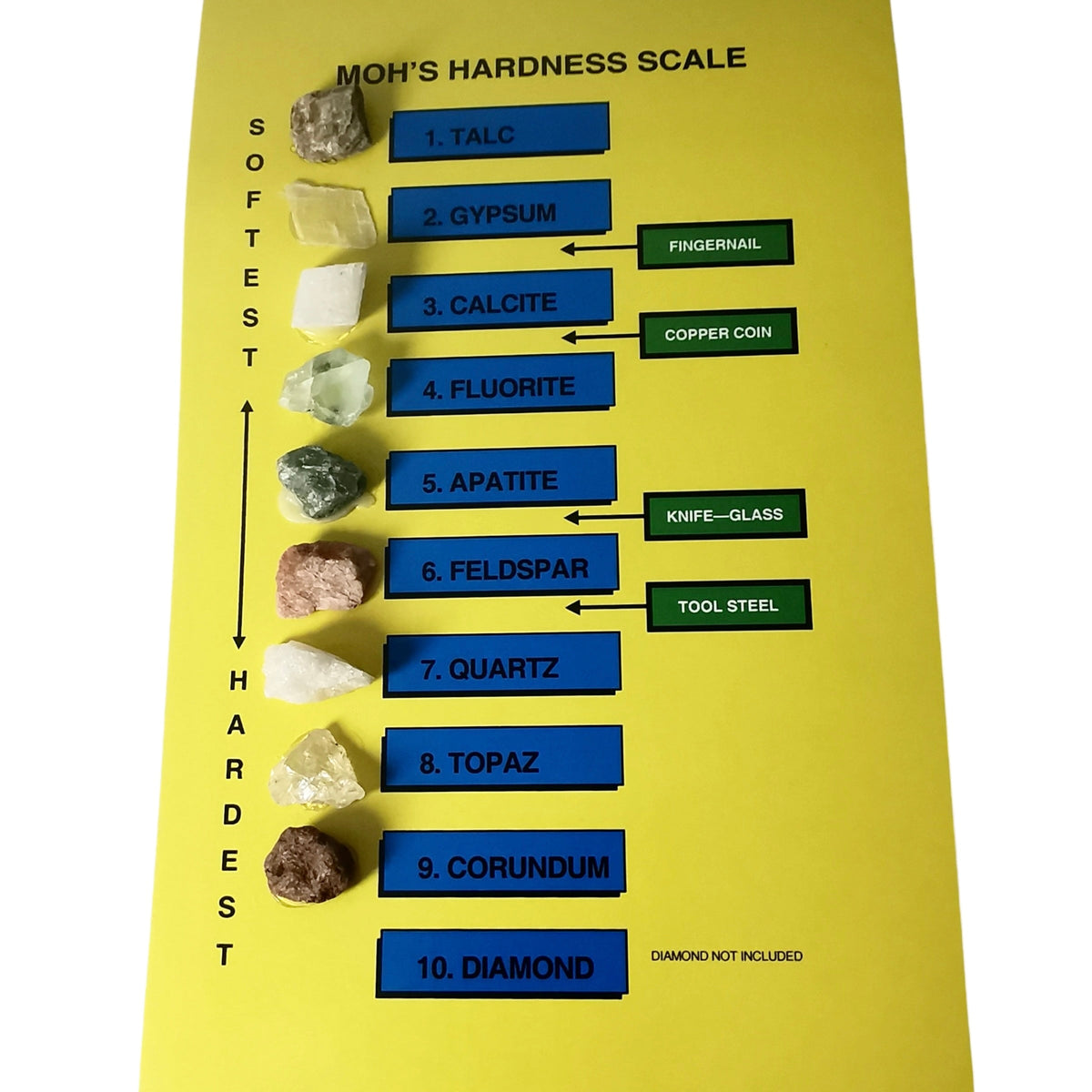
Friedrich Mohs, a German mineralogist, picked ten minerals of clearly different hardness in 1812.[1] From soft to hard: 1 talc, 2 gypsum, 3 calcite, 4 fluorite, 5 apatite, 6 orthoclase, 7 quartz, 8 topaz, 9 corundum, 10 diamond. Most kits leave out diamond to keep the cost down.[1]
What you need
- A Mohs set (or a mineral test kit).
- A 10x loupe to check for scratches.
- A piece of cardboard or a rubber mat to protect your table.[1]
How to do it
- Find a smooth, unscratched spot on your unknown.
- Hold it firmly on the table with one hand.
- Press a point of a reference mineral firmly into it and drag it across, away from your body and parallel to your fingers so you don't cut yourself.[1]
- Brush away the powder and look with your loupe. A real scratch is a groove. A mark that wipes off is just powder from the softer mineral, like chalk on a blackboard.[1]
- Repeat to confirm.

Reading the result
- If A scratches B, A is harder.
- If two minerals are the same hardness, they barely scratch each other and the result can be unclear.[1]
- Below about 5, a scratch comes easily. At 6 and up you need real pressure.[1]
Three things that trip people up
- The scale is relative, not even. It tells you order, not how much harder. A mineral scratches anything lower on the scale and is scratched by anything higher.[2] For how big the gaps really are, see Mohs and true hardness.
- Some minerals vary by direction. Kyanite blades are about 5 along their length and about 7 across them.[1]
- Breaking isn't scratching. A brittle specimen may crumble or break instead of scratching. That's a lack of toughness, not low hardness.[1]
Common references
Halite is 2 to 2.5, calcite 3, fluorite 4, pyrite 6 to 6.5, quartz 7 and jadeite 6.5 to 7.[1] You'll find kits and loupes in gemology tools.
Want a ready-made reference? The Mohs hardness scale education set gives you labelled minerals for each step of the scale.
See what's new: browse our newest arrivals for the latest pieces added to the shop.
Sources
- Geology.com (Hobart M. King): Mohs Hardness Scale.
- Adam Kelliher, Beyond Cabbing: Volume II, A Lapidary Glossary (Mohs's Scale of Hardness).