


Most rock collectors see the mineral after the hard part is over.
They see the polished malachite, the pyrite cube, the amethyst cathedral, the copper nugget, the rhodonite cabochon, the fluorite specimen, the jade carving, the silver ring, or the gold chain. They see the result sitting under lights, labelled, priced, cleaned, photographed, and ready to own.
What they usually do not see is the extraction story.
They do not see the drilling. They do not see the blasting. They do not see the core shack. They do not see the waste rock. They do not see the flotation circuit, the crusher, the haul trucks, the leach pad, the tailings facility, the water management, the permitting, the engineering, the assay lab, or the years of work between “there may be something here” and “this deposit can actually become a mine.”
That missing middle is important.
A mineral specimen in a rock shop can make geology look simple. A mine proves it is not.
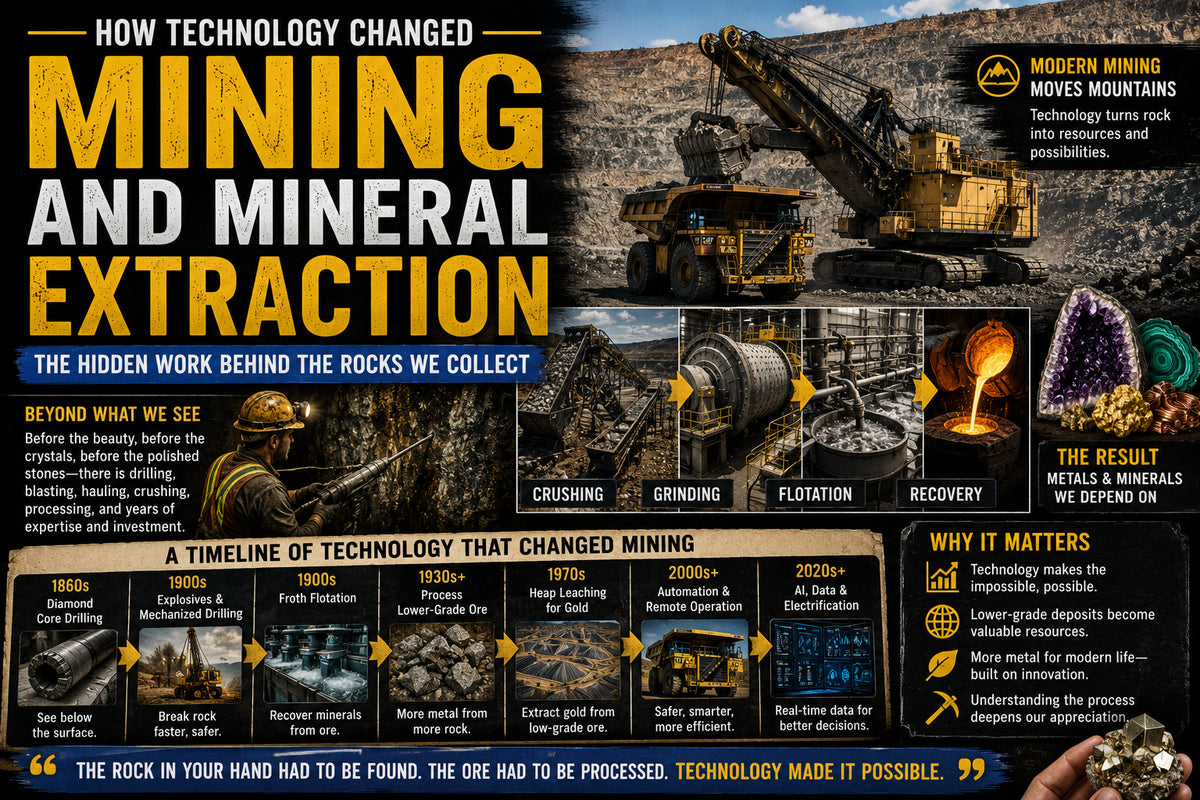
Finding minerals is one problem. Extracting them safely, legally, economically, and consistently is another. Over the last hundred years, mining changed because technology changed what could be profitably removed from the ground. Better drilling let geologists see below the surface. Better machines moved more rock. Better explosives broke rock more efficiently. Better chemistry recovered metals from material that older miners would have thrown away. Better modelling helped companies understand the shape and value of deposits before committing huge amounts of money.
Modern mining is not just men with picks chasing rich veins.
In many cases, modern mining is the organized movement and processing of enormous volumes of lower-grade rock. The ore may not look impressive to a collector. It may not glitter. It may not make a good specimen. But if the deposit is large enough, consistent enough, and recoverable with the right technology, it can matter more economically than a pocket of beautiful crystals.
That is one of the biggest differences between collecting and mining.
Collectors often value beauty, rarity, crystal form, colour, polish, locality, story, and display quality. Mining values recoverable material at scale.
Those two worlds overlap, but they are not the same.
A Rough Timeline of Mining and Extraction Technology
Mining did not become modern all at once. It changed in stages. Each new tool made it possible to dig deeper, move more material, process lower-grade ore, reduce labour, increase safety, or recover metals that older systems could not handle.
|
Period |
Development |
What changed |
|
1800s |
Steam power and industrial pumps |
Mines could be dewatered more effectively, equipment could be powered mechanically, and deeper underground mining became more practical. |
|
1860s onward |
Diamond core drilling |
The diamond core bit is often traced to Rodolphe Leschot in 1863. Core drilling allowed geologists to recover cylinders of rock from below the surface and study what was actually underground. |
|
Late 1800s to early 1900s |
Mechanized drilling and compressed air tools |
Drilling blast holes became faster than hand drilling, changing both underground and surface mining. |
|
Late 1800s to early 1900s |
Dynamite and improved blasting methods |
Blasting became more powerful, controllable, and scalable than older black powder methods. |
|
Early 1900s |
Froth flotation |
Froth flotation became one of the most important mineral-processing breakthroughs of the twentieth century, allowing valuable sulphide minerals to be separated from waste rock and making lower-grade ores economic. |
|
1930s onward |
Large-scale low-grade ore processing |
By the 1930s, flotation helped mining companies recover metals from lower-grade ores and material previously considered waste. |
|
Mid-1900s |
Open-pit mining at large scale |
Bigger shovels, trucks, drills, crushers, and conveyors made it possible to mine large, lower-grade deposits from the surface. |
|
1960s to 1970s |
Cyanide heap leaching for gold |
Heap leaching became a major method for extracting gold from low-grade ores. The U.S. Bureau of Mines worked on the method in 1969, and the gold industry adopted it widely in the 1970s. |
|
Late 20th century |
Computerized mine modelling |
Deposits could be modelled in three dimensions, with grade, tonnage, structure, economics, and mine planning integrated digitally. |
|
Late 20th century to 2000s |
Sensor-based ore sorting |
Mines could begin rejecting some waste before milling, saving energy, water, time, and processing capacity. |
|
2000s onward |
Automation and remote operation |
Automated and remote-controlled drills, trucks, loaders, and monitoring systems began changing how mines operate, especially in large open-pit operations. |
|
2020s onward |
AI, machine learning, electrification, and advanced monitoring |
Modern mining increasingly uses data systems, predictive maintenance, autonomous transport, battery-electric equipment, and real-time monitoring to improve safety, efficiency, and environmental performance. |
Some of these technologies have clear invention dates. Others spread gradually across the industry. The important point is not that mining suddenly changed in one year. It is that each layer of technology made a different kind of deposit possible.

Finding a Deposit Is Not the Same as Mining It

A beginner often assumes that if valuable minerals are found, a mine follows.
That is not how mining works.
A mineral occurrence is only evidence that something exists. It may be too small, too low grade, too remote, too deep, too fractured, too mixed with waste, too difficult to process, too environmentally sensitive, too legally restricted, or too expensive to extract.
Many mineral occurrences will never become mines.
This is especially important for rock enthusiasts because many collectible minerals are attractive but not economically meaningful. A quartz pocket can be beautiful and still have no mining value. A colourful copper stain can be interesting and still not indicate a workable copper deposit. A piece of rhodonite, jasper, agate, jade, or fluorite can be worth collecting without being part of anything a mining company would care about.
Mining is not just about whether something is present.
Mining asks harder questions:
Is there enough of it?
Is the grade high enough?
Can it be extracted safely?
Can it be processed?
Can it be permitted?
Can it be transported?
Can the waste be managed?
Can the mine survive changing metal prices?
Can the company recover its capital cost?
This is why modern mining looks so different from casual rock collecting. The collector may need one good piece. A mine needs repeatable geology, recoverable material, infrastructure, capital, and a processing method that works at scale.
1. Diamond Core Drilling Let Geologists See Underground
One of the most important changes in mining was diamond core drilling.
Before drilling, a prospector or miner was mostly limited to what could be seen at the surface, found in float, exposed in trenches, or accessed through shafts and adits. That meant a lot of guessing. The surface expression of a deposit may be small, misleading, weathered, oxidized, enriched, depleted, or offset from the best material below.
Diamond drilling changed that because it allowed geologists to pull continuous cylinders of rock from depth. Instead of only seeing the surface, they could examine the actual rock below the ground.
Core tells a story.
It shows rock type, alteration, mineralization, structure, fractures, veining, contacts, oxidation, sulphides, texture, and grade potential. It can be logged, photographed, split, assayed, stored, rechecked, and compared to other drill holes. Modern exploration diamond drilling uses diamond-encrusted drill bits to recover core, which geologists can analyze chemically and geologically. The first core bit is often attributed to Rodolphe Leschot in 1863.
For mining, this was revolutionary.
A company no longer had to rely only on what the land exposed naturally. It could drill a grid of holes, build a three-dimensional picture of the deposit, estimate grade and tonnage, and decide whether mining made sense.
For rock collectors, this is also worth understanding because the best-looking surface material is not always the main story. Sometimes the surface is just a weathered hint of a larger system. Other times, the surface is the only interesting part, and drilling proves there is nothing meaningful below.
Core drilling separates hope from evidence.
2. Mechanized Drilling Made Mining Faster and Deeper
Hand drilling is slow, brutal work.
In older mining, holes were drilled by hammer and steel. One person held and turned the drill steel while another struck it, or a single miner worked by hand. It took time, strength, and risk. Every blast hole represented labour.
Mechanized drilling changed the pace of mining.
Compressed air drills, jacklegs, wagon drills, rotary drills, and later more advanced hydraulic and automated systems made it possible to drill more holes, drill them faster, drill them more consistently, and mine at a scale that hand methods could not match.
This mattered both underground and on surface.
In underground mines, mechanized drilling improved development, stoping, and production. In open-pit mines, large blast-hole drills allowed huge volumes of rock to be prepared for blasting. The mine became less dependent on individual muscle and more dependent on systems, maintenance, fuel, compressed air, hydraulics, planning, and engineering.
This is one of the major shifts in mining history: extraction moved from craft labour toward industrial process.
That does not mean skill disappeared. It changed. The skill moved into operating, maintaining, planning, surveying, drilling patterns, ground support, ventilation, safety, and geology.
The romance of the lone miner with a pick is mostly not how modern mineral supply works.
3. Blasting Technology Changed How Rock Was Broken
Mining is often about controlled breakage.
The rock has to be broken small enough to move, haul, crush, and process. If it breaks poorly, everything downstream suffers. Oversized boulders slow loading. Poor fragmentation reduces crusher efficiency. Bad blast control can dilute ore with waste, damage walls, create safety hazards, and make the mine less profitable.
Older blasting relied on simpler explosives and less precise control. Modern blasting is much more engineered.
Blast design considers hole spacing, burden, depth, explosive type, timing, geology, fragmentation goals, vibration, wall stability, ore boundaries, water, safety, and environmental limits. Electronic detonators and improved timing systems allow more controlled blasts. Better explosives and blasting practices help mines move material more efficiently.
For a rock collector, blasting is a mixed thing.
Blasting can expose fresh mineralization. It can open pockets, veins, and structures that would otherwise stay hidden. Many specimens in the world exist because mining exposed them.
But blasting can also destroy specimens.
A crystal pocket that might have produced perfect minerals can be shattered instantly. A vein that might have yielded lapidary rough can be fractured into unstable pieces. A mine is not usually designed to preserve specimens. It is designed to extract ore.
This is why specimen recovery from active mines is often a matter of timing, access, permission, and luck. The mine’s priority is production, not saving every beautiful piece.
4. Big Equipment Made Low-Grade Deposits Mineable

A high-grade vein can sometimes be mined selectively. A lower-grade deposit usually needs scale.
That is where big equipment changed everything.
Large excavators, shovels, loaders, haul trucks, bulldozers, crushers, conveyors, and mills made it possible to mine enormous volumes of rock. This is especially important in open-pit mining, where the economic question is often not “is every rock rich?” but “can the average material be mined and processed profitably?”
This is the world of tonnage.
A rock enthusiast may pick up a piece and ask whether it is visually interesting. A mining engineer may ask how many tonnes per hour can be moved, what the strip ratio is, what the average grade is, what the recovery is, and what the operating cost per tonne looks like.
Modern mining often works because of repetition.
Drill. Blast. Load. Haul. Crush. Grind. Process. Repeat.
The individual rock may not look impressive. The system is what makes it valuable.
This is also why some mines are visually disappointing to collectors. The ore may be dull, disseminated, fine-grained, or ugly. The value is not in display quality. It is in chemistry and volume.
5. Crushing and Grinding Turn Rock into Processable Material

Before ore can often be processed, it has to be broken down.
Crushing reduces large rock into smaller pieces. Grinding reduces it further, sometimes into a fine powder or slurry. This is done because valuable minerals are often locked inside waste rock. To separate them, the ore has to be broken enough to liberate the useful mineral grains.
This is one of the least romantic but most important parts of mining.
A collector likes intact crystals, solid slabs, durable nodules, and attractive specimens. A processing plant often wants the opposite. It wants the rock broken down to the size where valuable minerals can be separated efficiently.
This is why mining and collecting are sometimes in conflict.
A mineral specimen has value because it stayed intact.
An ore has value because it can be broken apart and processed.
Once you understand that, you understand why a mine can produce a valuable metal without producing many attractive mineral specimens. The value may be microscopic, disseminated, chemically bound, or locked in sulphides that only become useful after crushing, grinding, and chemical processing.
The rock shop shows the piece that survived. The mine processes the material that does not need to survive.
6. Froth Flotation Changed the Economics of Ore
Froth flotation was one of the biggest breakthroughs in modern mining.
The basic idea is that finely ground ore is mixed with water and chemicals, then air bubbles are introduced. Certain valuable mineral particles attach to bubbles and rise into a froth, while much of the waste material stays behind. The froth can then be collected as a concentrate.
That sounds simple, but it changed the world.
Froth flotation made it possible to recover valuable minerals from ores that older gravity methods could not handle well. It became especially important for sulphide ores, including copper, lead, zinc, and other metals. The process developed rapidly in the early twentieth century and was operating successfully at Broken Hill, Australia, during that period.
By the 1930s, flotation allowed companies to recover metals from lower-grade ores and by-products that had previously been considered waste.
This is difficult to overstate.
Without flotation, many large low-grade deposits would have been far less useful. The world’s supply of copper, lead, zinc, molybdenum, and other metals would look very different. In many cases, flotation is the reason a deposit can become an economic mine rather than just an interesting mineralized zone.
For mineral collectors, flotation also explains why some important ore deposits produce very little that looks attractive. The valuable minerals may be fine-grained, disseminated, or mixed with other material. The mine is not chasing pretty pieces. It is producing concentrate.
This is the hidden chemistry behind many metals people use every day.
7. Cyanide Leaching and Heap Leaching Changed Gold Mining
Gold has a special place in the public imagination because people think of nuggets, flakes, veins, and visible yellow metal.
But much of modern gold mining is not about visible gold.
A lot of gold is too fine to see. It may be disseminated through large volumes of rock. The grade may be low, but if the deposit is large enough and recovery is possible, it can still be valuable.
Cyanide leaching made this possible in many cases.
In heap leaching, crushed ore is stacked on engineered pads and treated with a dilute cyanide solution that dissolves gold. The gold-bearing solution is collected and processed. The method became especially important for lower-grade gold ores. The U.S. Bureau of Mines worked on heap leaching as a way to extract gold from low-grade ores in 1969, and the gold industry adopted the technique widely in the 1970s.
This changed gold mining because it made some deposits profitable that older methods would not have handled well.
It also changed the environmental stakes.
Leaching requires careful design, containment, water management, monitoring, and closure planning. Poorly managed cyanide systems can create serious environmental harm. Properly engineered systems are designed to contain and recover solutions, but the risk profile is real and must be managed.
This is where rock enthusiasts should avoid simple thinking.
It is not accurate to say mining is just “digging up treasure.” It is also not accurate to pretend modern society can function without mined materials. The real issue is whether extraction is done responsibly, with serious engineering, regulation, monitoring, reclamation, and accountability.
Gold in a display case has a long shadow behind it.
8. Hydrometallurgy Expanded What Could Be Recovered
Hydrometallurgy uses chemistry in water-based systems to extract metals from ores, concentrates, or secondary materials.
Leaching, solvent extraction, ion exchange, and electrowinning are all part of this broader world. These methods can recover metals without always relying on traditional smelting alone. In some cases, hydrometallurgy makes lower-grade or more complex material more useful.
For copper, uranium, nickel, cobalt, gold, rare earths, and other materials, chemistry can be as important as digging.
This is one of the major hidden truths of mining: the mine is not just a hole in the ground. It is often a chemical plant attached to a geological problem.
For the public, that can be uncomfortable. Chemistry sounds less romantic than prospecting. It also carries real environmental responsibility. But it is part of how modern mineral supply works.
A rock collector may judge material by colour, shape, hardness, translucency, crystal form, or polish. A metallurgist judges it by how it behaves in a process.
Will it leach?
Will it float?
Will it grind properly?
Will it consume too much reagent?
Will it produce harmful waste?
Will it recover cleanly?
Will it make a saleable concentrate?
This is the side of minerals that most rock shops never explain.
9. Ore Sorting Helps Reject Waste Earlier
Ore sorting is a newer expression of an old goal: separate valuable material from waste as early as possible.
If a mine can reject barren rock before sending it through the mill, it can save energy, water, grinding capacity, reagent use, time, and money. Sensor-based sorting can use technologies such as X-ray transmission, colour, near-infrared, laser, density, magnetics, or other signals depending on the ore and mineral system.
This has special relevance to specimen collectors because sorting is also a mental habit collectors already understand.
When you sort rough material, you are asking:
What is worth cutting?
What is fractured?
What has colour?
What has pattern?
What is waste?
What is too unstable?
What has a chance of becoming something?
A mine asks a similar question at industrial scale, but with different criteria.
The mine is not looking for the prettiest piece. It is trying to avoid spending money processing rock that will not pay back the cost.
In some diamond mines, X-ray transmission sorting has also helped recover large stones while reducing breakage risk. That matters because the value of a large gem diamond can be destroyed by the wrong crushing or processing method. In that case, preserving the specimen is part of the economics.
Most mines are not specimen-preservation systems. But where individual crystals or stones carry major value, technology may be designed around recovery rather than destruction.
10. Computer Modelling Changed Mine Planning
A modern mine is planned long before most of the rock is moved.
Computer modelling changed how deposits are understood, valued, and extracted. Drill results, assays, geological logging, structures, density measurements, geotechnical data, metallurgy, economics, and pit designs can be integrated into three-dimensional models.
These models help estimate resources and reserves. They help define ore and waste. They help plan pits, underground workings, haul roads, waste dumps, processing schedules, and mine life. They help companies test different metal prices, recovery rates, costs, and operating scenarios.
This matters because a deposit is not mined all at once.
The order of extraction can determine whether a mine succeeds or fails. High-grade material may be mined earlier to pay back capital. Waste may have to be moved before ore can be accessed. Underground workings must be designed around safety, ventilation, ground support, and geometry. Processing plants need consistent feed. Stockpiles must be managed. Tailings capacity must be planned.
The mine is not just geology.
It is geology converted into a schedule.
For collectors, this explains why access to interesting material can be unpredictable. A mine may expose a specimen-rich zone for a short time and then move past it. A pocket may appear during one bench cut and be gone the next day. A vein may be accessible only during a specific phase of mining.
Specimen recovery often happens in windows. If the right person is not paying attention at the right time, the material may go straight to the crusher.
11. Automation and Remote Operation Changed Safety and Scale
Automation is now changing mining in the same way mechanization did earlier: by shifting work away from direct human exposure.
Automated haul trucks, remote-controlled loaders, automated drilling systems, real-time monitoring, collision-avoidance systems, and centralized control rooms are increasingly part of large modern mines. Automation in mining has grown since the 2000s, with commercial deployments of automated haulage systems in open-pit mining beginning in that era.
Recent reviews of mining automation describe automated haul truck systems, underground automation, and the continuing challenges of communication, localization, cost, skills, and implementation.
The basic value is straightforward.
If a person does not have to sit in a truck beside a highwall, operate a loader under unsupported ground, drill in a hazardous area, or inspect unstable terrain directly, the work can become safer. Automation can also improve consistency, reduce downtime, and allow mines to operate with tighter control.
But automation is not magic.
Mines are harsh environments. Dust, vibration, water, darkness, snow, heat, changing roads, unstable ground, and complex human-machine interaction all create problems. Autonomous systems need reliable maps, sensors, communications, maintenance, and oversight.
This is important because the public often imagines automation as a simple replacement of workers. In reality, it changes the labour structure. It reduces some roles, creates others, and shifts value toward technicians, programmers, maintenance specialists, engineers, data analysts, and remote operators.
The mine becomes less like a camp of muscle and more like an industrial data system in hostile terrain.
12. Environmental Technology Became Part of Extraction
Modern extraction is not only about removing material. It is also about managing consequences.
Water treatment, dust control, tailings design, acid rock drainage prediction, waste rock management, progressive reclamation, wildlife monitoring, closure planning, and environmental reporting are now part of responsible mining.
This does not mean every mine is harmless.
Mining disturbs land. It creates waste. It uses energy and water. It can affect ecosystems, communities, and watersheds. Bad mining can cause long-term damage. Old mines often left problems that modern regulations would not allow in the same way.
But it is also true that modern mining has far more environmental engineering than many older operations had.
For rock enthusiasts, this is worth understanding because every mineral object has a source. Even a harmless-looking crystal on a shelf came from somewhere. It may have come from a large industrial mine, a small artisanal dig, a quarry, a pocket opened by hand, a road cut, a river, a legal claim, an illegal pit, or a by-product of another operation.
The extraction story matters.
A polished stone is not morally better just because it is small. A giant mine is not automatically worse in every way than a small informal dig. Scale, regulation, safety, land rights, labour conditions, waste management, and transparency all matter.
The public conversation around mining is often too childish. It swings between “mining is evil” and “mining is progress.” The real world is harder. Modern life requires minerals, and extraction has consequences. Serious people have to hold both truths at once.
What Modern Mining Means for Mineral Collectors
Mineral collectors often stand at the edge of the mining world without realizing it.
Many specimens exist because mines exposed them. Many lapidary materials come from mining districts, quarries, claims, gravel operations, road cuts, or industrial excavation. Even materials sold as “natural” or “healing” are often part of supply chains involving labour, extraction, transport, sorting, export, import, cutting, polishing, wholesale, and retail.
Rock shops often show the clean ending.
Mining shows the cost of arrival.
This does not mean collectors should feel guilty for enjoying minerals. It means they should understand them better.
If you collect minerals, you should know that:
A beautiful specimen may come from a mine whose main product had nothing to do with specimens.
A colourful mineral may be worthless as ore.
An ugly rock may contain valuable metal.
A low-grade deposit may be more important than a rich-looking hand sample.
A mine may destroy some specimens while making others visible.
A polished stone may have passed through more hands, machines, and countries than the buyer imagines.
This is the more serious side of mineral collecting. It connects the display shelf back to geology, labour, engineering, economics, and land.
The Big Shift: From Rich Rock to Recoverable Systems
The deepest change in mining over the last hundred years is this:
Mining became less dependent on obviously rich rock and more dependent on recoverable systems.
Older mining often chased visible high-grade material. Modern mining can work with lower-grade deposits if the deposit is large, consistent, accessible, processable, and economic. That shift came from drilling, blasting, haulage, crushing, grinding, flotation, leaching, modelling, automation, and environmental engineering.
This is why some of the world’s most important mines do not produce rocks that would impress a beginner.
The value is not always visible.
The value may be in a fraction of a percent of copper spread through a mountain. It may be gold too fine to see. It may be molybdenum in sulphides. It may be lithium in brine or hard rock. It may be nickel, cobalt, rare earths, or industrial minerals that look plain until chemistry and scale make them important.
A rock collector learns to see beauty.
A mining geologist learns to see systems.
Both forms of seeing matter.
The Rock Shop Is the Last Chapter, Not the Whole Story
By the time a mineral reaches a collector, most of the story has already happened.
The ground formed. The minerals crystallized. The mountain rose. The rock fractured, altered, weathered, or eroded. A person found a clue. Someone mapped, sampled, drilled, blasted, dug, sorted, processed, cleaned, transported, cut, polished, labelled, and sold the material.
Technology changed nearly every step of that process.
It let geologists see underground before mining. It let mines move more rock. It let chemistry recover metals from lower-grade ore. It let computers model deposits before full extraction. It let automation remove people from some dangerous tasks. It let waste and water be monitored more carefully than in the past.
But technology did not make minerals simple.
It made the systems behind them larger, more precise, more expensive, and more interconnected.
For rock enthusiasts, that should deepen the fascination. A mineral is not just an object. It is the visible endpoint of geology, labour, machinery, chemistry, risk, capital, regulation, and human decision-making.
That is the side of minerals most people never see.
And once you understand it, a rock shop looks different. The shelves are no longer just displays of colour and shape. They are evidence of extraction systems, trade routes, geological luck, human skill, and the constant problem of turning the earth’s raw material into something people can actually use, study, wear, cut, or collect.