


Peridot is one of those gemstones that sounds simple until you start looking at the rocks behind it.
The gem itself is the transparent green variety of olivine, a magnesium-iron silicate mineral that forms in hot, deep, mafic and ultramafic environments. Good peridot can be bright, glassy, yellow-green to olive-green, and lively when cut. But olivine is not only a gemstone mineral. It is also one of the major minerals of Earth’s upper mantle, and it shows up in some of the deepest and densest rock systems exposed at the surface.
British Columbia is not famous as a major commercial source of gem-quality peridot. That needs to be said plainly. BC is not Pakistan, Myanmar, Egypt, Arizona, or one of the better-known peridot-producing regions.
But BC does have the deeper geological story: olivine-bearing basalt, peridotite, dunite, harzburgite, ultramafic bodies, altered mantle rocks, ophiolitic fragments, and mafic volcanic systems. In other words, the province has geology connected to the same mineral family that gives the world peridot.
That makes BC peridot an interesting subject, but not because the province is full of large cuttable green gems. It is interesting because it gives us a way to talk about mantle rocks, volcanic systems, ancient oceanic crust, and the difference between a mineral being present and a gemstone being usable.
That difference matters.
What Is Peridot?
Peridot is gem-quality olivine.
Olivine is a magnesium-iron silicate mineral. Its chemistry falls mainly between two end members:
Forsterite is the magnesium-rich end.
Fayalite is the iron-rich end.
Most gem peridot sits closer to the magnesium-rich side, with enough iron to produce its yellow-green to olive-green colour. The best material has a clean, glassy look and enough transparency to facet or cut into attractive gems.
As a gemstone, peridot is not quartz. It is not beryl. It is not garnet. It is not jade. It is olivine that happens to be clean, transparent, attractive, and durable enough to be used as a gem.
That is a narrow category.
A rock can contain olivine and still produce no usable peridot at all. The olivine may be too small, too fractured, too included, too altered, or too locked into a dense rock matrix. This is where geology and gemstone value split apart.
Olivine Is Common in the Earth, But Gem Peridot Is Not
Olivine is one of the most important minerals in Earth’s upper mantle. That does not mean it is sitting everywhere in gem form.
Most olivine is trapped inside rock. It may occur as tiny grains in basalt, dense crystalline grains in peridotite, or altered remnants in ultramafic rock. Only a small amount survives in the right size, colour, clarity, and condition to become peridot.
Gem peridot usually needs several things to line up:
It needs good colour.
It needs enough transparency.
It needs enough crystal size.
It needs limited fracturing.
It needs limited alteration.
It needs to survive transport, exposure, weathering, or mining without being reduced to cloudy grains, broken fragments, or altered rock.
That is a lot to ask from a mineral that commonly forms in hot, deep, reactive environments and then has to survive a long geological journey to the surface.
This is why peridot can be geologically tied to common rock-forming processes while still being uncommon as a gemstone.
Peridotite: The Rock Behind the Name
The word peridotite sounds close to peridot, and the connection is real, but the two words do not mean the same thing.
Peridotite is a rock. Peridot is a gemstone.
Peridotite is an ultramafic rock, meaning it is very rich in magnesium and iron and relatively poor in silica. These are dense, dark, mantle-style rocks, not light continental crust rocks like granite.
Peridotite commonly contains olivine along with pyroxene and other minerals. Depending on mineral proportions, it may be described more specifically as dunite, harzburgite, lherzolite, or other ultramafic rock types.
|
Term |
Meaning |
|
Olivine |
The mineral |
|
Peridot |
Transparent gem-quality olivine |
|
Peridotite |
Ultramafic rock commonly containing olivine |
|
Dunite |
Ultramafic rock made mostly of olivine |
|
Harzburgite |
Olivine-rich mantle rock with orthopyroxene |
|
Ophiolite |
A slice of oceanic crust and upper mantle exposed on land |
This is the heart of the BC story. British Columbia has ultramafic rocks and mantle-derived rock systems. That means olivine is geologically plausible. It does not mean gem peridot is common.
Why British Columbia Has Olivine-Related Geology

British Columbia is not a simple piece of continental crust. It is a collage of terranes: old island arcs, oceanic fragments, sedimentary basins, volcanic belts, intrusive complexes, and fault-bounded slices of crust added onto the western edge of North America over time.
That tectonic history matters because ultramafic rocks usually come from deep settings. Some represent pieces of the upper mantle. Some are linked to ancient oceanic crust. Some are associated with mafic and ultramafic magmas. Some have been dragged upward along major faults or preserved within accreted terranes.
In simpler language: parts of BC contain rocks that did not start life as ordinary surface rocks. Some started deep below the ocean floor or in mantle-like environments, then ended up in the mountains through tectonic violence.
That is where olivine enters the story.
Ophiolites: Ocean Floor in the Mountains
One of the most interesting settings for olivine-rich rocks is an ophiolite.
An ophiolite is a slice of oceanic crust and upper mantle that has been pushed onto land. A complete ophiolite sequence may include deep mantle rocks, layered ultramafic and mafic rocks, gabbro, sheeted dykes, basaltic lava, and deep-ocean sediments. Real examples are often broken, metamorphosed, faulted, and incomplete, but the idea is powerful: oceanic lithosphere gets exposed where we can study it.
For a rockhound or gem enthusiast, ophiolites matter because they can include olivine-rich rocks such as dunite and peridotite. For a geologist, they matter because they preserve evidence of ancient ocean basins, seafloor spreading, subduction, obduction, and terrane assembly.
BC has ophiolitic and ultramafic bodies that help tell this story. Some contain relict olivine or olivine-rich rock types. Some have been heavily altered. Some occur along major tectonic boundaries where slices of deep or oceanic material were caught up in the mountain-building process.
This is where the peridot article becomes more than a gemstone article. Peridot is the doorway. The real room is mantle geology.

Peridotite, Dunite, and Harzburgite in BC
BC ultramafic rocks include peridotite-family rocks such as harzburgite and dunite in certain belts and fault-bounded bodies.
Dunite is especially olivine-rich. In an ideal fresh sample, it may be made mostly of olivine. That sounds promising from a gemstone perspective, but most dunite is not a pile of peridot crystals. It is usually a dense rock made of interlocking olivine grains, often altered or deformed.
Harzburgite contains olivine plus orthopyroxene. It is common in mantle settings and is often discussed in relation to ophiolites and upper mantle residues.
Peridotite is the broader family term, covering olivine-rich ultramafic rocks with varying amounts of pyroxene.
These rocks are important because they tell us about high-temperature, deep-Earth environments. They are the sort of rocks that make olivine geologically meaningful in BC. But from a lapidary perspective, the question is much narrower: did any of that olivine survive as clean, transparent, cuttable material?
Usually, the answer is no.
The Coquihalla Serpentine Belt
Southern BC has a strong example of altered ultramafic geology in the Coquihalla region. The Coquihalla serpentine belt extends through a structurally complex zone from the Hope area toward the Fraser River and Boston Bar region. It includes partially altered ultramafic rocks, including harzburgite-type material.
This belt matters because it shows how olivine-rich mantle-style rocks can end up exposed in southwestern British Columbia. It also shows why these rocks often do not preserve fresh gem-quality olivine.
The original ultramafic minerals formed under very different conditions than those at Earth’s surface. Once those rocks were faulted, hydrated, fractured, and uplifted, they were no longer chemically frozen in their original state. Water and deformation changed them.
This is where serpentinization enters the article, but only as a formation process.
Serpentinization: Why Olivine Often Does Not Survive Cleanly
Olivine is not especially stable once water gets involved.
When olivine-rich and pyroxene-rich ultramafic rocks react with water, they can transform into serpentine minerals and associated alteration products. This process is called serpentinization.
A simplified version is:
olivine-rich ultramafic rock + water + deformation = altered ultramafic rock
That reaction can replace much of the original olivine. It can also create new minerals, change texture, introduce magnetite, produce veining, weaken the rock, and destroy the conditions that would make olivine useful as a transparent gemstone.
This is not just a cosmetic change. It is a mineralogical rewrite.
For peridot, that is bad news. Gem peridot requires clean olivine. Serpentinization tends to do the opposite: it breaks down olivine and replaces it with new minerals.
So when BC ultramafic rocks are described as serpentinized, the point is not that they are another green gemstone. The point is that the original olivine-bearing rock has been altered. That helps explain why BC can have olivine-related geology without being a notable large-stone peridot source.
Olivine in Basalt: A Different Peridot Story
Olivine is not restricted to mantle peridotite. It can also occur in mafic volcanic rocks, especially olivine-bearing basalt, alkali basalt, basanite, and related volcanic rocks.
This is a different geological setting.
In ultramafic rocks, olivine is part of the rock itself. In some basaltic volcanic systems, olivine may occur as crystals or crystal fragments carried upward by magma. These can appear as small grains, phenocrysts, or mantle-derived fragments caught in the volcanic rock.
This matters for BC because some localities may yield small peridot or olivine material from basaltic settings rather than from large ultramafic bodies.
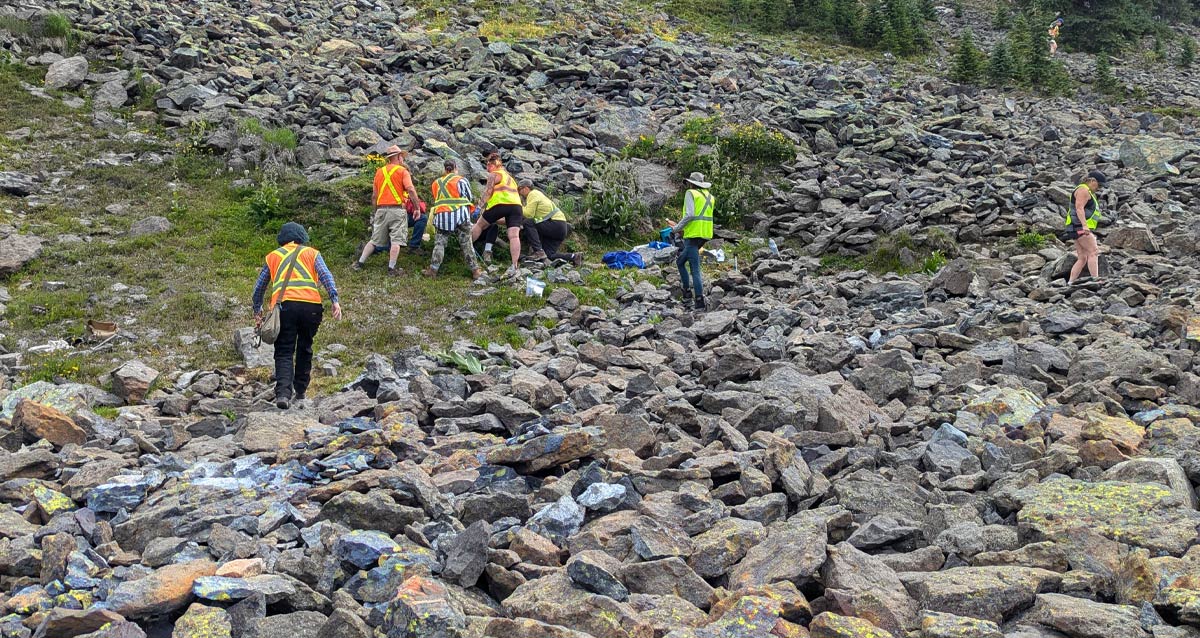
Places such as Lightning Peak are worth discussing in this context. The point is not that Lightning Peak is a major commercial peridot deposit. The point is that basalt-associated olivine can sometimes produce melee-sized peridot: small stones or tiny cuttable grains rather than large faceting crystals.
That is an important distinction.
A locality does not need to produce big jewellery-grade crystals to be geologically interesting. Small olivine grains in basalt can still show that the magma carried deep, magnesium-rich minerals upward toward the surface. For a cutter, however, that usually means the material is limited by size, recovery, clarity, and consistency.
So BC’s peridot story has at least two separate lanes:
Ultramafic lane: peridotite, dunite, harzburgite, mantle slices, ophiolites, and serpentinization.
Basalt lane: small olivine grains or crystal fragments in volcanic rocks, sometimes yielding melee rather than large gems.
Those two settings should not be treated as the same deposit type. They are connected by olivine, but they form and behave differently.
Why Basalt-Hosted Peridot Is Usually Small
Basalt-hosted olivine can be attractive, but it is often small.
In volcanic rocks, olivine may crystallize early from the magma or be carried upward from deeper levels. As the magma rises, erupts, cools, and solidifies, those crystals can become trapped in the basalt. Some survive as green grains. Others fracture, react, alter, or become too included to cut.
If the grains are clean enough, they may yield tiny stones. That is where the term melee matters.
In jewellery, melee refers to small cut stones, often used as accents. For BC peridot, that may be the more realistic scale in certain basaltic occurrences: small locality stones rather than big centre-stone gems.
That does not make them worthless. Locality stones can be interesting precisely because they are local, unusual, and connected to a specific geological story. But it does mean they should be represented honestly.
A small BC peridot from basalt is not the same product as a large commercial peridot from a major producing region.

Why Most Olivine-Bearing Rock Is Not Peridot Rough
For olivine to become peridot rough, it needs to be large enough, clean enough, and transparent enough to cut. Most olivine-bearing rocks fail that test.
Common problems include:
Small grain size
The olivine may be present only as tiny grains within a rock.
Alteration
Water can convert olivine into secondary minerals, destroying transparency.
Fracturing
Tectonic stress can crack the mineral beyond usefulness.
Inclusions
Magnetite, chromite, pyroxene, amphibole, alteration products, and fluid-related inclusions can make the material cloudy or unattractive.
Weathering
Olivine can weather more readily than many common silicate minerals.
Matrix problems
Even if olivine is present, it may be locked in a dense rock that does not yield clean individual crystals.
This is why “olivine-bearing” and “gem-quality peridot” are completely different claims.
The first is geological.
The second is gemological and commercial.
BC Peridot as a Locality Gem
BC peridot is best understood as a locality gem possibility, not a major commercial gemstone category.
That means a documented transparent olivine crystal or a small faceted BC peridot can be interesting because of where it came from. The value is partly in the story: a local stone connected to BC’s volcanic or ultramafic geology.
That kind of material may appeal to:
-
locality collectors
-
BC mineral collectors
-
lapidary people interested in unusual local material
-
collectors who value provenance
-
geology-minded customers
-
jewellers looking for a stone with a regional story
But it should not be oversold. BC is not known for abundant large peridot crystals. Some occurrences may be better thought of as small olivine or peridot grains, possibly suitable for melee, not large calibrated gemstones.
That is still interesting. It is just a different kind of interesting.
What Would Make a BC Peridot Find Credible?
A credible BC peridot find needs more than colour and hope.
It needs actual mineral identification and enough quality to justify the name. Ideally, the material would show transparent to translucent olivine grains or crystals, confirmed by testing. For serious claims, visual identification is not enough.
Useful confirmation could include:
-
refractive index testing
-
specific gravity testing
-
microscopy
-
Raman spectroscopy
-
X-ray diffraction
-
electron microprobe analysis
-
thin section petrography
-
locality documentation
For a casual collector, that may sound excessive. For a gemstone claim, it is not. If the material is being sold as BC peridot, the burden of proof is higher.
The same rule applies to any local gemstone: the more specific and valuable the claim, the better the evidence needs to be.
Peridot and Nickel: The Ultramafic Connection
Ultramafic rocks are not only interesting because of olivine. They are also important in economic geology.
Mafic and ultramafic systems can be associated with nickel, copper, chromium, cobalt, platinum-group elements, and other commodities. In parts of BC, ultramafic rocks are explored more seriously for metals than for gemstones.
This is a useful reality check. The same rock family that makes gem people think about peridot may make economic geologists think about nickel sulphides or chromite. The value of the rock depends on the mineral system, not the colour.
An ultramafic belt may be important even if it never produces a single facetable stone.
Why This Article Matters for BC Rockhounds
The value of BC peridot as a topic is not that it sends beginners chasing green gemstones. The value is that it teaches a better way to think about rocks.
One mineral can exist in several different contexts.
Olivine can be a gemstone.
Olivine can be a rock-forming mineral.
Olivine can be a clue to mantle processes.
Olivine can be partly replaced by alteration.
Olivine can occur as small grains in basalt.
Olivine can be present in rocks that are economically interesting for completely different reasons.
That is a better lesson than “go find peridot.” It is also more accurate.
BC geology is usually not simple deposit-hunting. It is context. Terranes, faults, metamorphism, intrusion, alteration, volcanism, and uplift all matter. The province has a habit of taking straightforward minerals and giving them complicated histories.
Olivine is a perfect example.
Final Answer: Does BC Have Peridot?
The honest answer is:
British Columbia has olivine-related geology, but it is not known as a major source of gem-quality peridot.
BC has ultramafic rocks. It has peridotite-family rocks. It has altered mantle-style material. It has ophiolitic fragments and mafic volcanic systems. Some basaltic settings, including places like Lightning Peak, may produce small olivine or peridot grains suitable for melee rather than large gems.
But gem peridot is a narrow thing: clean, transparent, attractive olivine of cuttable quality. That is much rarer than olivine-bearing rock.
So the better way to say it is this:
British Columbia may not be a famous peridot province, but it contains the deeper geological systems that explain where olivine comes from, how ultramafic rocks reach the surface, how basalt can carry small olivine grains upward, and why most olivine-bearing rock never becomes gemstone material.
That is the real BC peridot story.
By Adam Kelliher
Related Reads
- Jade vs Serpentine: Why Green Rock Is Not Enough
- Rhodonite in British Columbia: The Pink Manganese Stone with a Mining Past
- Gemstones Found in British Columbia: Jade, Agate, Amethyst, Rhodonite, Quartz, and More
- How Geologists Know Where to Look for Minerals in British Columbia
- Dallasite: Vancouver Island’s Volcanic Mosaic Stone