


By Adam Kelliher
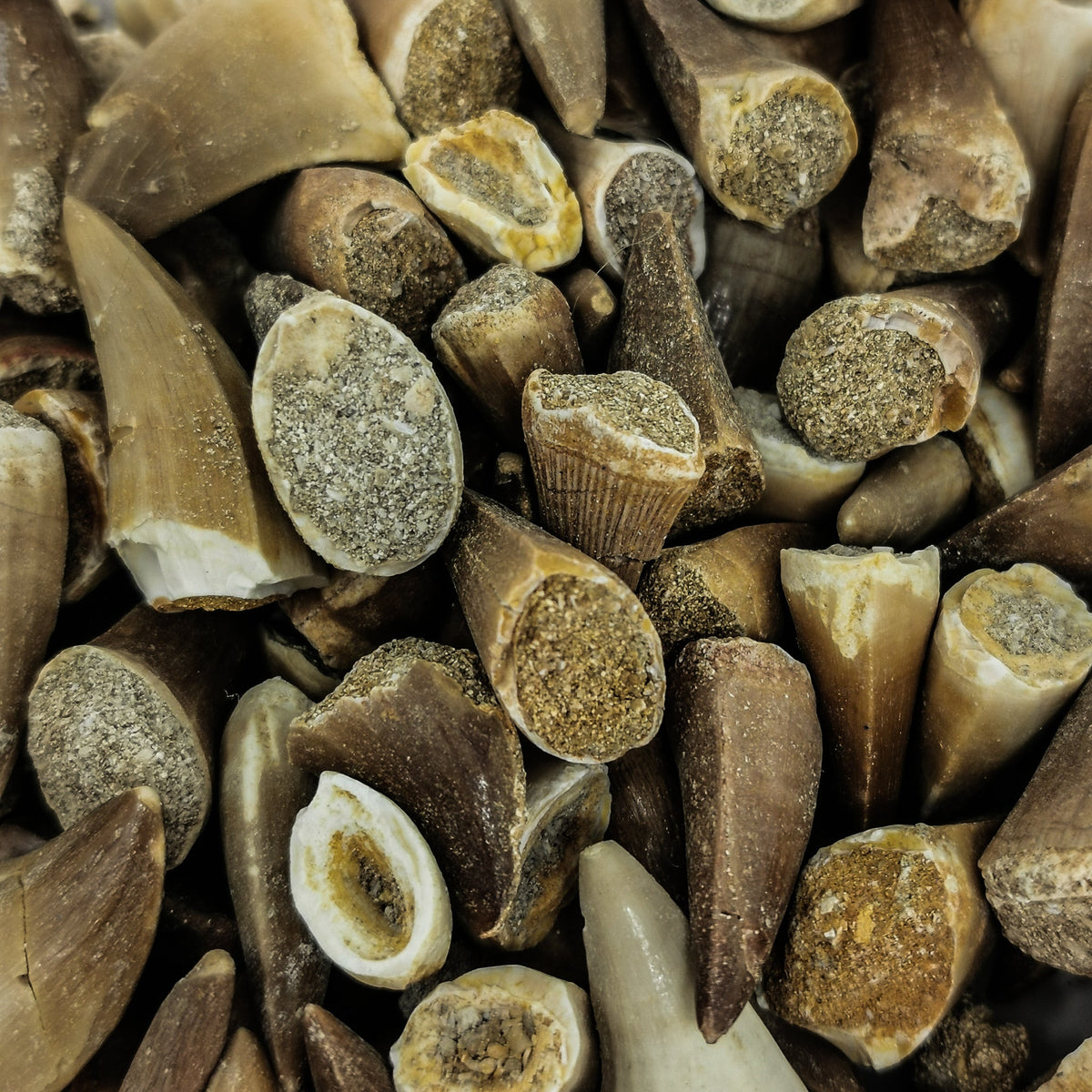
The short answer: a mosasaur tooth is a real fossil from a Late Cretaceous sea lizard, and the small Moroccan teeth in our shop start at $7.50, which is why they make a straightforward gift. Almost all of ours come from the phosphate mines of the Oulad Abdoun Basin. If you want the longer geology, I wrote it up in Mosasaur Teeth from Morocco; this post is about choosing one to give.[1][2]
You're buying a shed crown, sometimes with part of the root. Mosasaurs replaced teeth through life, the way sharks do, so loose teeth are common. The phosphate beds were laid down in a shallow arm of the Atlantic near the end of the Cretaceous, about a million years or less before the extinction, and they are one of the richest mosasaur outcrops in the world, with many species living at the same time.[1][2]

What to look for on a gift tooth
On a loose tooth, look for the enamel crown and, if it's still there, a distinct root. Colour runs from brown to black to creamy, depending on the phosphate. A complete, reasonably pointed crown is easier to live with than a heavily worn stub, but worn teeth are still real fossils. I wouldn't fuss over a species name on a small isolated tooth; the shop label is honest about locality, not a full identification.
We also have teeth still sitting in phosphate matrix, from $50, which show the rock the tooth came out of. Matrix pieces are sometimes assembled, so if that matters to the person you're buying for, ask us and have a look at the join before you buy.[3]
A different shape in the same beds is Globidens, from $40. Those teeth are blunt, built for crushing, not the usual pointed stabbing crown. Khouribga is in the same Moroccan phosphate country. I treat a Globidens label as the shop identification on an isolated tooth, not a museum ID.[1]
How to give one
The small loose teeth are the easy gift: they don't need a stand, they fit in a box, and you can look them over in person in our 6,000 sq ft rock shop in Vancouver. If you want something that displays on a shelf, pick a matrix specimen. For a wider check on composites and repairs, see Real or Fake Fossil? 6 Ways to Check.
If they already like dinosaurs, a mosasaur is a sea lizard, not a dinosaur, which is a better conversation than a label that oversells it. And if you're still choosing, a digital gift card lets them pick the tooth themselves.
If you want a wider list of rock and fossil presents, see our Holiday Gift Guide for gifts under $50 and $100.
See what's new: browse our newest arrivals for the latest pieces added to the shop.
Sources
- Longrich, N.R., Bardet, N. and co-authors. 2025. Mosasaurids bare the teeth: an extraordinary ecological disparity in the Phosphates of Morocco just prior to the K/Pg crisis. Diversity 17(2):114.
- Longrich, N.R. et al. 2022. Thalassotitan atrox, a giant predatory mosasaurid from the upper Maastrichtian phosphates of Morocco. Cretaceous Research.
- See also our shop practice on matrix composites, and Real or Fake Fossil? 6 Ways to Check.