


By Adam Kelliher
The short answer: almost every "meteorite" people bring into a shop is an Earth rock — an iron-oxide concretion, slag, magnetite-rich stone, or a pebble with desert varnish. Arizona State's meteorite centre says fewer than 1% of the rocks sent to it are meteorites. Washington University's Randy Korotev counts only about 15 meteorite finds a year in all of North America.[1][4]
Real meteorites are out there, and they are sold. So are meteorwrongs, and so is glass sold as moldavite. A few screening tests, used together, will send most backyard rocks back to the garden.
How labs tell the public to screen a rock
From 1900 through 2024, about 1,862 meteorites were found in North America. Recognized observed falls worldwide numbered 854, including 17 in Canada on Korotev's tally.[1] About 9 in 1,000 meteorites come from the Moon and 5 in 1,000 from Mars.[1]
Fusion crust is the first thing to look for: a thin melted rind, rarely more than 1–2 mm thick, almost always darker than the wet interior. No fusion crust, no good reason to suspect a meteorite. Desert varnish can mimic it.[1][4] About 95% of meteorites attract a cheap ceramic ("fridge") magnet. Skip the neodymium magnet; it will grab plenty of Earth rocks too.[1][2] Meteorites attract a magnet because they carry iron-nickel metal, which ordinary Earth rocks lack. A magnetic rock with no shiny metal grains on a cut or broken face is not a meteorite; the magnetism is usually magnetite.[1]
A streak on unglazed tile helps knock out the usual look-alikes: hematite streaks rust-red, magnetite dark grey. Fresh meteorites give no streak, or a weak grey one under hard pressure. Weathered ordinary chondrites can streak brownish-orange and be only weakly magnetic, and igneous rocks and slag can leave no streak either, so a blank tile does not prove a meteorite.[3][4][6]
The most common meteorwrong Korotev is sent is an iron-oxide concretion. Slag is magnetic, can show flow marks and vesicles, and turns up "in the middle of nowhere" because it is used as road and rail fill.[1][4][5] Other red flags: quartz that scratches glass, vesicles, layers, veins, crystals, fossils, transparency, perfectly round mill balls, sharp edges, and finds on beaches, in river beds, or beside rail lines.[1] Phone and AI image apps are, in Korotev's words, nearly always wrong when they suggest a meteorite.[1]

Two Canadian stories, and what isn't a meteorite
BC has two world-class falls to hang this on. In 2021, the Golden meteorite landed on a pillow next to a sleeping woman.[7][8] In 2000, the Tagish Lake meteorite — one of the most primitive meteorites known — fell along the northern BC / Yukon border.[9][10]
Tektites are a different thing: glass made when an impact melts the ground and throws the melt out. Moldavite, irgizite and Libyan desert glass belong in that family, not with meteorites. GIA has published how imitation moldavite is caught.[11][12] For the longer version, see Tektites vs Meteorites.
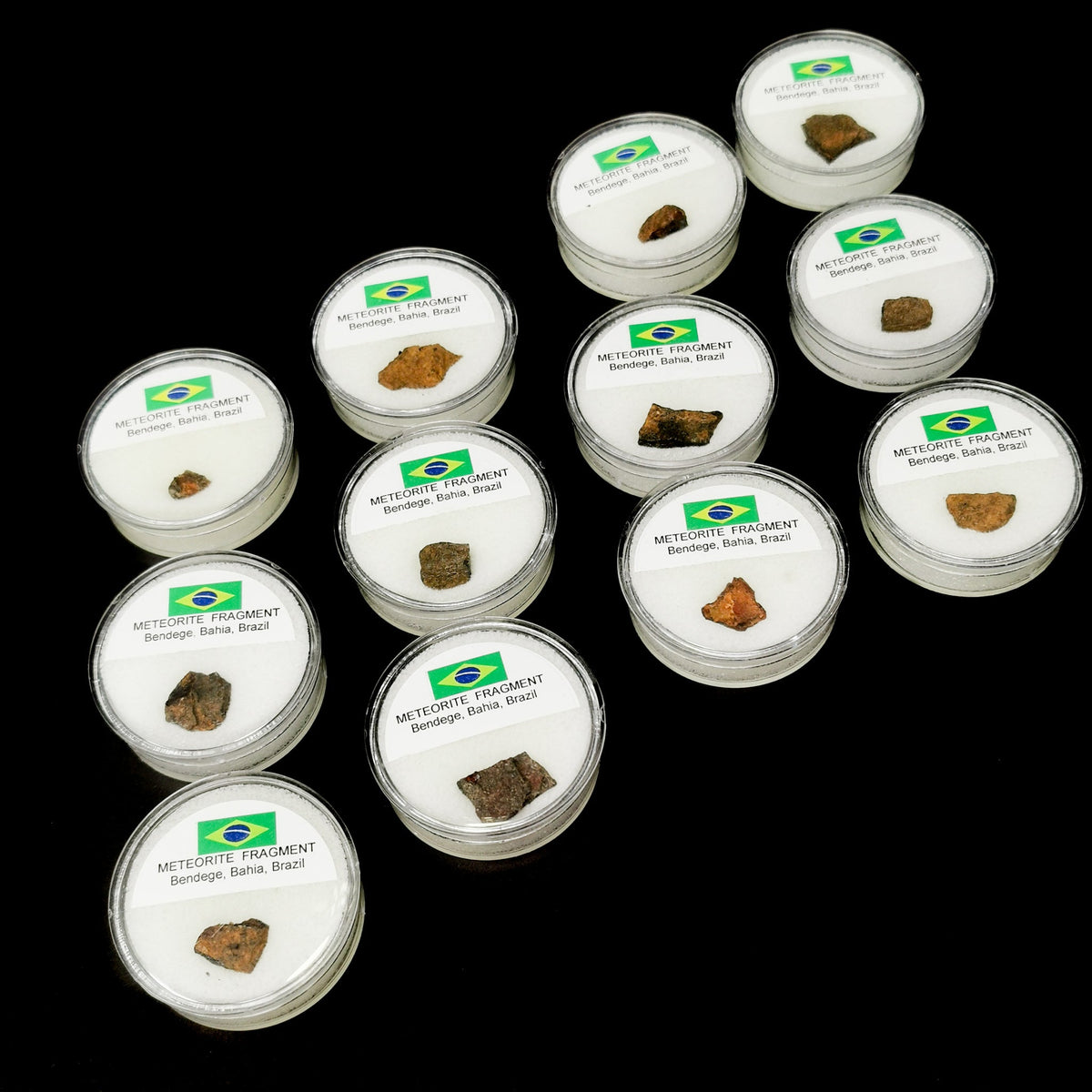
We stock a Bendegó meteorite from Brazil, plus impact glasses such as small moldavite and irgizite tektite. A shop magnet test is only a first screen. University labs do the formal work.
See what's new: browse our newest arrivals for the latest pieces added to the shop.
Sources
- Korotev, R.L. Some meteorite realities. Washington University in St. Louis.
- Korotev, R.L. Magnetic attraction. WashU.
- Korotev, R.L. Streak. WashU.
- Buseck Center for Meteorite Studies, Arizona State University. How can I find a meteorite?
- Buseck Center for Meteorite Studies, ASU. Meteorite ID.
- University of Nevada, Reno. 2023. How do I know if I found a meteorite?
- Meteoritical Society. Meteoritical Bulletin: Entry for Golden (MB 111, 2023).
- The Golden meteorite fall: fireball trajectory, orbit, and meteorite characterization. Meteoritics & Planetary Science (2023).
- Brown, P.G. et al. 2000. The fall, recovery, orbit, and composition of the Tagish Lake meteorite. Science 290: 320–325.
- Hildebrand, A.R. et al. 2006. The fall and recovery of the Tagish Lake meteorite. Meteoritics & Planetary Science 41.
- GIA. 2015. Moldavites: natural or fake? Gems & Gemology, Spring 2015, Gem News International.
- GIA. 2021. Imitation moldavite. Gems & Gemology, Summer 2021, Lab Notes.