


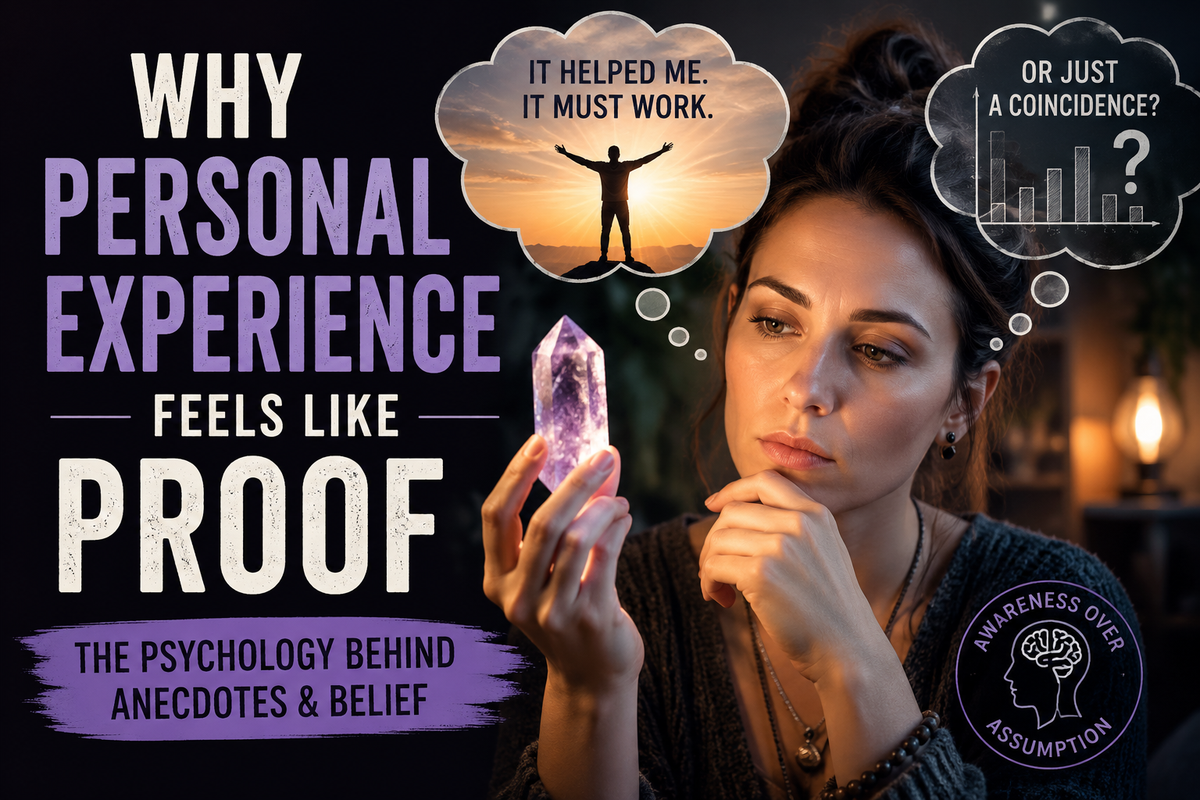
Personal experience is powerful because it feels immediate. You were there. You felt it. You remember what happened before, what changed, and what happened after. That is naturally going to feel more convincing than a study, a statistic, or someone else telling you that your conclusion may not be as certain as it seems.
That is not because people are stupid. It is because experience is how we learn most things in life.
If you touch a hot pan and burn your hand, you learn not to touch it again. If you eat something and immediately become sick, you start wondering whether the food caused it. If you walk into a room and feel that something is wrong, you may pay attention to that feeling before you can explain it properly. Human beings are built to notice patterns, connect events, and make fast judgments because that is often useful.
The problem is that the mind does not simply record what happened. It interprets what happened.
It decides which details mattered, which events were connected, what should be remembered, what should be ignored, and what explanation makes the experience feel coherent. That process is often useful, but it is not perfect. A person can be honest, intelligent, observant, and completely sincere while still being wrong about why something happened.
That distinction matters, especially when discussing crystals, healing claims, manifestation, ritual, energy, luck, protection, or any other subject where personal testimony carries a lot of weight. The goal is not to tell someone that their experience was fake. The goal is to separate the experience itself from the explanation that was attached to it.
The Crystal Experience May Be Real Even When the Explanation Is Wrong

Suppose someone says that holding a crystal helped them feel calmer.
There is no reason to immediately accuse them of imagining it. They may have genuinely felt calmer. Their breathing may have slowed. Their attention may have shifted. Their body may have relaxed. The stone may have reminded them of safety, intention, discipline, or someone they trusted.
The experience can be real.
What remains uncertain is the cause.
Saying, “I held the stone and felt calmer,” is a description of what happened. Saying, “The stone emitted an energy that reduced my anxiety,” is an explanation of why it happened. Those are not the same claim.
The first may be completely accurate. The second requires more evidence because several explanations could fit the same experience. The person may have sat still for the first time all day. They may have expected the stone to help, and that expectation changed how they interpreted their body. They may have slowed their breathing without realizing it. The difficult moment may already have been passing. The object may have acted as a focus point and interrupted a spiral of thought.
None of those explanations makes the experience worthless. They simply suggest that the cause may have been psychological, behavioural, situational, or some combination of the three rather than a physical energy coming from the mineral.
That is the part people often resist, because it can feel like the meaning is being taken away. But questioning the mechanism does not erase the experience. It just asks us to be more careful about what the experience actually proves.

Why Crystal Anecdotes Feel Stronger Than Statistics
A personal story has details. It has emotion. It has a beginning, a turning point, and an outcome. A statistic does not.
If someone says, “I carried this stone during the hardest year of my life, and it helped me get through it,” that has emotional weight. You can imagine the person, the struggle, and the relief. If someone else says, “A study involving five thousand people did not find a measurable effect,” the information may be more useful for evaluating the claim, but it feels distant.
That is why anecdotes are persuasive.
An anecdote is a personal story used as evidence. Anecdotes can be valuable because they show what an experience felt like from the inside. They can raise questions, point toward possible patterns, and help people explain why something mattered to them.
What they usually cannot tell us is how common the result was, what would have happened otherwise, how many people tried the same thing and experienced nothing, or whether another cause explains the outcome better.
One story can show that something happened to one person. It cannot show that the same thing will reliably happen to other people, and it cannot tell us whether the person identified the cause correctly.
That is where people often overreach. They move from, “This happened to me,” to, “This proves the stone works.”
Those are not equal statements.
Confirmation Bias: The Evidence We Notice

Confirmation bias is the tendency to notice and remember evidence that supports what we already believe while giving less attention to evidence that contradicts it.
It does not usually feel like bias while it is happening. It feels like the pattern is revealing itself.
Suppose someone believes citrine attracts money or opportunity. One day they carry it and receive an unexpected payment, a refund, a new customer, or a job offer. That event stands out because it fits the belief.
Now think about all the ordinary days when they carried the same stone and nothing unusual happened.
Most people do not make a note of those days. They do not say, “I carried citrine for eight hours and received no unexpected financial opportunity.” Nothing happened, so there was no story to remember.
Over time, the confirming events remain visible while the non-confirming events disappear. This makes the belief feel as if it has been repeatedly proven, even when the full record may be much less impressive.
The same thing happens outside crystal beliefs. A business owner remembers the social media post that produced a large sale and forgets the ten similar posts that did nothing. A gambler remembers the machine that paid out. An investor remembers the prediction that came true. A sports fan remembers wearing a lucky shirt during a win and gives less attention to all the losses that happened while wearing it.
The person is not necessarily being dishonest. They are remembering the examples that fit.
The Phone Call Example
One of the clearest examples of this is when you think about someone and then they call.
Almost everyone has had that happen. You are thinking about a friend, family member, or someone you have not heard from in a while, and then the phone rings. You answer and say, “That is strange. I was just thinking about you.”
The timing feels meaningful because the thought and the call happened close together.
What usually gets ignored are all the times you thought about that person and they did not call.
You may have thought about them dozens of times over several months. Most of those thoughts went nowhere. The phone stayed silent, nothing memorable happened, and the moment passed.
Then one day the thought and the call line up, and that example becomes important because it makes a good story.
If we are trying to determine whether thinking about someone somehow caused them to call, we cannot count only the successful match. We also have to count all the times the thought occurred without the call.
Those missing examples are contradictory evidence.
The same principle applies to crystals. If someone carries a stone associated with prosperity and later receives money, that event may be remembered as proof. But how many times did they carry it and receive nothing? How many people carried the same stone and had no financial improvement? How many people received money while carrying no crystal at all?
If we count only the hits and ignore the misses, almost anything can start to look convincing.
Memory Is Not a Perfect Recording
People often talk about memory as though the mind stores a video of the past.
It does not.
Memory is rebuilt.
We remember pieces of events and reconstruct the rest through emotion, later information, expectation, and the story we now believe about what happened.
This does not mean every memory is false. It means memory is more flexible than it feels.
A person may remember that they bought a crystal and then their life improved. Years later, the sequence may seem clean and obvious. Before the crystal, things were bad. After the crystal, things became better.
Real life is usually more complicated.
Maybe they had already been moving toward change. Maybe they had started talking to someone, leaving a bad situation, sleeping better, exercising more, or making different decisions. Maybe the crystal became the symbol of the turning point rather than the actual cause of it.
Over time, the messy period gets simplified into a cleaner story because the mind prefers coherence.
“I was struggling, then I found the stone, then everything changed” is easier to remember than a long list of overlapping influences, half-finished decisions, gradual improvements, setbacks, and unrelated events.
The person may sincerely remember the period that way. Their confidence does not prove that the memory is complete.
Stories Become Cleaner After the Fact
People need narratives. We want to know what changed us, what caused the turning point, and why one period of life ended while another began.
That is not a flaw. Stories help us understand ourselves.
The problem is that stories often become more orderly than the events themselves.
Someone may say, “Everything changed when I bought that stone.”
Maybe the stone did matter. Maybe it marked the moment they finally decided to take themselves seriously, leave a bad relationship, set boundaries, or make a difficult change.
But the actual cause may have been broader.
They may have been building toward that decision for months. A friend may have challenged them. They may have reached a point of exhaustion. The crystal may have given them a symbol for something they were already ready to do.
That does not make the object meaningless. It just means the object may have represented the change rather than caused it in the way the person later believed.
The Availability Effect and Crystals

The availability effect is the tendency to judge how common or important something is based on how easily examples come to mind.
A vivid story is easier to remember than a table of numbers.
Imagine hearing someone describe how a crystal helped them through a crisis. They explain where they were, how desperate they felt, what they did, and how quickly things changed. You can picture the whole situation.
Now compare that with someone saying that hundreds of people reported no measurable result.
The first account feels stronger because it is human and memorable. The second may contain more useful evidence, but it does not create the same picture in the mind.
This is one reason testimonials work so well in advertising. A personal account gives the audience a story to identify with. It feels specific, and specificity feels true.
The problem is that vividness is not the same as reliability.
One dramatic success may be surrounded by thousands of ordinary failures. A memorable story may be rare. A frightening event may feel common because it is easy to picture, even when the actual risk is low.
When an example is emotionally powerful, people tend to give it more weight than it deserves.
Personal Stories Can Be Honest and Still Mislead
A personal story does not have to be false to be misleading.
Suppose someone says, “I used this crystal and then my headaches improved.”
That may be completely true.
The problem begins when the story is treated as proof that the crystal reliably causes headache relief.
Several important details are missing. How long did the headaches usually last? Were they already improving? Did the person also change their sleep, diet, medication, caffeine intake, stress level, or screen use? How many times did they use the same crystal without improvement? How many other people tried it and experienced nothing?
Without those comparisons, the story remains real but incomplete.
This is the fairest way to deal with personal testimony. You do not need to accuse someone of lying. You can accept that the event happened and still question what conclusion the event supports.
That allows you to respect the person while being honest about the limits of the evidence.
Motivated Reasoning: When We Want the Claim to Be True
People do not evaluate every claim with the same level of strictness.
We tend to demand stronger evidence for conclusions we dislike and accept weaker evidence for conclusions we already want to believe.
That is motivated reasoning.
Suppose someone has spent years learning about crystals, buying them, recommending them, and building part of their identity around them. They may have friends in that community. They may sell them. They may have used the belief to make sense of grief, illness, loss, or major life changes.
At that point, questioning the claim is no longer just about evidence.
It can feel like a challenge to their intelligence, identity, past decisions, community, or livelihood.
Evidence that supports the belief feels reassuring. Evidence that weakens it feels threatening. The person begins protecting the conclusion rather than testing it.
This happens everywhere, not just with crystals. People do it with politics, religion, business, diets, relationships, parenting, health, investments, and almost anything else tied closely to identity.
A business owner may defend a failed strategy because admitting it failed would mean admitting they wasted years. Someone may protect a bad relationship because acknowledging the truth would force a painful decision. A person may continue believing in a treatment because accepting that it did not work would make the suffering feel even harder to process.
Motivated reasoning is difficult to recognize because it still feels like reasoning. The person may be gathering examples, making arguments, and explaining contradictions. But the conclusion was protected from the beginning.
Why Changing Your Mind Can Feel Like Losing Something
People often underestimate the emotional cost of changing a belief.
From the outside, saying, “Maybe the crystal did not cause the improvement,” may seem like a small correction.
For the person, it may affect much more.
Maybe they recommended the stone to friends. Maybe they spent a great deal of money. Maybe they taught other people how to use it. Maybe the belief helped them survive a difficult period. Maybe the community around it gave them friendship, identity, or belonging.
Changing their mind may feel like losing more than an idea.
That is why ridicule usually fails. If someone feels that giving up a claim means giving up meaning, dignity, or community, they will usually defend the claim more strongly.
A better approach is to separate the value of the experience from certainty about the explanation.
The ritual may still have mattered.
The stone may still carry meaning.
The person may still have grown.
They do not have to discard the entire experience simply because they become less certain about how it worked.
That makes honest reconsideration possible.
Survivorship Bias: The Stories That Stay
Survivorship bias happens when we focus on the examples that remain visible and ignore the examples that disappeared.
In the crystal world, success stories survive.
People tell stories about the stone that helped them find love, improve their business, calm their anxiety, leave a bad relationship, or move through grief.
People who tried the same thing and experienced no result usually stop talking about it.
Some lose interest. Some leave the community. Some decide the practice was not useful. Some feel embarrassed. Some simply move on.
Their stories disappear.
What remains is a collection of apparent successes.
This can make a practice look far more reliable than it is.
The same problem appears in business. People study successful entrepreneurs and look for the habits that made them successful. They may notice that many of them took risks, worked long hours, ignored criticism, and believed strongly in themselves.
What often disappears are all the people who did the same things and failed.
If you study only the survivors, almost any trait can look like the cause of success.
The same is true of crystal testimonials. If you only hear from people who stayed because they felt the practice worked, the evidence will naturally lean positive.
The failures are not absent because they never happened. They are absent because failed experiences do not remain visible.
Why Testimonials Feel More Convincing Than They Are
Testimonials speak the language of lived experience.
Statistics speak the language of comparison.
A testimonial says, “This happened to me.”
A comparison asks, “How often did this happen, and how often would it have happened anyway?”
The first feels personal. The second is usually more useful for evaluating a general claim.
Suppose ten people say a certain crystal improved their sleep. That sounds meaningful.
Now suppose ten thousand people tried it.
Ten positive reports would then represent a very small portion of the people involved.
Or suppose the same number of people improved while using an ordinary stone they had been told was special. That would suggest the expectation or ritual mattered more than the mineral itself.
Without that comparison, the testimonials sound stronger than they are.
Controlled studies are useful because they place personal experience into context. They do not make the experience disappear. They help us understand whether the result happened more often than chance, expectation, or normal improvement would predict.
Sincerity Is Not the Same as Accuracy
This is the deeper point behind the entire discussion.
People often assume there are only two possibilities.
Either the person is telling the truth, or they are lying.
That is too simple.
A person can tell the truth as they understand it and still be wrong about the explanation.
They may remember selectively. They may overlook contradictory examples. They may confuse timing with cause. They may interpret the experience through a belief they already held. They may sincerely report what they felt while misunderstanding why they felt it.
There is no contradiction in saying, “I believe this person is honest, but I do not think their experience proves the claim.”
That position allows you to respect the person while still evaluating the reasoning.
Intelligence Does Not Protect People From Bias
Critical-thinking errors are not limited to gullible or uneducated people.
Intelligent people can be especially good at defending conclusions they already prefer. They can produce more sophisticated arguments, find more supporting examples, and explain away contradictions more effectively.
Education helps when it teaches someone to test their own beliefs.
It does not help much if it is used only to find errors in other people.
The real test of critical thinking is not how quickly someone can point out another person’s mistake. It is whether they are willing to look for weaknesses in their own explanation.
That means asking what evidence would change their mind. It means counting failures as seriously as successes. It means recognizing when a story is emotionally powerful but evidentially weak. It means being willing to say that certainty feels stronger than the evidence deserves.
Meaning Does Not Prove Mechanism
None of this requires treating crystals as meaningless.
People have always used objects to carry meaning. Wedding rings represent commitment. Religious objects represent faith. Photographs preserve relationships. Medals represent achievement. Family heirlooms connect generations.
A crystal can serve a similar purpose.
It may remind someone of a promise, a person, a period of growth, or a value they are trying to live by. It may become part of a ritual that helps them stop, reflect, breathe, or regain focus.
That role can be real.
The mistake is assuming that because the object has meaning, every physical or spiritual claim made about it must also be true.
Meaning is not the same as mechanism.
A ritual may help someone without proving the traditional explanation attached to it. A symbol may change behaviour because the person responds to the symbol. A stone may matter deeply without emitting a measurable force.
Those possibilities do not weaken the experience. They describe it more honestly.
How to Think About Personal Experience More Carefully
Personal experience becomes more useful when we ask better questions about it.
What exactly happened?
What else changed during the same period?
How many times did the expected result fail to happen?
Was the improvement already underway?
Did the object change the person’s attention, behaviour, or expectations?
Would the same outcome probably have happened without it?
Are we remembering the event accurately, or has the story become cleaner over time?
Are we hearing only from people who had positive results?
What evidence would count against the claim?
These questions do not erase the experience. They help separate what is known from what is assumed.
A person may still conclude that the practice was valuable. They may simply become more careful about explaining why.
A More Honest Relationship With Experience
Personal experience matters because it is where most human understanding begins. It should not be treated as useless, but it should not be treated as infallible either.
Every experience passes through a mind that selects details, rebuilds memories, favours some explanations, ignores others, and protects meanings that have become emotionally important.
That means a person can report an experience honestly and still misunderstand what caused it.
Recognizing that distinction is not disrespectful. It allows us to take the person seriously without treating every explanation attached to the story as proven.
The experience may be genuine. The interpretation may still be incomplete.
That is not an accusation.
It is simply a more careful way of thinking.
By Adam Kelliher