




Specifications
Beschreibung
Locality: Temblor Formation, Central California, USA
Era: Neogene Period (Miocene Epoch)
Geological Age: ~23–10 MYA
Desmostylus was first described in 1888 by the Yale paleontologist Othniel Marsh, from a set of teeth found in marine deposits in Alameda County, California. Marsh took it for a sea cow. When later fossils turned up in Japan, they were interpreted as possibly early elephants or sea cows, though they differed from both.
Desmostylus belongs to the Desmostylia, an extinct group of plant-eating marine mammals known from the coasts of the North Pacific, including California, Oregon, Washington, Mexico, Japan and the Russian Far East. A 2023 study by Smithsonian researchers Kumiko Matsui and Nicholas Pyenson reported a Desmostylus tooth from the earliest Miocene of northern California, suggesting that the genus's distinctive tooth shape stayed largely unchanged for more than 15 million years.
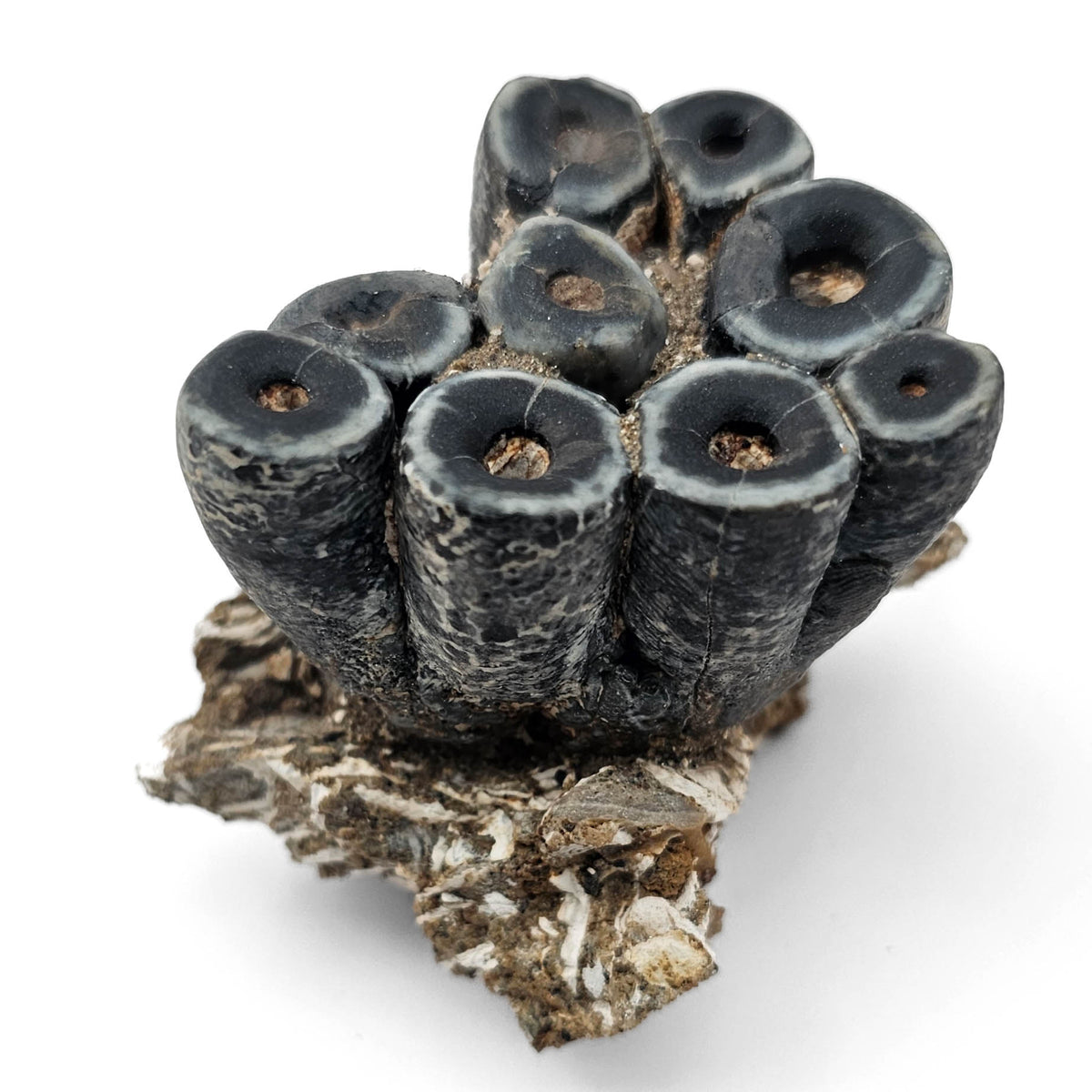
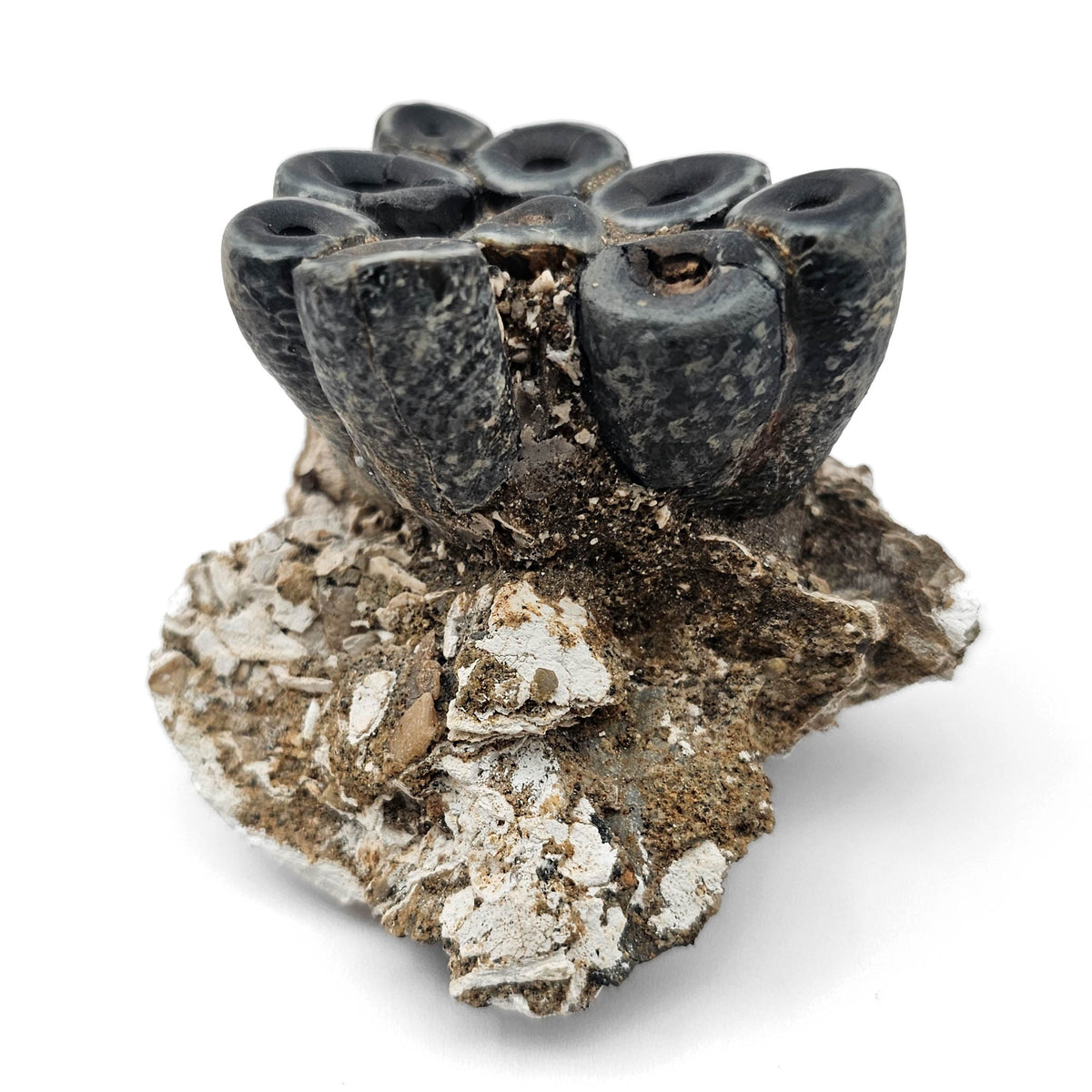
This one-of-a-kind Desmostylus tooth fossil shows a well-defined cluster of thick, columnar tooth structures rising vertically from a compact marine matrix. Each column displays a rounded top with a central depression, creating a distinctive ring-like pattern typical of Desmostylus dentition. The enamel is dense and dark grey to black, with subtle surface wear and natural mottling from mineralization. The columns are tightly packed, forming a near-cylindrical bundle that would have functioned as a powerful grinding surface. The base matrix is rich in shell fragments and fine sediment, with visible inclusions that point to a coastal depositional environment.
Desmostylus teeth are unique among mammals, composed of bundled cylindrical columns rather than flat or ridged chewing surfaces. This structure was highly effective for crushing tough marine vegetation such as kelp and seagrass. Fossils from California commonly come from shallow marine sedimentary formations where shell beds, sand, and silt accumulated along ancient shorelines. The presence of intact enamel alongside fragmented shell material suggests relatively rapid burial and minimal transport before fossilization, preserving both the tooth structure and surrounding matrix.
Desmostylus represents an entirely extinct lineage of marine mammals, unrelated to modern whales or sirenians, making specimens like this especially important for understanding convergent evolution in aquatic environments. The unusual geometry of the tooth is instantly recognizable and remains one of the most distinctive features in vertebrate paleontology.
This fossil is often associated with individuality and adaptation, reflecting a species that evolved highly specialized features to occupy a narrow ecological niche. It represents resilience through specialization and stands as a physical reminder of how diverse life has been throughout Earth’s history.
Quantity: 1pc
With this product, you will get the actual stone in the photograph. We do what we can to buy good quality products and price them honestly. The rocks may differ from the photos, but we hope we do them justice.