


By Adam Kelliher
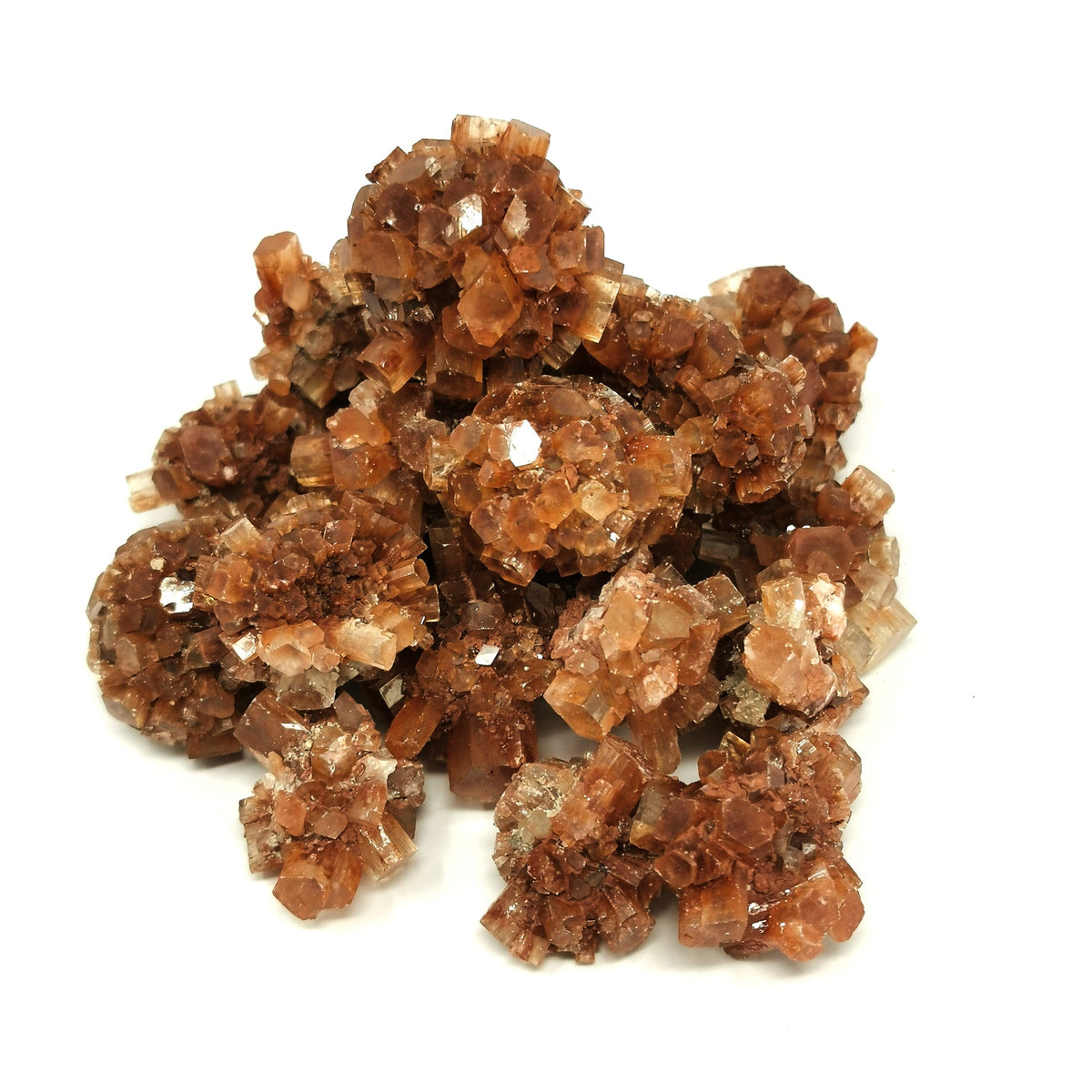
The short answer: aragonite is calcium carbonate, the same recipe as calcite, packed into a different (orthorhombic) crystal structure. The six-sided "columns" and starburst clusters from Tazouta, Morocco, are twins: three crystals grown together at about 120 degrees, faking a hexagonal shape. A 2024 study found those Moroccan crystals grew at only about 20–22 °C in magnesium-rich clays, while the classic Spanish crystals from Molina de Aragón grew from much hotter fluids.[1][4]
The shop nickname for the radiating Moroccan clusters is "sputnik". The shape is geometry, not a spaceship.
Three crystals pretending to be one
Handbook of Mineralogy lists aragonite as hardness 3.5–4, density about 2.95, and commonly twinned by repeated contact twinning on {110}, giving pseudohexagonal columnar trillings. It is trimorphous with calcite and vaterite: same chemistry, different structures.[1]
Over geologic time aragonite converts to calcite. It forms in warm marine waters and shells, evaporites, hot-spring sinter, cave dripstone, some high-pressure rocks, and basalt cavities. Fine crystals are uncommon; Tazouta near Sefrou, Morocco, and Molina de Aragón in Guadalajara, Spain, are among the notable localities.[1]

Named for Aragón — from a town that isn't in Aragón
Aragonite was the first mineral described from Spain. Torrubia wrote up hexagonal crystals near Molina de Aragón in 1754. Werner used the name in 1788, thinking the locality was in Aragón; Molina de Aragón is in Guadalajara, outside that region. Haüy published the description in 1791.[2][3]
Gavryushkin and colleagues (2024) compared geological aragonite from Tazouta, from two Spanish localities, and from Russia. The Moroccan and Spanish specimens sit in magnesium-rich clays. Clumped-isotope temperatures for Tazouta came out at 20–22 °C; fluid inclusions for Molina de Aragón gave 210–225 °C. They propose an infiltration–sedimentary origin for Tazouta and a hydrothermal one for the Spanish crystals, and they show that geological aragonite is as heavily twinned as the aragonite in shells.[4]
Magnesium in seawater favours aragonite over calcite by making calcite harder to nucleate, which helps explain why so many shells and marine cements are aragonite in the first place.[5] Aragonite can also fluoresce red or yellow under UV, and some localities phosphoresce.[1]
We stock the Tazouta clusters, plus other habits such as the blue aragonite obelisks from Helmand and tumbles. It's a soft carbonate, so water and acids can dull a surface; keep clusters dry. For UV response generally, see How to Use a UV Light on Your Rock Collection.
See what's new: browse our newest arrivals for the latest pieces added to the shop.
Sources
- Anthony, J.W. et al. Handbook of Mineralogy: Aragonite.
- Universidad de Zaragoza, Museo virtual de mineralogía. Minerales definidos en España.
- Haüy, 1791. Sur l'Arragonite de Werner (original description, as cited in gemmological classifications).
- Gavryushkin, P.N., Rečnik, A., Donskikh, K.G. et al. 2024. The intrinsic twinning and enigmatic twisting of aragonite crystals. PNAS 121.
- PNAS 2015. Nucleation of metastable aragonite CaCO3 in seawater.