




Specifications
Descripción
Fossil Megalodon Tooth, Neogene period.
Locality: Peace River region, Florida, U.S.A.
Era: Miocene to Pliocene
Geological Age: 23-3.6 mya
Florida's Peace River has been known for its fossils for more than 170 years. In 1850, G. W. Rains reported megalodon shark teeth, along with mammoth, mastodon and turtle fossils, from Peace Creek and its tributaries. "So thickly are these fossils strewed along the course of the [Peace Creek]," he wrote, "that, in many places its bed is literally paved with their remains."
The fossils in the river are a mix of ages. In 1915, Florida State Geologist E. H. Sellards was the first to argue that the river had reworked fossils from different times. As a result, Miocene and Pliocene sea creatures such as sharks lie alongside Pleistocene land animals in the same gravels.
Megalodon teeth also turn up nearby in the Bone Valley, the nickname for the Central Florida Phosphate District, in early Pliocene phosphate deposits. The Florida Museum of Natural History describes the Bone Valley Formation as one of the richest producers of vertebrate fossils in the state.
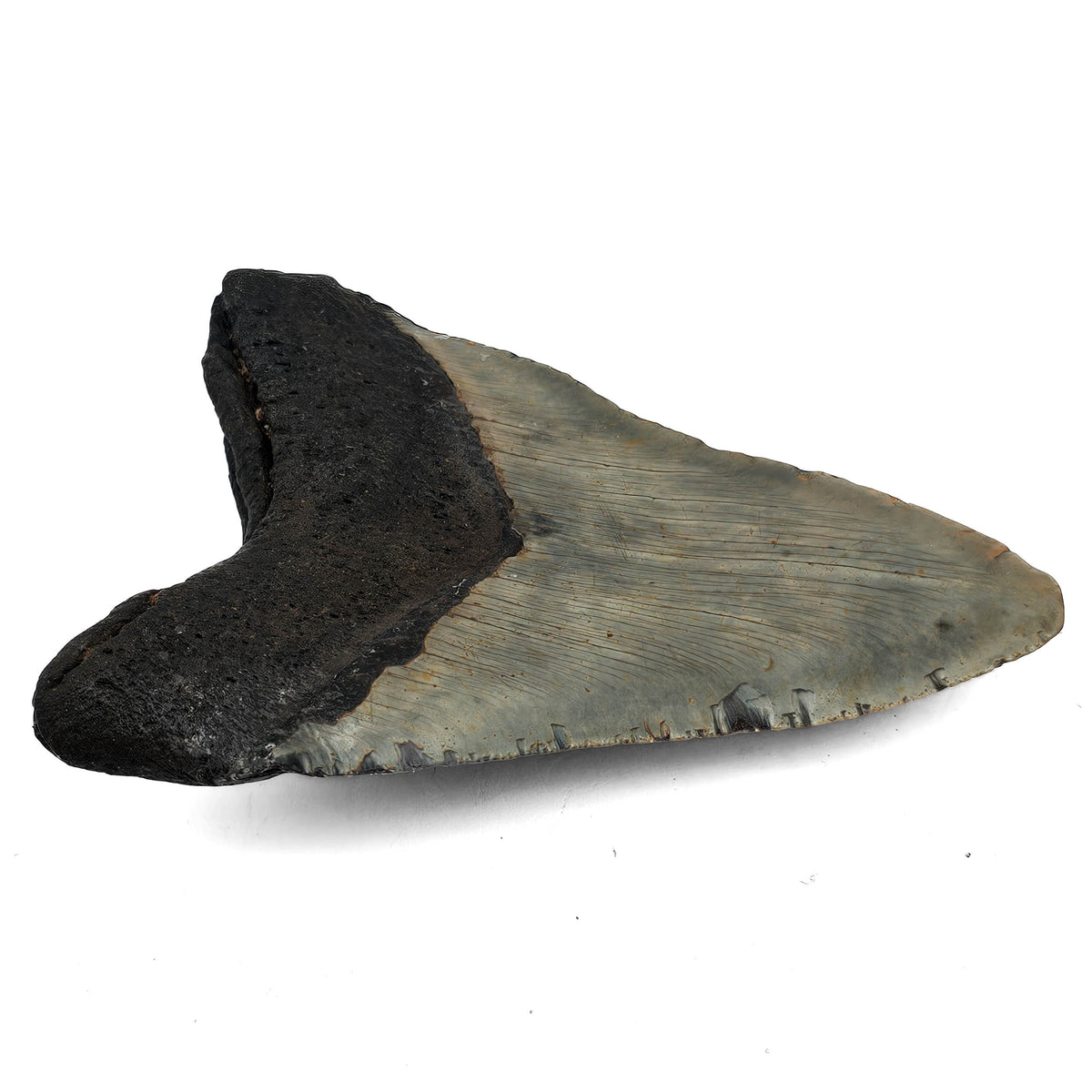
This one of a kind megalodon tooth fossil specimen from Florida, U.S.A. features a bold triangular shape with a wide black root and gray-green enamel blade. The tooth has a dramatic two-tone appearance, with the dark fossilized root contrasting against the lighter enamel face. Fine natural striations run down the blade, and the edges show visible serration detail, giving the piece a powerful prehistoric display quality. The specimen appears naturally worn with mineral staining, edge chipping, and surface texture consistent with a fossilized marine tooth.
Megalodon, scientifically known as Otodus megalodon, was one of the largest predatory sharks to ever live, roaming ancient oceans roughly 23 to 3.6 million years ago. Fossil teeth are the most common remains because shark skeletons are made mostly of cartilage, while teeth fossilize much more easily. Florida is one of the classic U.S. localities for megalodon teeth, especially from phosphate-rich marine deposits, river beds, and coastal fossil zones connected to the Hawthorn Group and related Miocene to Pliocene formations.
Spiritually, fossil shark teeth are often associated with strength, protection, survival, courage, and ancient ocean energy. Megalodon teeth in particular are commonly viewed as symbols of power, resilience, confidence, and primal instinct, making them popular with fossil collectors, ocean lovers, and those drawn to bold natural history pieces.
Quantity: 1pc
With this product, you will get the actual stone in the photograph. We do what we can to buy good quality products and price them honestly. The rocks may differ from the photos, but we hope we do them justice.