




Specifications
Descripción
Locality: Darmstadt, Germany
Era: Cenozoic (Pleistocene)
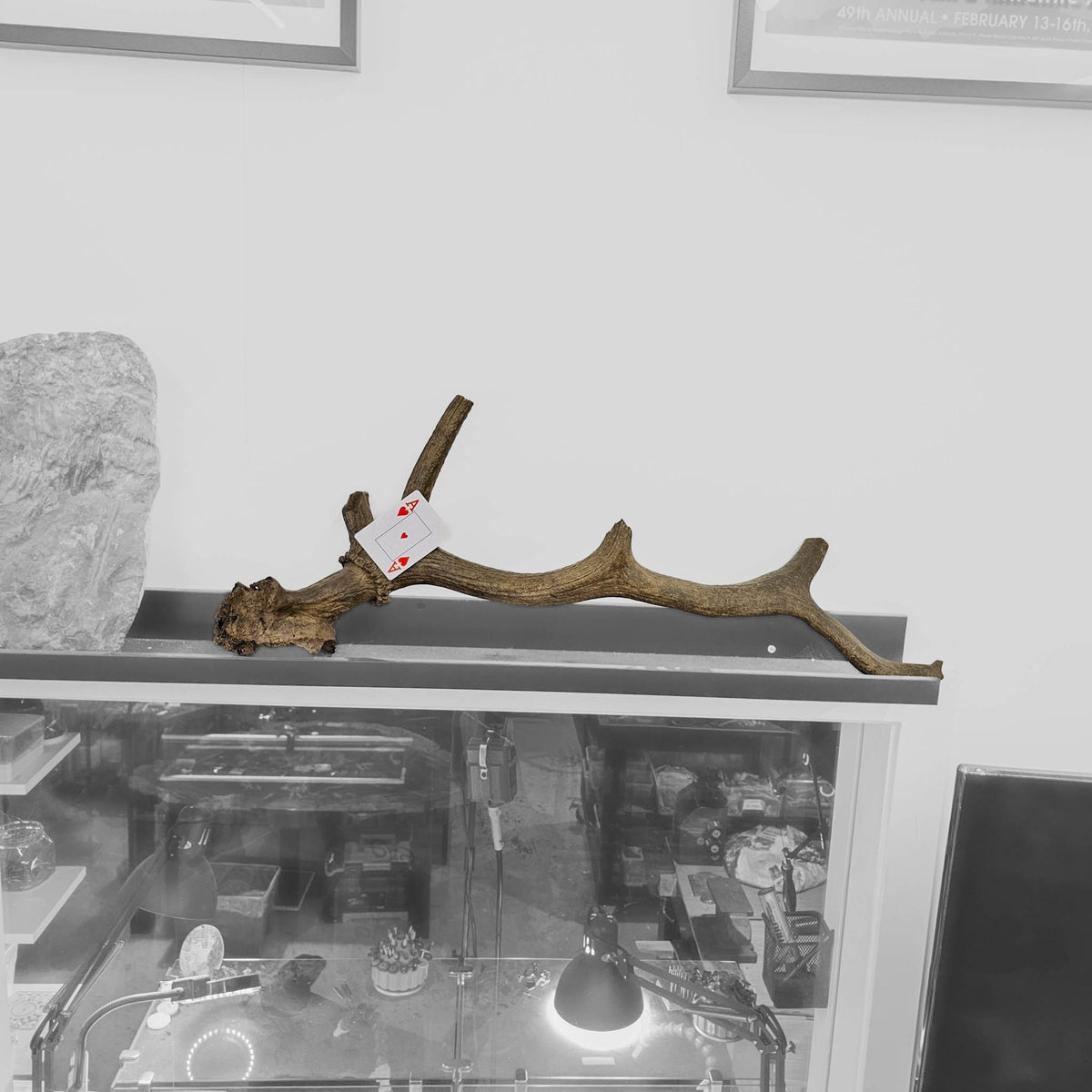
Description: This is a long, branched red deer antler in a dark grey-brown fossil colour, with several tines rising from the main beam and the knobbly burr still attached to a section of skull at the base. Fine lengthwise grooves run along the beam.
It dates from the Pleistocene, about 100,000 years ago. Ice Age antlers in the Upper Rhine valley are typically recovered from river gravels and sands.
Red deer, Cervus elaphus, grow and shed a new set of antlers every year. Antler is bone, grown from a base on the skull called the pedicle and ringed by a rough burr. Because this antler is still attached to part of the skull, it was not a shed antler but came from the animal itself.
Identifying features: The pearled burr rings the base where the antler grew from the skull, and a section of skull bone is still attached below it. The beam is rounded rather than flattened, the surface carries the fine lengthwise grooves of the original antler, and the darker staining follows those grooves.
Red deer antlers were among the most important raw materials for Stone Age people in Europe, used for picks, harpoons and tools.
Approximate size: 78 x 31 cm (30.5 x 12 in)
Quantity: 1pc
With this product, you will get the actual stone in the photograph. We do what we can to buy good quality products and price them honestly. The rocks may differ from the photos, but we hope we do them justice.