


By Adam Kelliher
The short answer: hand polishing works like machine polishing, just slower. Work through finer and finer abrasives, removing every scratch from the step before, then finish with a fine compound such as diamond paste on a soft backing like leather or felt. The rules that matter most are to dry and inspect the stone between every step, and to go back a step rather than rub harder.[1]
This post follows my book, Beyond Cabbing. Some of it runs against what you'll read online, and I'll explain why where it does.
How abrasion works
Every lapidary step is controlled scratching. Coarse abrasives remove material fast and leave deep scratches. Each finer step replaces those with smaller ones, until the scratches are too small to see and light reflects evenly. Think of sanding wood: rougher paper removes more but leaves a rougher finish.[1] Polishing is just the last step of that, removing the microscopic scratches left by sanding.[1]
The sequence
On my cabochon wheels, I go from shaping grits through a 600 to 1200 pre-polish, then finish at 3000.[1] By hand, use sanding sticks or abrasive sheets on a firm backing and follow the same order. Don't skip steps. Each one has to remove the scratches from the one before.

Dry it and look
This is where most beginners lose heart. Once the stone goes from matte to a satin sheen, every missed scratch shows up.[1] Water hides them. It forms a thin film that makes the surface look polished, so always dry the stone fully and look at it under strong light, ideally sunlight, between every step.[1] Scratches left from a coarser step look whiter and deeper. Circle them with a felt pen.[1]
Go back. Don't push harder.
Common advice is to keep working a stubborn scratch at the fine step. The book says no. Rubbing one spot harder wears that area unevenly and distorts the shape, and a fine abrasive takes forever to remove a coarse scratch. Go back to the step that can actually remove it, fix it, then work forward again.[1]
Diamond paste
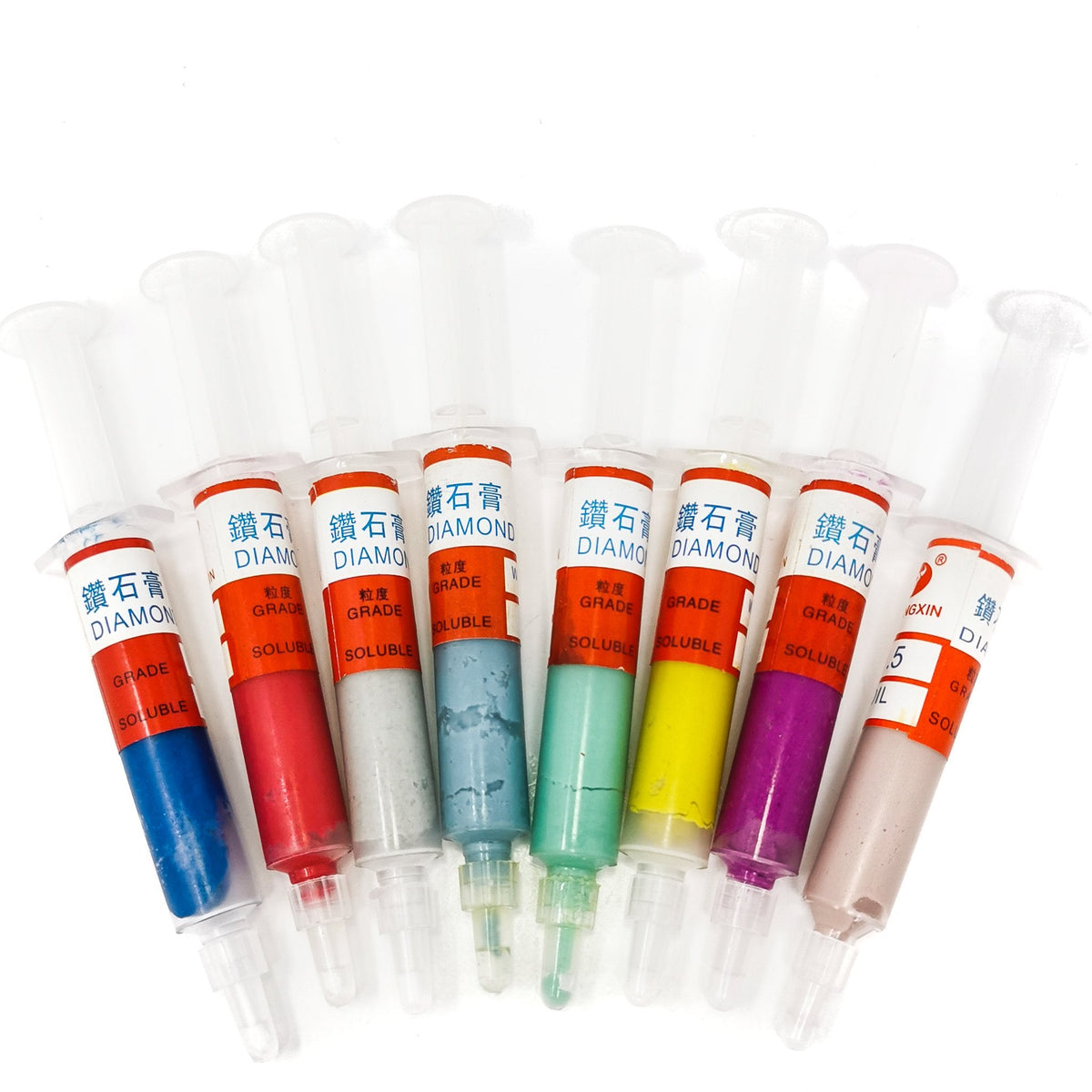
Diamond paste is a charge, the compound that does the cutting. The carrier is what holds it: leather, felt, cloth or a wooden lap.[1] Paste is rated in microns rather than grit, and smaller numbers are finer. A 14 micron paste is much coarser than a 1 micron one.[1] Keep a separate carrier for each paste, because a stray coarse particle will drag a scratch through a fine polish.[1]
We sell diamond polishing paste and hard felt to carry it.

How shiny is shiny enough?
You'll see people chasing extremely fine grits. A 3000 finish is a commercial-grade polish. Wheels go up to 50,000, and around 14,000 water starts beading on the surface, but past 3000 the gain isn't always worth the time. I stop at 3000 most of the time.[1]
For the machine side, see Lapidary for Beginners: Equipment and Tumbling Grit and Polish Explained. More tools are in lapidary tools.
Hand polishing is a low-cost start in lapidary equipment for beginners. When you are ready for more, see our full tool range and lapidary tools.
See what's new: browse our newest arrivals for the latest pieces added to the shop.
Sources
- Adam Kelliher, Beyond Cabbing: Volume I, Cutting a Cabochon (pre-polishing, drying and inspecting, finishing) and Volume II, A Lapidary Glossary (abrasion, carrier, charge, micron, polishing) and finishing chapter.