


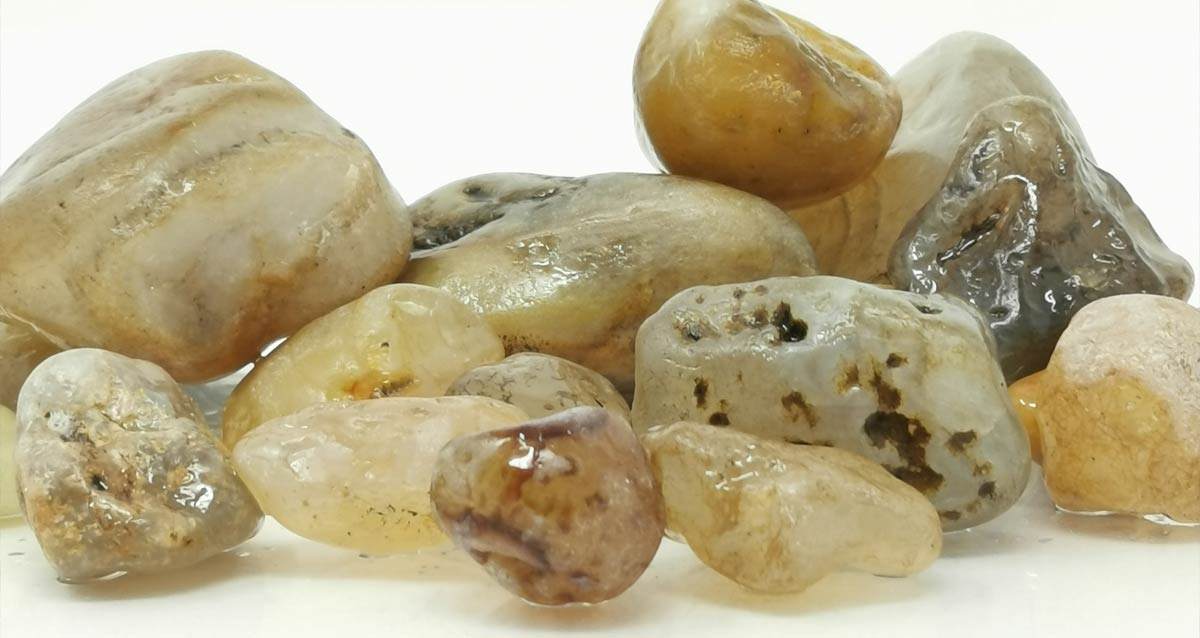

People bring rocks into Rubble Rock and Gem all the time with some version of the same question: “I found this near Vancouver. What is it?” It is a fair question, but around the Lower Mainland it is rarely as simple as it sounds. A green cobble found on a beach might not be jade. A rusty, heavy stone might not be ore. A striped rock might not be a fossil. A smooth quartz pebble from the Fraser River might have travelled a long way before it ended up in your hand.
Why the Rock You Found Near Vancouver May Not Have Formed Anywhere Near Vancouver
The main problem is that Vancouver is not a clean geological display case where every loose rock tells you exactly what is underneath your feet. The region has been shaped by bedrock geology, glaciation, river transport, marine sedimentation, landslides, construction, landscaping, and urban fill. That means the rock’s current location is useful information, but it is not proof of where the rock formed.
The first rule of Vancouver rock identification is simple: the place you picked up the rock is not always the place the rock formed. Around here, a loose stone may have been moved by glacial ice, carried by the Fraser River, rounded on a beach, dumped as construction fill, imported as landscaping stone, or reworked from an older sediment deposit. The rock itself still matters. The location still matters. But the location has to be treated as evidence, not a conclusion.
Bedrock Versus Loose Rock
The most important distinction is between bedrock and transported rock.
Bedrock is solid rock still attached to the Earth. It is the original rock beneath soil, sediment, roads, buildings, forests, and water. If you break a sample directly from a natural outcrop, quarry wall, road cut, or cliff face, the location becomes much more meaningful because the rock is still connected to its geological source.
Transported rock is different. It has been broken loose and moved. It may have travelled a few metres or hundreds of kilometres. It may have been carried by glaciers, rivers, waves, gravity, or people. Most casual rock finds around Vancouver are transported rocks, not bedrock samples. Beach cobbles, river stones, landscaping rocks, driveway gravel, and loose stones from construction sites are all examples where the “found location” can be misleading.
Around Vancouver, location is evidence. It is not a birth certificate.
This is where many mistaken identifications begin. Someone finds a green stone in Vancouver and assumes Vancouver has jade at that spot. Someone finds a rusty rock beside a trail and assumes there is ore nearby. Someone finds a fossil-looking pattern on a beach and assumes the fossil formed at that beach. Sometimes those guesses are possible, but they are not safe starting points. In Vancouver, the rock’s location often tells you where it ended up, not where it began.
Vancouver Sits in a Geological Mixing Zone
The Lower Mainland is already geologically complicated before we even talk about glaciers or people moving rocks around. Vancouver sits near the Strait of Georgia, the Fraser River delta, the Coast Mountains, Vancouver Island, and a broad lowland shaped by repeated changes in sea level, sediment supply, and glacial history. The surrounding region includes granitic and dioritic rocks from the Coast Mountains, older volcanic and sedimentary rocks, glacial deposits, marine sediments, river sediments, and modern human-placed aggregate.
This mix matters because Vancouver is not one simple rock environment. A loose cobble found in the city might be related to Coast Mountain bedrock, Fraser River sediment, older glacial deposits, local construction aggregate, or imported decorative stone. The geology under the city and the geology represented by a loose stone in someone’s hand are not always the same thing.
For customers and beginner collectors, this is often the frustrating part. The rock may genuinely be interesting, but the story is rarely as clean as “I found this here, therefore it formed here.” Around Vancouver, a rock can have a long travel history before it becomes a beach pebble, garden stone, or gravel-bar find.
Glaciers Did a Lot of the Mixing
The Lower Mainland was heavily shaped by ice-age glaciation. During glacial periods, ice advanced over the region, scraped across bedrock, carried boulders and sediment, and left behind mixed deposits when it melted. In some places, later meltwater sorted that material into sand and gravel. In other places, fine sediment settled in marine or glacial lakes. The result is a messy but important geological archive.
A glacier does not sort material politely. It can pick up clay, sand, gravel, cobbles, and boulders and carry them together. When that unsorted mixture is deposited directly by ice, it is called till. Till is one of the main reasons loose rocks in glaciated regions can be difficult to identify by location alone. A single deposit can contain pieces from several source areas, all dropped together after being transported by ice.
Meltwater from glaciers creates another type of deposit called outwash. Outwash is usually better sorted than till because moving water separates material by size. Fast water can move gravel and cobbles; slower water drops sand; very slow water allows silt and clay to settle. Outwash deposits are common sources of sand and gravel, which later become gravel pits, construction aggregate, road base, drainage rock, and landscaping material.
This is why a gravel pit or construction excavation in the Lower Mainland can expose a surprising mixture of stones. The deposit may not represent one bedrock unit. It may represent a transported collection assembled by ice and water. For rock identification, that changes everything.
Buried Landscapes Make the Ground Even More Complicated
The Lower Mainland is not just one blanket of glacial material sitting neatly on bedrock. Older landscapes were buried, eroded, flooded, cut by channels, covered by new sediment, and buried again. Some old ground surfaces now sit below younger deposits. Some ancient channels are filled with gravel. Some areas contain marine clay or silt from times when sea level was different. Other areas contain sand and gravel from glacial meltwater or river systems.
This is why the geology can change over a short distance. One site may expose clay. Another nearby site may expose sand and gravel. A deeper excavation may hit older deposits with a different source and history. What looks like one neighbourhood on a map may contain several stacked or overlapping geological stories below the surface.
For rockhounds, this means that finding an interesting stone in one area does not automatically mean there is a bedrock source nearby. It might be part of an old glacial deposit, a buried river channel, a reworked gravel layer, or modern construction material. The rock may be natural, but not necessarily local in the way people assume.
The Fraser River Adds Another Layer of Confusion
The Fraser River is one of the major reasons Vancouver-area sediments are so mixed. It drains a huge part of British Columbia and carries sand, silt, clay, and rock fragments toward the Strait of Georgia. By the time that material reaches the Lower Mainland, it may represent bedrock from far outside Vancouver.
The river also reworks older glacial deposits. That means some material may have been moved first by ice, then later picked up again by water. A pebble found near the Fraser can therefore have a complicated history. It may have come from a distant part of the drainage basin, from a glacial deposit cut by the river, from local bank erosion, or from human-placed fill.
This helps explain why Fraser River gravel can contain such a variety of stones. Quartz, chert, volcanic rock, granitic rock, dark mafic rock, jasper-like material, and other durable fragments can all appear in the same general system. Some pieces are attractive. Some are dense. Some are colourful. Some polish naturally in water. That does not automatically make them gemstones or ore; it means they survived transport.
For collectors, Fraser River material can be enjoyable and educational, but it should be approached realistically. The river is a conveyor belt, not a guarantee of local mineral deposits.

Beaches Make Ordinary Rocks Look More Interesting
Beach rocks cause a lot of confusion because beaches naturally polish, round, stain, and sort stones. Waves move cobbles back and forth. Sand abrades their surfaces. Saltwater, iron staining, manganese staining, algae, and weathering can change their appearance. A rough, ordinary rock can become a smooth, attractive cobble after enough time in a beach environment.
This creates several common mistakes. Green beach stones are mistaken for jade. Rusty stones are mistaken for ore. Black heavy stones are mistaken for meteorites. Striped stones are mistaken for fossils. Translucent quartz pebbles are mistaken for rare gemstones. None of these guesses are ridiculous, but they are incomplete. Surface appearance alone is not enough.
A beach-polished stone may hide the features needed for identification. Fresh fracture, hardness, grain size, mineral content, crystal shape, density, and internal texture usually matter more than the polished outside. The beach can make a rock more attractive while also making it harder to read.
Beach polish is not a value test. It is just abrasion with good lighting.
This does not mean beach rocks are worthless. Many are beautiful, and some are excellent for personal collections or lapidary practice. The point is that a smooth surface should not be confused with rarity, value, or geological identity.
Landscaping Rock Is Often Not Local at All
One of the biggest traps in urban rock identification is landscaping stone. Many “found in Vancouver” rocks were found beside apartment buildings, parking lots, sidewalks, commercial properties, drainage strips, garden beds, or boulevard plantings. In those settings, the rock may not have any natural relationship to the spot where it was found.
Landscaping rock can come from local gravel pits, crushed quarry rock, river rock from another region, decorative imported stone, construction fill, railway ballast, or leftover job-site material. A stone beside a sidewalk may have travelled farther by truck than it ever travelled by glacier.
This matters because Vancouver uses enormous amounts of aggregate. Roads, foundations, concrete, drainage systems, retaining walls, seawalls, landscaping beds, and construction sites all require stone, gravel, sand, or fill. Humans move rock constantly, and urban environments are full of material that has been placed for practical reasons, not geological purity.
In an urban setting, a dump truck can be just as important as a glacier.
If you found the rock in a landscaped bed, a parking strip, a road shoulder, or a construction area, the first question should not be “what is the local bedrock?” The better question is “was this rock placed here?” In many urban cases, that question saves a lot of wasted guessing.
Why Every Green Rock Near Vancouver Is Not Jade

Green rocks create more confusion than almost anything else. Someone finds a green cobble near Vancouver and hopes it is jade. That is understandable because British Columbia is famous for jade, and nephrite jade is one of the province’s best-known lapidary materials. The problem is that many different rocks can be green.
A green stone might be serpentine, greenstone, basalt with green alteration minerals, epidote-rich rock, chlorite-rich rock, actinolite-bearing rock, or imported decorative stone. It might be a natural cobble, a piece of landscaping material, or a rock transported by glacial ice or river systems from somewhere else.
Real B.C. jade is nephrite. Nephrite is not simply a green rock. It is a tough, dense, interlocking rock made mainly of fine fibrous tremolite-actinolite amphibole. Good nephrite has particular physical properties: toughness, density, fracture behaviour, hardness, texture, and in some cases translucency along thin edges. It also forms in specific geological settings, commonly where ultramafic rocks such as serpentinite have reacted with silica-bearing rocks and fluids.
Green is a clue. It is not a diagnosis.
Many green rocks are attractive and some cut well, but most green Vancouver-area cobbles are not jade. A proper jade identification depends on the properties of nephrite, not just the colour of the stone.
Serpentine Is a Common Jade Look-Alike

Serpentine deserves special mention because it often fools people. It can be green, smooth, waxy, and attractive. Some varieties are carved or sold decoratively, and to a beginner it can look close enough to jade to cause confusion.
Serpentine is generally softer and less tough than nephrite. It tends to scratch more easily and behaves differently under cutting and polishing. Some serpentine can be beautiful lapidary material, but it is not the same as jade.
This distinction matters in British Columbia because serpentinized ultramafic rocks occur in parts of the province, including regions outside Vancouver that can still contribute transported material. Glaciers, rivers, and people can all move green stones into places where the geological context becomes less obvious. A green rock found around Vancouver may have a real B.C. origin and still not be jade.
The practical lesson is straightforward: do not identify jade by colour alone. That is how most jade misidentifications happen.
Heavy, Rusty, or Metallic-Looking Rocks Are Not Automatically Ore
Another common category is the heavy, rusty, shiny, or metallic-looking rock. People often wonder if these are gold ore, silver ore, copper ore, or some kind of valuable mineralized material.
Most are not.
Rusty staining usually comes from iron-bearing minerals oxidizing. Pyrite, magnetite, iron-rich silicates, and small amounts of sulphide minerals can all create dramatic colours and stains. A rock can look “mineralized” without containing metal in any economically meaningful amount.
Ore is not a rock that looks important. Ore is rock that can be mined, processed, and sold at a profit. That requires grade, volume, accessibility, metallurgy, permitting, infrastructure, and market conditions. A rusty rock on a beach or trail is usually just a rock with iron staining or minor sulphides.
This is where geological setting matters. Real mineral deposits form in specific environments controlled by faults, intrusive rocks, volcanic systems, sedimentary basins, hydrothermal fluids, pressure, temperature, chemistry, and time. British Columbia has many types of mineral deposits, but they are not random. A heavy rock is not automatically ore any more than a green rock is automatically jade.

Black Magnetic Rocks Are Usually Not Meteorites
Black magnetic stones are another common false alarm. Meteorites are rare. Black magnetic Earth rocks are common. Around Vancouver, possible explanations include basalt, magnetite-bearing rock, mafic volcanic rock, slag, industrial material, iron-rich beach cobbles, or construction aggregate.
Magnetism alone does not prove a meteorite. Weight alone does not prove a meteorite. A dark crust does not prove a meteorite. Many ordinary terrestrial rocks contain magnetite, and some man-made materials are strongly magnetic.
Meteorite identification requires a much more specific set of evidence, including internal texture, fusion crust, density, metal content, nickel content, chondrules in some types, and consistency with known meteorite classes. Most suspected meteorites are not meteorites, especially when they come from urban, beach, or construction environments where dark magnetic material is common.
A magnetic rock is still worth identifying, but the starting assumption should be terrestrial unless the evidence says otherwise.
Fossil-Looking Rocks Are Often Just Fossil-Looking
Many rocks imitate fossils. Rings, stripes, tubes, shell-like curves, leaf-like patterns, wormy marks, and branching black shapes can all look biological at first glance. Sometimes they are fossils, but many are not.
Common fossil mimics include mineral veins, bedding layers, concretions, iron staining, manganese dendrites, weathering patterns, shell-shaped fractures, ripple marks, root traces, and layered sedimentary or metamorphic rocks. Manganese dendrites are a classic example: they can look like tiny fossil plants, but they are mineral growths along cracks or bedding planes.
A fossil is not just a shape that reminds us of life. It needs to preserve biological structure or a convincing biological pattern. A rock that looks like a bone, shell, leaf, or egg may simply have weathered into a suggestive form.
Loose Vancouver-area rocks add another complication because they may be transported. Even if a fossil-bearing rock is real, a beach or gravel-bar location does not always prove the fossil formed there. It may have been moved by ice, water, or people. That does not make it less interesting, but it does change the interpretation.
Pretty Pebbles Are Worth Enjoying, But They Are Not Always Rare
Some Vancouver-area stones are simply attractive. Quartz pebbles can be rounded, translucent, and warm-coloured from iron staining. Jasper-like rocks can show red, yellow, brown, or green colours. Fine-grained volcanic rocks can become smooth and pleasant in the hand. Beach stones can develop beautiful surfaces after years of abrasion.
A rock can be beautiful without being rare. A rock can be common without being worthless. A rock can have little resale value but still be excellent for a personal collection, display, education, or lapidary practice.
For lapidary work, the useful question is often not “is this valuable?” but “will it cut well?” A good cutting stone needs enough hardness, toughness, colour, pattern, and stability to survive sawing, grinding, sanding, and polishing. Some ordinary-looking stones cut surprisingly well. Some exciting-looking stones fracture, undercut, crumble, or refuse to take a good polish.
A beach pebble does not need to be jade, agate, fossil, or ore to be worth keeping. It is better to understand what it is than to force it into a more exciting category.
Gravel Pits and Construction Sites Can Be Educational, But Misleading
Gravel pits, road cuts, and construction excavations can expose material that is normally hidden under soil, pavement, and vegetation. Around the Lower Mainland, these exposures may reveal glacial till, outwash, sand, gravel, clay, buried channels, old surfaces, and reworked deposits.
This is useful, but it can also be misleading. A gravel pit is usually not exposing a gemstone deposit. It is exposing transported material. The stones inside may come from different source areas and may have been moved by ice, water, or both.
That is why gravel pits can produce such a variety of rocks. Quartz, chert, jasper-like material, greenstone, basalt, granitic cobbles, concretions, and unusual erratics can all occur in the right deposit. Some may be attractive. Some may be useful for lapidary. Some may be good teaching specimens. But the deposit is not saying “all these rocks formed here.” It is saying “all these rocks were brought here.”
That difference is the heart of Vancouver rockhounding.
A Practical Way to Think About Vancouver Rock Finds
If you find a rock around Vancouver, start by asking how much you actually know about its context. Was it attached to bedrock, or was it loose? Was it found in a natural creek, beach, or riverbank, or was it found in a landscaped urban setting? Were there many similar rocks nearby, or was it a single oddball stone? Was it rounded by water, angular from crushing, polished by waves, or freshly broken?
Those questions will not identify the rock by themselves, but they will keep you from making the most common mistakes.
A loose rounded cobble from a beach has probably been transported and polished. A stone from a garden bed may have been purchased by a landscaper. Angular gravel beside a road may be crushed quarry aggregate. A rock broken from an outcrop carries stronger local geological information. A stone found in a natural river bar may represent the river’s drainage basin more than the exact spot where you picked it up.
The rock’s physical properties matter too. Hardness, density, magnetism, fracture, streak, grain size, crystal form, reaction to acid, and fresh internal texture are usually more useful than surface colour. Green is not enough for jade. Heavy is not enough for ore. Magnetic is not enough for meteorite. Striped is not enough for fossil. Translucent is not enough for gemstone.
What to Bring for Rock Identification
If you want a better identification, bring the rock and as much context as possible. A photo of where it was found can help. Knowing whether it was loose or attached to bedrock helps even more. It is useful to know whether it came from a beach, river, gravel pit, construction site, garden bed, outcrop, or road cut.
If the rock has a broken surface, that can be more useful than the weathered exterior. A fresh surface shows grain size, internal colour, mineral texture, fractures, and sometimes crystal structure more clearly. You do not need to smash every rock you find, but if there is already a broken face, it often tells more than the polished outside.
Simple observations also help: whether it scratches glass, whether a magnet sticks to it, whether it feels unusually dense, whether it fizzes with vinegar or acid, whether it has visible crystals, whether it has layering, whether it shows metallic grains, and whether similar rocks were nearby.
Better information leads to better identification. Guessing from colour alone is where most wrong answers begin.
The Main Lesson
Vancouver rocks are confusing because Vancouver has been mixed by natural and human processes. The region includes bedrock from different geological settings, glacial deposits, Fraser River sediment, beach cobbles, marine clay and silt, buried landscapes, construction fill, landscaping stone, and imported aggregate.
A rock found here may have been moved by ice, water, waves, gravity, or people. It may be interesting, attractive, educational, or useful for lapidary without being jade, ore, agate, fossil, or meteorite.
The better habit is to separate the evidence from the hope. Ask what the rock is made of, how it might have been transported, whether it is natural to the spot, and whether its properties actually match the identification you want to give it.
That is the difference between guessing and geology. Around Vancouver, that difference matters.