


Most people first meet stone after someone else has already made the important decisions.
They see the polished cabochon, the jade pendant, the agate slab, the amethyst bead, the carved animal, the faceted sapphire, the obsidian point, the quartz sphere, or the patterned jasper sitting in a tray under lights. The stone looks finished, obvious, and inevitable, as if the beauty was always sitting there waiting to be revealed.
That is not really how lapidary works.
Stone cutting is the point where geology becomes craftsmanship. The earth provides the rough material, but the cutter has to decide what that material can become. A good piece of rough can be ruined by the wrong cut. A plain-looking stone can become beautiful when oriented correctly. A fractured piece can be saved if the cutter understands where the weakness is. A hard stone can still undercut, pit, bruise, burn, orange-peel, or refuse polish if it is treated like every other rock.
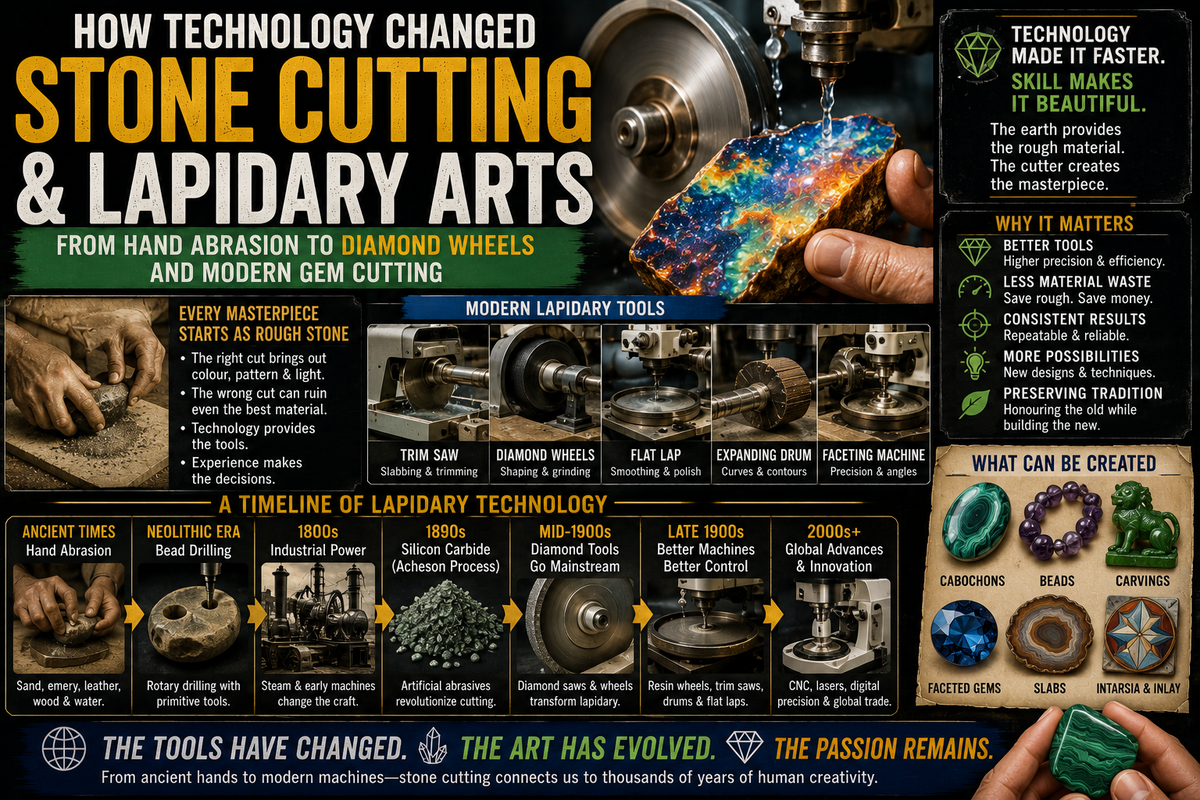
Technology changed lapidary dramatically. It made cutting faster, cleaner, more repeatable, and more accessible. It gave cutters diamond saws, silicon carbide grit, electric motors, trim saws, slab saws, flat laps, expanding drums, resin-bond diamond wheels, faceting machines, ultrasonic drills, and mass-production carving systems.
But technology did not remove the judgment.
A machine can spin the wheel. It cannot tell you where the best colour is hiding. It cannot decide whether a stone should become a cabochon, a bead, a carving, a slab, a freeform, or a specimen. It cannot know whether the fracture is shallow or fatal. It cannot feel when jade is cutting too hot, when agate is chipping at the edge, when rhodonite is undercutting, or when a polish is real instead of just temporarily shiny.
Lapidary technology made stone cutting faster. It did not make stone cutting automatic.
That distinction matters.
A Rough Timeline of Lapidary Technology
Lapidary did not begin with modern gem machines. It is one of the oldest forms of material craftsmanship. Humans learned early that some stones were harder, brighter, tougher, more colourful, or more useful than others. From there, stone became tool, ornament, trade good, amulet, seal, sculpture, jewel, and art object.
|
Period |
Development |
What changed |
|
Ancient world |
Hand abrasion and natural abrasives |
Stone was shaped by rubbing harder materials against softer ones. Sand, quartz, emery, corundum, water, leather, wood, copper, bronze, and iron all became part of early cutting and polishing traditions. |
|
Neolithic and Bronze Age cultures |
Stone bead drilling |
Beads made stone portable, wearable, tradable, and symbolic. Ancient lapidary drilling became highly advanced in cultures such as the Harappan civilization, where rotary drilling and specialized drill materials were used for hard stone beads. |
|
Ancient Egypt, Mesopotamia, India, China, Greece, and Rome |
Hardstone carving, seals, inlays, beads, and engraved gems |
Lapidary became specialized craft. Stone was no longer only a tool material; it became status, recordkeeping, personal identity, ritual object, and decoration. |
|
Medieval period |
Lapidary texts and gem traditions |
Stones were catalogued, described, traded, carved, polished, and assigned meanings. Medieval lapidary traditions mixed observation, medicine, symbolism, religion, and early natural philosophy. |
|
1400s onward |
European faceting develops |
Transparent gemstones increasingly became cut for light performance, not only colour and polish. Medieval and Renaissance European cutters helped develop faceting traditions that changed how gems were valued. |
|
1450s |
Diamond polishing advances |
Lodewyk van Bercken is traditionally associated with improvements to diamond polishing through the use of the rotating scaif, helping make more controlled diamond cutting possible. |
|
1800s |
Industrial power and mechanized workshops |
Water, steam, and later electric power made larger cutting shops more productive. Stone cutting became less limited by hand labour alone. |
|
1890s |
Silicon carbide / carborundum |
Edward Acheson developed carborundum, a synthetic silicon carbide abrasive. His patent described it as a practical substitute for diamond, corundum, and other abrasives in mechanical applications. |
|
Early 1900s |
Wider industrial abrasive production |
Synthetic abrasives made cutting, grinding, and polishing harder materials more practical, consistent, and accessible. Silicon carbide became mass-produced as an abrasive in the 1890s. |
|
Early to mid-1900s |
Electric motors enter smaller shops |
Hobby and small-shop lapidary became more realistic. Cutting no longer required large industrial setups or purely hand-powered systems. |
|
Mid-1900s |
Diamond saw blades and diamond abrasives become common in lapidary |
Hard stones could be slabbed, trimmed, ground, and shaped faster and with more control. Diamond changed the economics of cutting agate, jasper, jade, quartz, and other hard materials. |
|
Postwar 1940s to 1960s |
Lapidary clubs and magazines expand |
Lapidary became a major social hobby. Publications such as Lapidary Journal, launched in 1947, helped spread cutting knowledge, equipment information, field-trip culture, and club activity. |
|
Late 1900s |
Resin-bond diamond wheels, expanding drums, trim saws, flat laps |
Cabochon cutting became more controlled, more beginner-accessible, and more efficient. |
|
Late 1900s to 2000s |
Precision faceting machines improve |
Better machines, laps, indexes, angle control, and designs made faceting more repeatable for both hobbyists and professionals. |
|
2000s onward |
Global mass-production cutting hubs |
Beads, carvings, cabochons, spheres, towers, calibrated stones, and decorative objects became available at global scale through cutting centres in places such as India, China, Thailand, Brazil, Indonesia, Mexico, and Germany. |
|
2010s onward |
YouTube, online learning, and maker culture |
Lapidary knowledge moved beyond clubs, books, and apprenticeships. More people could learn cutting basics online, though not always with the discipline or safety culture that clubs provided. |
|
2020s onward |
CNC carving, 3D design, laser scanning, waterjet, ultrasonic drilling, and better small-shop equipment |
Traditional lapidary increasingly overlaps with digital design, precision machining, industrial tooling, and small-scale custom production. |
The broad pattern is simple: lapidary moved from slow hand abrasion, to powered wheels, to synthetic abrasives, to diamond tooling, to globalized production, to digital and machine-assisted cutting.
But the core act is still the same.
Stone is shaped by controlled erosion.
Lapidary Is Controlled Erosion
The basic science of lapidary is not complicated. You use something harder, sharper, or more abrasive to wear away stone in a controlled way.
That is true whether someone is rubbing a bead blank with abrasive sand, grinding an agate cabochon on a silicon carbide wheel, cutting jade on a diamond saw, polishing quartz with cerium oxide, or faceting sapphire on a precision lap.
The material is removed one scratch at a time.
That is why lapidary is slow when done well. Every stage has to remove the damage from the stage before it. A saw cut leaves deep marks. A coarse wheel removes the saw marks but leaves its own scratches. A medium wheel removes those. A fine wheel removes those. Pre-polish removes the final visible scratch pattern. Polish only works when the surface is already prepared.
This is where beginners often misunderstand the process.
Polish is not a magic final step. Polish does not fix bad sanding. It reveals whether the sanding was done properly.
A good polish is built long before the polishing compound touches the stone.
1. Hand Abrasion Was the First Lapidary Technology
Before machines, stone cutting meant patience.
Ancient cutters used natural abrasives and simple tools. Sand, quartz, emery, corundum, water, leather, wood, copper, bronze, iron, and other materials were used depending on the culture, stone, and period. The principle was always the same: use abrasion to shape a harder material than the hand alone could control.
This is easy to underestimate because modern cutters are spoiled by machines. A lapidary can now take a piece of agate to a diamond wheel and change its shape in minutes. In the ancient world, shaping hard stone was labour-intensive. A bead, seal, amulet, or carved object represented time, skill, and access to suitable materials.
That is part of why stone objects mattered so much. They were durable. They travelled well. They could hold identity, trade value, ritual meaning, beauty, and status. A stone bead was not just a bead. It was evidence that someone had the tools, knowledge, trade network, and patience to make something difficult.
The oldest lapidary lesson is still true today: the stone gives resistance, and the cutter has to earn the shape.
2. Bead Drilling Turned Stone Into Portable Value
Beads are one of the most important lapidary forms in human history.
A bead is small, but it solves a major problem. It turns stone into something portable, wearable, countable, tradable, and socially visible. Once a stone can be drilled, it can be strung. Once it can be strung, it can become ornament, currency, identity marker, offering, heirloom, or trade item.
Drilling hard stone was not simple.
Ancient bead makers had to solve problems of rotation, pressure, abrasive, alignment, heat, breakage, and patience. Hard stones such as agate, carnelian, jasper, quartz, and other silica-rich materials do not politely accept a hole. The drill has to grind through them.
Archaeological research on Harappan bead drilling describes advanced rotary drilling traditions and specialized drill materials used for hard stone bead production, showing that ancient lapidary could be highly sophisticated rather than primitive.
For modern collectors, this matters because beads are often treated as simple commercial products. A strand of stone beads may look ordinary in a shop because we now see them everywhere. But historically, bead drilling was one of the great technical achievements of lapidary.
The object is small. The skill behind it is not.
3. The Wheel Changed Stone Cutting
The rotating wheel is one of the major turning points in lapidary.
Once abrasion could be attached to a spinning surface, cutting became more controlled and efficient. The wheel allowed the cutter to bring stone to a consistent moving abrasive instead of relying only on hand rubbing. That idea sits behind grinding wheels, polishing wheels, cabbing machines, trim saws, flat laps, faceting laps, and carving tools.
The wheel did not eliminate hand skill. It concentrated it.
A cabochon cutter still has to hold angle, pressure, symmetry, dome height, girdle thickness, and orientation. A faceter still has to control index, angle, meetpoints, polish, and transfer. A jade carver still has to understand grain, toughness, heat, and tool pressure.
The wheel made cutting faster. It also made mistakes faster.
This is still true in every modern lapidary shop. Give an inexperienced person a powerful diamond wheel, and they can destroy a good piece of rough much faster than they could with sandpaper. Technology increases capability. It also increases the consequences of bad judgment.
4. Faceting Changed Transparent Gemstones
Faceting changed how people valued transparent gems.
Before faceting became highly developed, many stones were polished as rounded cabochons, beads, tablets, carvings, or engraved gems. That approach still works beautifully for many materials. Jade, turquoise, opal, moonstone, star sapphire, chrysoprase, jasper, agate, rhodonite, malachite, and many other stones often make more sense as cabochons or carvings than as faceted gems.
Transparent gems introduced a different problem: light.
Faceting is not just polishing flat faces onto a stone. It is the control of reflection, refraction, symmetry, proportion, and optical return. The cutter is no longer only revealing colour or pattern. They are engineering how light moves through the gem.
European faceting traditions developed during the medieval and Renaissance periods, with sources commonly placing important early faceting developments around the fifteenth century.
This changed value.
A transparent gem could now be judged by brilliance, scintillation, symmetry, windowing, extinction, face-up colour, weight retention, and precision. The cutter had to balance beauty against yield. Cutting too deep or too shallow could hurt the gem. Saving too much weight could produce a lifeless stone. Chasing perfection could waste expensive material.
That tension still defines faceting today.
A good faceter is not just someone who can follow an angle diagram. A good faceter understands the stone, the refractive index, the rough shape, the inclusions, the colour zoning, the market, and the trade-off between weight and performance.
5. Industrial Power Made Cutting Scalable
Industrial power changed lapidary by making repetition possible.
Water-powered and later steam- and electric-powered cutting shops allowed more work to be done with less direct hand labour. Larger wheels, saws, belts, shafts, polishing stations, and workshop systems could be run more consistently. Stone cutting became more productive and more specialized.
This mattered in historic cutting centres such as Idar-Oberstein in Germany, where water-powered agate cutting and later global stone importing helped build one of the world’s most famous lapidary traditions. It also mattered in diamond cutting centres, jade carving workshops, bead-making districts, and later mass-production gemstone factories.
Industrial power changed the scale of the craft.
Before that, lapidary was slow and local. With powered shops, stone could be cut in greater volume, sorted by labour specialization, and connected to broader trade networks. One worker might saw. Another might preform. Another might drill. Another might polish. Another might carve. Another might inspect or string or mount the finished product.
The modern rock shop depends on this history.
A tray full of polished stones is not just “nature.” It is industrial organization applied to geology.

6. Silicon Carbide Made Hard-Stone Cutting More Practical
Silicon carbide was one of the major abrasive breakthroughs.
Edward Acheson developed carborundum, a synthetic silicon carbide abrasive, in the 1890s. His patent described the material as a practical substitute for diamond, corundum, and other abrasive materials in mechanical applications. Silicon carbide was being mass-produced as an abrasive in the 1890s, which made it important for industrial grinding and eventually for lapidary use.
For lapidary, this mattered because many collectible stones are hard.
Quartz is hard. Agate is hard. Jasper is hard. Many garnets are hard. Jade is tough. Petrified wood can be hard and inconsistent. Some materials are not extremely hard on paper but are miserable because of grain, fracture, undercutting, or mixed mineral content.
Silicon carbide wheels, belts, papers, and grits made cutting these materials more practical before diamond tooling became as common and affordable as it is now.
This is part of the bridge between ancient lapidary and modern lapidary.
The old cutter used natural abrasives and patience. The modern cutter increasingly used synthetic abrasive technology. That opened the door for hobbyists, schools, clubs, and small shops to do work that once required more specialized industrial setups.
It also shaped the classic lapidary club era. Many older cutters learned on silicon carbide wheels long before resin-bond diamond wheels became the beginner-friendly standard in many modern shops.
7. Diamond Saws Changed How Rough Was Opened
The saw is where many lapidary decisions become permanent.
Before a stone is a cabochon, a slab, a matched pair, a carving blank, a sphere, or a pendant, someone has to decide how to open the rough. That first cut can reveal beauty or destroy it.
Diamond saws changed lapidary because they made hard stone cutting faster, cleaner, and more controlled. Instead of breaking material by hammer, chisel, fracture, or crude cutting methods, a lapidary can cut slabs, trim preforms, remove waste, isolate colour, and expose patterns with far more precision.
This changed the economics of rough.
A thinner saw kerf wastes less material. A cleaner cut gives better slabs. A good trim saw can rescue small areas of colour from fractured rough. A slab saw can open a nodule and reveal whether the inside is worth working. A diamond blade can turn a boulder into usable material, or prove that the whole piece was not worth the time.
For collectors, this is important because rough stone lies.
The outside of a rock often tells only part of the story. Agate nodules may be plain outside and spectacular inside. Jasper may hide colour under rind. Jade may have weathered skin, fractures, bruising, or quality changes that only become clear when cut. Rhodonite may look promising until black manganese oxides, fractures, or soft zones show themselves. Petrified wood may reveal pattern, rot, quartz pockets, or instability only after slabbing.
A saw does not just cut stone. It creates information.
8. Diamond Grinding Wheels Made Cabochon Cutting Faster
Cabochon cutting is one of the core lapidary arts.
A cabochon is usually a shaped and polished stone with a rounded top and a flat or slightly curved back. It is one of the best cutting styles for opaque, translucent, patterned, chatoyant, included, or structurally interesting stones.
Jade, agate, jasper, turquoise, opal, moonstone, rhodonite, malachite, chrysoprase, lapis, petrified wood, and many other materials often make more sense as cabochons than as faceted stones.
Diamond grinding wheels changed cabochon cutting because they remove material quickly and consistently. Compared with older silicon carbide systems, diamond wheels can be faster, cleaner, and easier to use, especially across hard materials.
But diamond wheels also create a modern problem.
They let beginners move too fast.
A good cutter is not just trying to make the stone round. They are trying to preserve the best part of the material, control the dome, avoid flat spots, remove saw marks, keep the girdle clean, avoid overheating, and stop before they erase the reason the stone was interesting in the first place.
The best part of a stone is often small.
A careless cutter will grind through the colour. They will cut away the pattern. They will chase symmetry until the cab becomes boring. They will dome too high and lose the scene. They will dome too low and make the stone feel dead. They will undercut soft areas and then blame the polish.
Diamond made cabochon cutting easier to enter. It did not make mastery easier.
9. Polishing Compounds Changed the Finish
Polishing is where lapidary becomes honest.
A stone may look good when wet. It may look good after a fine sanding stage. It may look good under oil, wax, or artificial enhancement. But a true polish shows whether the surface has been properly prepared.
Different stones respond to different polishing systems. Cerium oxide, tin oxide, aluminum oxide, chromium oxide, diamond compound, leather, felt, canvas, resin, wood, and modern polishing pads all have their place depending on the material and the cutter’s system.
Quartz and agate often respond well to cerium oxide. Jade can be more complicated because toughness, texture, mineral structure, and heat all matter. Malachite, rhodonite, turquoise, serpentine, calcite, obsidian, opal, and feldspar each create different problems. Some materials undercut because their minerals have different hardnesses. Some pit. Some orange-peel. Some scratch easily. Some take a polish quickly but lose it under wear.
A polishing compound is not a universal solution.
The cutter has to understand the material.
This is one of the reasons lapidary is more difficult than it looks online. A video can show a stone becoming shiny, but it often does not show the judgment behind the abrasive sequence, wheel choice, pressure, water, heat control, drying, inspection, and final finish.
Shiny is not always polished.
A real polish has depth, clarity, and durability. It is not just a surface trick.
10. Precision Faceting Machines Made Repeatability Possible
Faceting requires control.
A faceting machine holds the stone at specific angles and indexes it around a precise pattern. This allows the cutter to place facets in repeatable positions and control how light returns through the gem. The broad lapidary field includes cabochon cutting, faceting, carving, beads, tumbling, and engraved gems, but faceting is especially dependent on precision equipment. GIA describes gem cutting styles using categories such as faceted stones, cabochons, and beads, emphasizing the importance of cut quality in coloured stones.
Modern faceting machines made it possible for skilled hobbyists and small professional cutters to produce accurate gems outside major cutting centres.
But again, the machine does not make the decision.
The faceter must orient the rough, manage inclusions, account for cleavage, preserve colour, choose a design, transfer the stone cleanly, polish each facet, meet the points, and decide whether the stone should prioritize weight, brilliance, colour, or durability.
This is why faceting can become obsessive. The tolerances are small. The consequences are visible. A bad meetpoint, a windowed pavilion, a scratched table, or a poor polish can reduce the quality of the stone immediately.
Faceting is where lapidary becomes geometry under pressure.
11. Tumbling Made Polished Stone Available to Everyone
Rock tumbling deserves respect because it introduced countless people to lapidary.
A tumbler is simple in principle. Stones, water, and abrasive grit are placed in a barrel or vibratory machine. Over time, the stones grind against the grit and each other, usually moving through four stages: rough, medium, pre-polish and polish.
Tumbling is often dismissed because it is not as technically demanding as cabbing, faceting, or carving. But tumbling changed the accessibility of polished stones.
It made it possible for families, schools, hobbyists, and beginners to turn rough stones into polished material without needing a full lapidary shop. It also created one of the largest categories in the modern rock trade: tumbled stones.
That matters commercially.
Tumbled stones are small, durable, affordable, easy to ship, easy to display, and easy for beginners to understand. They are often the first rock product a child owns. They are also a major bridge between casual crystal buyers and more serious mineral collecting.
The downside is that tumbling can flatten the perceived skill of lapidary. People see a polished stone and assume polish is simple. But good tumbling still takes grit discipline, a well-filled barrel with mixed rock sizes, patience, and proper cleaning between stages. I don't fuss over sorting a mixed load by hardness; I just pull out anything softer than about 5 on the Mohs scale, because it won't take a shine in a tumbler anyway (Adam Kelliher, Beyond Cabbing).
Skip the cleaning between stages, though, and you're just making noisy mud.
12. Carving Tools Expanded What Stone Could Become
Carving is where lapidary moves from shape to sculpture.
A cabochon follows the stone’s surface. A carving cuts into form. Animals, Buddhas, skulls, flowers, leaves, figures, vessels, seals, cameos, intaglios, netsuke, jade carvings, and ornamental objects all require a deeper relationship between material and design.
Modern carving tools changed what could be done at small scale. Flex shafts, diamond burrs, sintered tools, ultrasonic drills, water-cooled systems, and small rotary tools gave carvers more control. CNC carving and digital duplication later made some carving forms scalable.
But carving is still limited by the stone.
A carver must understand toughness, cleavage, grain, fracture, inclusions, hardness, heat, unsupported details, and polish access. A design that works in wax, wood, or plastic may fail in stone. Thin legs break. Sharp points chip. Undercuts become difficult to polish. Fragile stones cannot hold ambitious detail. Tough stones can survive forms that brittle stones cannot.
This is especially obvious in jade.
Jade is not valuable only because it is green. Good jade is valued for toughness, texture, translucency, colour, polish, and the way it can survive carving. That toughness is why jade has such a long carving history. It can hold forms that many other stones cannot.
Technology gives the carver tools. The stone still sets the terms.

13. Global Cutting Hubs Changed the Rock Shop
Modern rock shops exist because global lapidary production exists.
A local cutter can make beautiful one-of-a-kind pieces, but most rock shops also rely on international cutting centres that produce beads, carvings, spheres, towers, cabochons, palm stones, massage wands, bookends, bowls, freeforms, pendants, and decorative objects at scale.
This is the part customers rarely understand.
A $12 carved stone animal is not cheap because stone is easy to carve. It is cheap because the supply chain is built around volume, specialized labour, lower wages in certain regions, efficient cutting systems, export networks, and repeated designs. A factory cutting thousands of similar objects is not the same thing as a local artist cutting one custom piece.
Both have a place, but they are different worlds.
In major cutting hubs, rough material may arrive by the tonne. It may be sorted by quality, colour, fracture, size, pattern, and intended product. One grade becomes beads. Another becomes carvings. Another becomes cabochons. Another becomes slabs. Another becomes low-end tumbled goods. Another gets dyed, stabilized, filled, backed, or treated. The best material may be held back for higher-value work.
This is where lapidary becomes industrial.
It is no longer just one person at a wheel. It is labour division, machinery, sourcing, grading, export, pricing, and market demand.
A rock shop shelf is the end of that chain.
14. Lapidary Clubs Spread the Knowledge
Technology did not spread lapidary by itself. People did.
Lapidary clubs, mineral societies, field trips, public shows, club shops, newsletters, and magazines helped turn stone cutting into a social hobby. Before the internet, clubs mattered because they gave people access to equipment, instruction, rough material, safety culture, field locations, shows, and community.
Publications also mattered. Lapidary Journal began in 1947 and covered lapidary, rockhounding, and rock discoveries for decades, helping preserve and spread hobby knowledge. Some regional lapidary and mineral federations also formed around clubs, with examples such as the Northwest Federation organized in 1938 and the Eastern Federation organized in 1950.
This history matters because lapidary is hard to learn alone.
You can watch a video, but a video cannot stand beside you and tell you that you are pressing too hard. It cannot smell overheating stone. It cannot notice that your wheel is contaminated. It cannot stop you before you cross-grind a scratch into a cab that takes another hour to remove. It cannot tell you that the material you are cutting is not worth the time.
Clubs created apprenticeship without calling it apprenticeship.
People learned by standing near better cutters.
That is something the internet still struggles to replace.
15. The Internet Changed Learning, but Not Mastery
The internet gave lapidary a second major democratization.
YouTube, forums, online suppliers, social media, digital diagrams, equipment reviews, and online classes made information easier to access. A beginner no longer has to wait for a club meeting or find an old book to learn the basics of cabbing, tumbling, faceting, or polishing.
That is good.
But it also creates a problem: information is not the same as competence.
A person can watch ten videos and still not understand pressure, heat, sound, scratch discipline, wheel contamination, dome geometry, grain direction, fracture risk, or polish failure. They can learn the sequence without understanding why the sequence works.
Lapidary is a physical craft. The body has to learn it.
You feel the stone drag. You hear the wheel. You notice when water is not carrying swarf away properly. You see whether a scratch is isolated or part of the previous grit. You learn that some materials punish impatience. You learn that a cabochon is not finished just because it is shiny under water.
The internet can open the door. It cannot do the repetitions for you.
16. Digital and Machine-Assisted Cutting Changed the Modern Edge
Modern lapidary now overlaps with digital design and precision manufacturing.
CNC carving, waterjet cutting, laser scanning, ultrasonic drilling, digital templates, computer-aided design, and improved small-shop machinery all give cutters more options. Some work can be repeated more consistently. Some designs can be planned before touching the rough. Some production can be scaled. Some fragile shapes can be approached more carefully.
This is especially relevant in commercial cutting.
Factories can produce repeated forms with consistent dimensions. Calibrated cabochons can fit standard jewelry settings. Beads can be drilled and shaped uniformly. Carvings can follow repeatable models. Decorative stone products can be cut for global retail categories.
For individual artists, digital tools can help with planning and precision, but they do not remove the cutter’s responsibility.
The stone can still surprise you.
A hidden fracture can ruin the job. A colour zone can disappear. A soft patch can undercut. A polish can fail. A material can behave differently from the last piece even if the label is the same.
Stone is not plastic. It does not care about your design file.
What This Means for Rock Collectors
Collectors often think of lapidary as “polishing rocks.”
That is too small.
Lapidary is the decision-making bridge between rough geology and finished value. It determines what a stone becomes. It can elevate material or waste it. It can reveal pattern, preserve colour, improve durability, create symmetry, and turn rough into something wearable, usable, or collectible.
It also teaches a more serious way of looking at stone.
A cutter does not only ask, “Is this pretty?”
A cutter asks:
Can it survive the saw?
Where is the best orientation?
Is the colour skin-deep or throughout?
Will it fracture?
Will it undercut?
Will it take polish?
Is the pattern better as a slab or cabochon?
Is the stone too soft for jewelry?
Should this be kept as a specimen instead of cut?
Is the rough worth the time?
Those questions change how you collect.
A beginner sees a cool rock. A lapidary sees potential, risk, waste, orientation, fracture, hardness, polish, and final use.
That is a deeper form of collecting.
Technology Made Lapidary More Accessible, Not Easier
Modern lapidary equipment is extraordinary.
A small shop can now do work that would have been difficult, slow, or impossible in earlier periods. A beginner can buy a trim saw, cabbing machine, flat lap, tumbler, or faceting machine and begin learning without needing an industrial workshop. Diamond tools are widely available. Polishing compounds are easy to order. Rough from around the world is sold online. Instruction is everywhere.
That does not mean the craft is easy.
Modern tools reduce labour. They do not remove discipline.
The cutter still has to inspect the rough, choose the cut, manage the sequence, clean between grits, control heat, avoid contamination, understand polish, and stop before ruining the material.
In fact, better tools sometimes expose worse judgment.
A slow tool gives you time to think. A fast tool lets you make a permanent mistake immediately.
That is why lapidary is still a craft, not just a machine process.
The Cutter Still Matters
The history of lapidary technology is not a story of machines replacing skill.
It is a story of tools changing what skill can do.
Hand abrasion taught patience. Bead drilling turned stone into portable value. Wheels made cutting more controlled. Faceting turned light into part of the craft. Industrial power made production scalable. Silicon carbide made hard-stone grinding more practical. Diamond saws and wheels changed speed and precision. Clubs spread knowledge. The internet spread access. Digital tools expanded possibility.
But the cutter still matters.
The cutter decides whether to preserve or remove. Whether to chase size or beauty. Whether to cut through a flaw or work around it. Whether a stone should become jewelry, a carving, a slab, a bead, or nothing at all.
That is the part of lapidary people often miss.
A finished stone is not just a rock made shiny. It is a series of decisions made under resistance.
The stone resists. The tool removes. The cutter interprets.
That is lapidary.