


Today, if someone wants to learn about rockhounding, they usually start online. They search Google. They watch YouTube. They look for GPS coordinates, Facebook groups, Reddit threads, old forum posts, government maps, or someone’s blog explaining where to go and what to expect.
That is normal now.
But it is not how this hobby was built.
Before the internet, rockhounding was a physical culture. If you wanted to learn where to collect, how to identify what you found, how to cut a stone, how to polish a cabochon, how to use a trim saw, how to display a mineral specimen, or how to meet people who knew more than you did, you usually had to show up somewhere.
That somewhere was often a lapidary club.
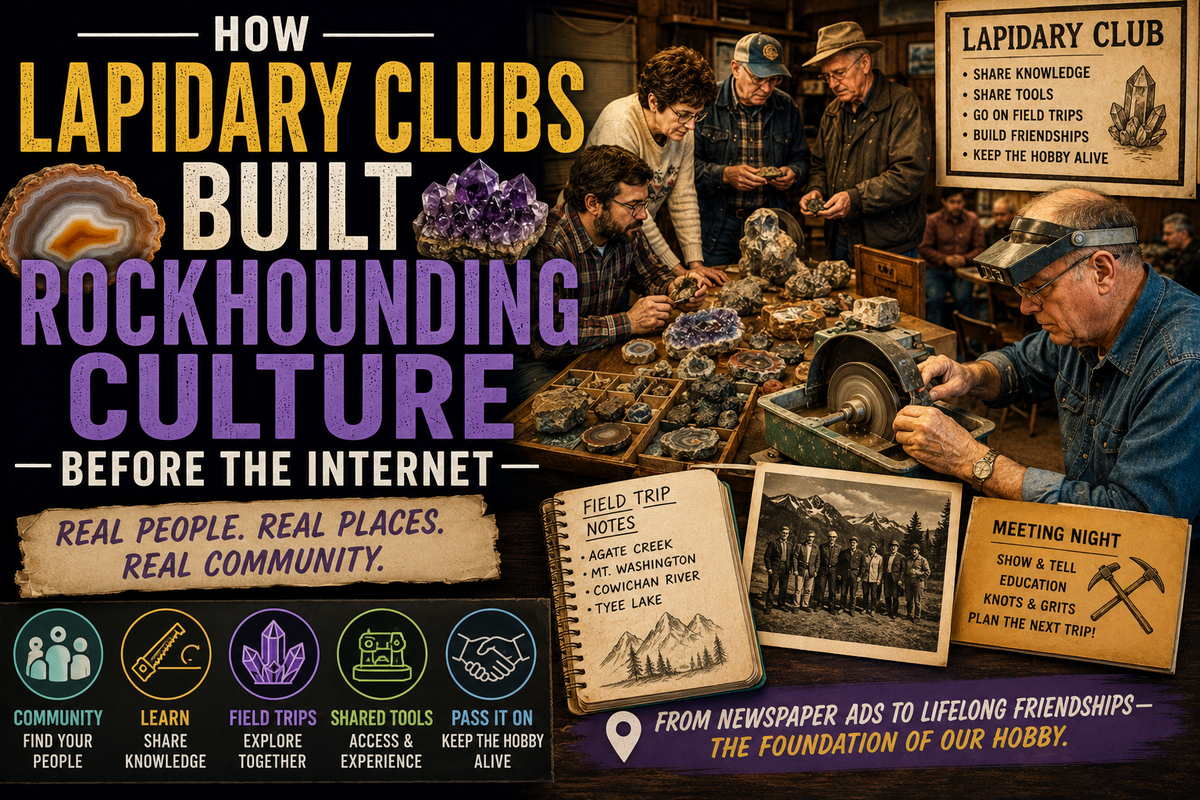
For a long time, lapidary clubs were not just hobby groups. They were the search engine, the YouTube channel, the tool library, the community college class, the field-trip network, the gem show committee, and the social club all in one.
They were how rockhounds found each other.
The World That Made Lapidary Clubs Necessary
Lapidary clubs made sense because the hobby had real barriers.
A person could go outside and pick up rocks for free, but that was only the beginning. To do anything serious with those rocks, they needed knowledge and equipment. They needed to know what they had found. They needed to know whether it was worth cutting. They needed saws, grinders, polishing wheels, dop wax, grit, belts, safety instruction, and someone willing to explain why the first stone they cut fell apart.
Most people could not build a full lapidary shop at home. Even today, a decent setup takes space, money, water, noise tolerance, and a willingness to cover yourself in mud. In the 1950s and 1960s, that problem was even more obvious. Shared club equipment made the hobby possible for people who could not otherwise afford it.
The club solved the problem.
A beginner could join, attend a meeting, ask questions, go on field trips, learn from older members, use shared equipment, and eventually produce something worth showing. That matters. It turned rock collecting from a private curiosity into a public craft.

British Columbia’s Lapidary Story Started With a Newspaper Ad
The origin story of organized lapidary culture in British Columbia is almost perfect because it shows how different the world was.
In February 1952, 85 people responded to a newspaper ad and met at the Geology Hut at the University of British Columbia to form the Lapidary Club of Vancouver.
That is worth sitting with for a second.
No Facebook event. No group chat. No email newsletter. No website. A newspaper ad. A room. People physically showing up because they were curious about rocks, minerals, gemstones, cutting, polishing, collecting, and learning from each other.
That was the beginning.
In 1953, members from Chilliwack and Hope formed the Fraser Canyon Jade and Rock Society. Early in 1955, the New Westminster Club formed. These clubs had similar problems and similar interests, so the need for a central organization became obvious. Representatives from the clubs met over the next two years to form a constitution and build the structure of a provincial society.
On December 23, 1955, the Lapidary, Rock & Mineral Society of British Columbia was incorporated. In 2002, the name changed to the British Columbia Lapidary Society.
The original mandate was broader than simply cutting stones. The society existed to promote the study, collecting, cutting, polishing, and engraving of gemstones, minerals, rocks, and other geological materials. It also existed to encourage exploration of British Columbia for lapidary materials and to improve the exchange of information between rock hobbyists and lapidary groups.
That tells us something important.
The BC lapidary movement was not only about making pretty cabochons. It was about field collecting, education, geology, exploration, craftsmanship, and building relationships between clubs.
It Was Never Just One Hobby
People often use “rockhounding” as if it means one thing. It does not.
Inside the old club world, several related hobbies overlapped:
There were people who loved mineral specimens. They cared about crystal form, locality, rarity, matrix, condition, and display quality.
There were lapidary people. They cared about how a rock cut, whether it held together, whether it took a polish, whether it undercut, whether it had pattern, colour, translucency, and toughness.
There were field collectors. They cared about maps, roads, gravel bars, mines, quarries, old reports, local rumours, and whether the weather would ruin the trip.
There were jewellery makers. They cared about silverwork, settings, soldering, wirework, findings, and wearable finished pieces.
There were fossil people. They cared about preservation, formation, age, locality, and ethical collecting.
There were micromount collectors. They cared about tiny crystals most people would miss entirely.
There were practical prospectors. They cared about claims, showings, gold, base metals, industrial minerals, and the kind of geological clues that might mean something economic.
A good club could hold all of those people in the same room. That was part of its power.
The old lapidary world was not as sharply divided as the modern online world. Today, algorithms split people into niches. Back then, the club meeting forced overlap. The person cutting agate might sit beside the person collecting zeolites, who might sit beside the retired prospector, who might sit beside the silversmith, who might sit beside the kid who just wanted to know why one rock was magnetic.
That mixture created better hobbyists.
Clubs Were Social Infrastructure
This is the part people miss.
Lapidary clubs did not grow only because people liked rocks. They grew because people used to socialize through hobbies.
Before cell phones, streaming, social media, and endless online distraction, people had to leave the house to participate in a hobby community. They joined bowling leagues, garden clubs, camera clubs, model railway clubs, ceramics classes, woodworking groups, quilting circles, ham radio clubs, naturalist societies, scouts, 4-H, night-school classes, and lapidary clubs.
That was normal civic life.
A hobby was not just something you consumed alone. It was something you practiced with other people. You went to meetings. You volunteered. You brought coffee. You helped set up tables. You listened to a guest speaker. You entered a display. You learned from someone older. You taught someone younger. You paid dues. You swept the workshop floor. You drove in a convoy to a collecting site. You came home tired with a bucket of rocks and a better sense of belonging than you had before.
That is difficult to recreate online.
The internet can distribute information faster than any club ever could, but it does not automatically create commitment. A club asks something from you. You have to show up. You have to participate. You have to be useful eventually. That is why clubs mattered.
Why Community Centres, Schools, and Halls Became the Natural Home
Lapidary clubs often ended up in community centres, schools, recreation halls, fairgrounds, church basements, and public meeting rooms because those were the natural gathering places of civic life.
The relationship made sense.
The community had space. The club had volunteers, equipment, knowledge, and programming. Members paid dues. Workshops generated modest income. Shows, raffles, auctions, tailgate sales, and donations helped support the organization. Municipal recreation systems and night-school programs gave people a way to learn practical skills outside formal university education.
British Columbia’s own lapidary history shows this clearly. The BCLS was initially responsible for organizing a prospectors course at Vancouver’s Night School in 1959. That is not a small detail. It shows that lapidary and rockhounding sat somewhere between recreation, adult education, earth science, and practical field skill.
This was not just a few people polishing rocks in isolation. It was a form of public education.
The Newsletter Was the Internet Before the Internet
The club magazine and bulletin mattered more than modern readers may understand.
Before websites and social media groups, a printed bulletin carried the network. It told members about meetings, field trips, shows, club elections, safety concerns, collecting ethics, new discoveries, equipment, workshops, obituaries, dealer ads, and technical information.
In BC, plans for a yearbook became a Quarterly Bulletin, first issued in November 1956. In 1960, that bulletin became The Canadian Rockhound, described by the BCLS as the first Canadian magazine of its kind. Later, the society published The British Columbia Rockhounder Magazine.
That publication history tells us the hobby needed more than meetings. It needed memory.
A club magazine preserves the culture of a hobby. You can open old issues and see what people cared about: summer camps, gold rush history, quartz discoveries, prospecting stories, gemstone identification, jewellery tips, club shows, field-trip reports, lapidary methods, dealer ads, volunteer messages, and reminders not to ruin collecting sites for everyone else.
That last point matters.
One recurring message in old rockhound culture is etiquette. Take only what you can use. Respect landowners. Do not destroy sites. Do not leave trash. Do not be the person who gets access closed for everyone else.
That message still needs repeating because the basic problem has not changed. A good location can be wrecked by selfish collectors. Once that happens, access disappears.
Field Trips Were the Main Attraction
For many people, field trips were the reason to join.
A person could read about rocks in a book, but that did not teach them how to find material in the real world. The field is different. Out there, rocks are dirty, fractured, weathered, covered in moss, half-buried in creek beds, mixed into talus, or hidden in roadcuts. Beginners do not know what to look for. They need someone to point and say, “That is the material. That is waste. That is the contact. That is float. That is not worth carrying.”
That kind of learning is hard to get from a screen.
Club field trips also made collecting safer and more organized. People could share rides, tools, maps, food, campsites, local knowledge, and physical effort. Older members could teach etiquette. New members could learn what a realistic day looked like. Sometimes you found something. Often you did not. Either way, the field trip turned failure into education instead of isolation.
British Columbia was especially suited to this kind of culture because the province is physically large, geologically varied, and full of difficult access. Roads, logging routes, mines, rivers, gravel bars, quarries, mountain passes, and remote camps all shaped how rockhounds learned the province.
The annual Rockhound Rendezvous began in Kamloops in 1958. Summer camps developed throughout the province. The BCLS history even notes that some areas enjoyed by rockhounds later were a direct result of those camps.
That is an important idea: organized trips did not just use collecting knowledge. They created it.
Gem Shows Grew Out of Club Culture
The public-facing side of the hobby became the gem and mineral show.
The first BCLS-sponsored Gem and Mineral Show was held in February 1958 at the B.C. Building in Exhibition Park. Over time, the BC Gem Show became one of the major events of its kind.
Shows were not only sales events. They were education, display, competition, recruitment, and social gathering.
A show gave clubs a reason to organize. Members could display their best work. Dealers could sell tools, rough, books, slabs, finished stones, jewellery, mineral specimens, fossils, and equipment. Demonstrators could show how stones were cut, polished, wrapped, set, carved, or faceted. Beginners could walk in with curiosity and leave with a club brochure, a rock hammer, a bag of rough, and a new problem: now they wanted to know more.
Modern gem shows still carry this DNA, even when the commercial side is more obvious. A good show is still a meeting place between collectors, cutters, dealers, teachers, and the public.
What About County Fairs and Rock Collection Contests?
There is a connection, but it is not always documented neatly.
County fairs, youth programs, school science fairs, 4-H geology projects, and public exhibitions helped normalize the idea that rocks could be collected, labelled, judged, and displayed. A good rock collection was not just a box of stones. It was organized. It had names, localities, categories, and some explanation of why the specimens mattered.
That display culture naturally fed into gem and mineral shows.
A fair display might reward a young collector for assembling and labelling rocks. A club show could take that same instinct and make it more serious: better cases, better labels, better specimens, better lapidary work, better judging standards, and more specialized audiences.
So what happened to rock collection contests?
They did not disappear completely, but they lost their place in general public life.
Part of that is because county fairs changed. Many became more focused on rides, food, vendors, livestock, entertainment, and commercial attractions. Part of it is because schools and youth programs moved away from specimen-based natural history. Part of it is because land access, liability, and safety became more complicated. Part of it is because the hobby aged. And part of it is because the specialized gem show absorbed much of that function.
The rock collection contest did not die as much as it migrated. It moved from the county fair table into club showcases, federation competitions, judged displays, educational cases, museum partnerships, and gem show exhibits.
But something was lost in the process. The average child is less likely now to be publicly rewarded for building a rock collection, labelling it properly, and explaining what each specimen is. That matters because display forces discipline. It teaches that collecting is not just possession. It is observation, classification, memory, and communication.
The Craft Side Was Always There
Lapidary clubs were not only about finding rocks. They were about transforming them.
That transformation is what separates lapidary from casual collecting. A collector may pick up an interesting stone and put it on a shelf. A lapidary looks at the same stone and asks different questions.
Will it cut?
Will it fracture?
Where is the pattern?
Is there a face in this stone?
Will it undercut?
Will it take polish?
Should it become a cabochon, a slab, a pendant, a carving, a display face, or nothing at all?
That kind of thinking requires practice. You learn it by ruining stones. You learn it by listening to people who have already ruined more stones than you have. You learn it by watching a saw reveal what the outside of the rock refused to tell you.
That is why shared workshops were so important. They gave beginners access not only to equipment, but to judgment.
The old club world also overlapped with silversmithing, wirework, faceting, carving, fossil preparation, and specimen cleaning. You can see that mixture clearly in old club publications and show culture. The hobby was not cleanly separated into “geology” and “jewellery.” It lived between them.
Clubs Also Protected Knowledge
Old rockhounding knowledge was often local, fragile, and easy to lose.
A collecting site might be known by an old road name that no longer exists. A mine might be remembered by a retired member who went there in the 1960s. A gravel bar might be productive only after the right flood. A jasper locality might be described by landmarks that are gone now. A fossil site might be closed. A road might be deactivated. A quarry might have changed owners. A once-common collecting spot might now be private, protected, developed, or exhausted.
Clubs preserved some of that knowledge through field-trip reports, newsletters, meeting talks, maps, and oral memory.
The internet gives the illusion that all knowledge has been preserved. It has not. A lot of rockhounding knowledge lived in people, and when those people passed away without writing it down, the knowledge went with them.
That is one reason old club bulletins and magazines matter. They are not just nostalgic. They are records of where people went, what they found, what they thought was worth teaching, and how the hobby actually functioned.
The Demographic Shift
The demographic story is complicated, but the broad shape is clear.
Lapidary clubs historically attracted families, retirees, tradespeople, amateur naturalists, prospectors, teachers, hobby jewellers, and people who liked practical crafts. Some clubs also had youth programs or junior members. In many cases, retired people were the backbone because they had time, patience, tools, and experience.
Over time, many clubs aged.
That happened across many civic hobbies, not only lapidary. The same pattern affected model railways, ham radio, stamp collecting, local history groups, garden clubs, camera clubs, and service clubs. Younger people did not stop needing meaning, skill, or community. They just found different places to look for it.
The internet changed the first step. A beginner no longer had to join a club to get basic information. They could watch videos, order tools online, buy rough from anywhere, and learn alone.
But learning alone has limits.
You can watch someone cut a stone online, but the video does not feel the vibration in your hands. It does not smell the overheated wheel. It does not notice that you are pushing too hard. It does not tell you that your “jade” is serpentine, your jasper is undercutting, your quartz is fractured, your cab is too flat, or your polish problem started three sanding stages ago.
A club can do that.
Why Clubs Matter More Now, Not Less
Modern people are drowning in information and starving for competent feedback.
That is the real argument for lapidary clubs today.
The old reason to join a club was access to information, equipment, and people. That is still true, but the deeper reason has changed. Today, clubs matter because they force people back into reality.
Stone cutting is physical. Rockhounding is physical. Display is physical. A field trip has weather, distance, weight, mud, bugs, bad roads, broken tools, and disappointment. A cabochon has consequences. You either shaped it well or you did not. You either removed the scratches or you left them. You either understood the material or the material taught you the hard way.
That is valuable now.
A person can spend all day online collecting opinions and still not build a skill. Lapidary does not reward opinion. It rewards attention, patience, pressure control, sequencing, observation, and the humility to let the stone tell you what it can become.
That is why the club model still has power. It gives people a way to be around others who are practicing something real.
The Internet Did Not Replace Clubs. It Replaced the Weak Parts.
It is easy to romanticize the old club world. That would be a mistake.
The internet improved many things. It made information easier to find. It made maps better. It made identification resources more available. It allowed isolated hobbyists to learn without waiting for a monthly meeting. It gave people access to global materials, online lectures, digital archives, satellite imagery, geological databases, and videos of techniques that used to be hard to see unless someone local could teach them.
That is good.
But the internet mostly replaced the weak parts of clubs: slow communication, limited access to basic information, dependence on whoever happened to be in your town, and the difficulty of finding entry-level explanations.
It did not replace the strongest parts.
It did not replace shared equipment. It did not replace field mentorship. It did not replace club shows. It did not replace the discipline of display. It did not replace old local knowledge. It did not replace the value of standing beside someone at a machine while they show you what you are doing wrong.
The best future for lapidary is not online or offline. It is both.
Use the internet for research. Use clubs for reality.
British Columbia’s Club Legacy
British Columbia’s lapidary clubs were built around a province that rewards curiosity but punishes laziness.
The geology is rich, but not simple. Access can be difficult. Many good collecting areas are remote. A beginner can waste a lot of time chasing rumours, bad directions, exhausted sites, misidentified rocks, or legal problems. Clubs helped people navigate that.
They also helped give BC rockhounding a public identity.
The BCLS and its clubs helped organize shows, camps, field trips, publications, zones, education, and provincial advocacy. Club members played a role in getting jade declared British Columbia’s provincial stone in 1968. The society joined national and outdoor recreation organizations to give rockhounds a broader voice.
That is more than hobby administration. That is institution-building.
The people who built these clubs were not just collecting rocks. They were building a structure that allowed other people to collect, cut, learn, display, and belong.
What Was Lost
Some of the old culture has weakened.
Fewer people grow up making things with their hands. Fewer kids are taught to collect, label, compare, and display natural objects. Fewer families organize their social lives around clubs. More collecting locations have access restrictions. More people expect instant coordinates instead of learning how to research. More beginners want certainty before they have earned judgment.
That is the cost of convenience.
The old club system had flaws, but it taught patience. You had to attend. You had to listen. You had to learn from people. You had to wait for trips. You had to read bulletins. You had to look at maps. You had to build trust before someone showed you a good location.
That slower process filtered people. Not perfectly, but usefully.
Today, information moves faster than responsibility. That is why collecting ethics matter more than ever. A single careless video, post, or coordinate dump can send too many people to a fragile place. A good club teaches restraint. It teaches that access is earned and can be lost.
What Still Matters
The best parts of lapidary club culture are still relevant:
Show up.
Learn from people who know more than you.
Share tools.
Respect collecting sites.
Do not take more than you can use.
Label your material.
Teach beginners.
Volunteer.
Display your work.
Keep records.
Preserve local knowledge.
Understand that the hobby is bigger than your own collection.
That sounds old-fashioned because it is. But old-fashioned does not mean obsolete. Some things last because they solve permanent human problems.
People still need skill. They still need community. They still need mentors. They still need standards. They still need a reason to leave the house and do something real with their hands.
Lapidary clubs were built for that.
The Real Lesson
The history of lapidary clubs is not just a story about rocks. It is a story about how people used to build community around shared difficulty.
A rough stone does not become polished because someone likes it. It becomes polished through sequence, pressure, patience, correction, and time. The same thing is true of a hobby culture.
British Columbia’s lapidary clubs began with people answering a newspaper ad and showing up in person. From there came clubs, a provincial society, bulletins, shows, camps, field trips, night-school courses, workshops, displays, advocacy, and generations of people who learned to see the province differently.
Before the internet, clubs were how rockhounds found each other.
Now, they may serve a different purpose. They remind people that not everything worth learning can be downloaded. Some knowledge has to be handled, cut, ruined, corrected, polished, and passed across a bench from one person to another.
By Adam Kelliher