


By Adam Kelliher
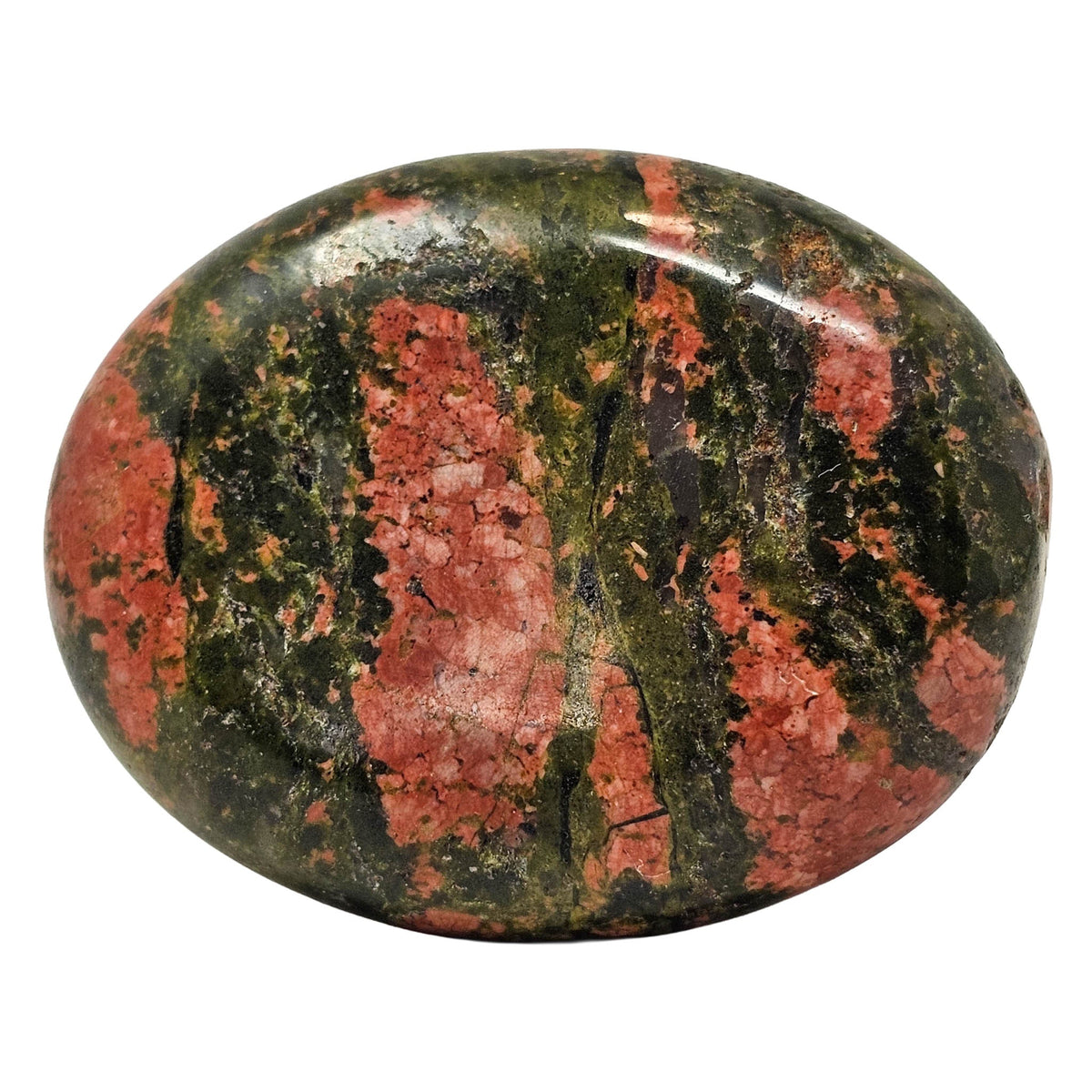
The short answer: unakite is not a mineral. It's an altered granite: pink potassium feldspar, green epidote, and usually colourless quartz. Hot water worked through the rock; the calcium-bearing feldspar and the dark minerals were replaced by epidote, the pink feldspar stayed (its colour coming from tiny hematite inclusions), and the quartz was left alone.[1]
Pink plus green is what survived plus what replaced it.
An altered granite, named for the Unakas
The Geological Survey of Western Australia defines unakite as epidote-rich hydrothermally altered granite, first described from the Unaka Mountains of North Carolina, "essentially an altered granite composed of pink orthoclase feldspar, green epidote, and typically, colourless quartz."[1]
Bradley proposed the name in 1874 for a granitic rock from the Great Smoky Mountains, part of the Unaka range, with specimens from Cocke County, Tennessee and Madison County, North Carolina. He described granite in which mica or hornblende had been replaced by epidote, with orthoclase in various shades of pink.[4]
Epidote itself forms as a secondary mineral, including by alteration of plagioclase (saussuritization). Hardness 6–7.[1][6] That, plus the granite framework, is why unakite takes a polish and holds up as a decorative stone.

The Blue Ridge story
Virginia's state geology agency treats unakite as a metamorphic rock formed when granite is exposed to elevated temperatures and hydrothermal fluids, and notes that in Virginia it occurs in the Blue Ridge Province, including as rounded cobbles in Blue Ridge rivers.[2] A University of Maryland senior thesis summarises the prevalent Blue Ridge idea: alteration of about 1.0-billion-year-old charnockite basement by hydrothermal fluid associated with the Neoproterozoic Catoctin basalt flows. The epidote is entirely secondary; biotite, pyroxene and hornblende from the parent rock were consumed to make it.[3]
Unakite has also been described from Finland and India, and Western Australia records a few minor occurrences. Commercial production is listed from Virginia, South Africa, Sierra Leone, Brazil and China.[1][3][7]
We stock unakite tumbles, palm stones and tetradecagons. Some of those listings give Ontario as the source. I haven't seen a geological paper confirming that locality, so I'll leave it as the shop label rather than a field fact. For the rock-versus-mineral distinction, see Rock vs Mineral vs Crystal.
See what's new: browse our newest arrivals for the latest pieces added to the shop.
Sources
- Fetherston, J.M., Stocklmayer, S.M. & Stocklmayer, V.C. 2017. Gemstones of Western Australia, 2nd ed. GSWA Mineral Resources Bulletin 25, ch. 30 (epidote group).
- Virginia Energy, Geology and Mineral Resources: Rocks of Virginia, "Unakite".
- Councell, L. 2016. Hydrothermal formation of unakite in the Blue Ridge Mountains, Virginia: a geochemical analysis. University of Maryland GEOL394 senior thesis.
- Bradley, F.H. 1874. American Journal of Science 3rd ser. 7: 519–520, as quoted in later unakite literature.
- Phalen, W.C. 1904. A new occurrence of unakite: a preliminary paper. Smithsonian Miscellaneous Collections 45.
- Handbook of Mineralogy: Epidote.
- Geology.com. Unakite (secondary).