


By Adam Kelliher
The short answer: "garnet" is a family, not one mineral. The IMA recognises 32 species that share the garnet crystal structure. The gem trade then adds variety names — rhodolite, hessonite, malaia, melanite, tsavorite, demantoid — that describe colour ranges within or between species. The public star-garnet dig at Emerald Creek, Idaho, closed early in 2026 after its supply of excavated material ran out.[1][3][4][9]
If you only remember one thing: the species tells you the chemistry; the trade name tells you the colour.
One structure, many names
The garnet supergroup includes every mineral with the garnet structure, whatever elements fill its sites. Most are cubic. The 2013 IMA report listed 32 approved species, and it discourages the old "pyralspite" and "ugrandite" labels as formal species or series names.[1]
GIA's gem classification works from refractive index, colour and spectrum, and groups gem garnets as grossular, andradite, pyrope, pyrope-almandine, almandine, almandine-spessartine, spessartine and pyrope-spessartine.[2] Typical properties: refractive index about 1.714–1.888, specific gravity 3.47–4.15, hardness 6.5–7.5.[3]
The trade names sit on top of that:
- Rhodolite: slightly purplish red to red-purple pyrope-almandine.[2][4]
- Hessonite: orange, cinnamon-brown or pinkish grossular.[4]
- Tsavorite: dark green grossular.[4]
- Melanite: black titanium-bearing andradite.[4]
- Demantoid: rich green andradite.[4]
- Malaia (also spelled malaya): a trade name for pyrope-spessartine in red, orange, peach or pink.[2][4]
Hessonite and spessartine often show eye-visible inclusions; almandine, pyrope and rhodolite usually don't.[3] The old line that "garnet comes in every colour except blue" is outdated: pyrope-spessartine from near Bekily, Madagascar, can be blue-green in daylight and purple in incandescent light, mainly from vanadium.[5]

Star garnet, and the Emerald Creek closure
Idaho's star garnets are almandine-pyrope. The star comes from needles of rutile: four-ray stars have needles along one set of directions; six-ray stars have two. Four-ray stars are the more common.[6][8] Idaho made the star garnet its state gemstone in 1967. The stones weather out of mica-garnet schist; the gravels were mined for abrasive garnet from the 1940s through the 1980s.[7]
The U.S. Forest Service page for the Emerald Creek Garnet Area, updated 9 July 2026, says the area closed early in 2026 because its supply of excavated material ran out. India is the only other place the Forest Service lists as producing star garnets in any quantity.[9] Whether the Idaho site will reopen isn't stated.
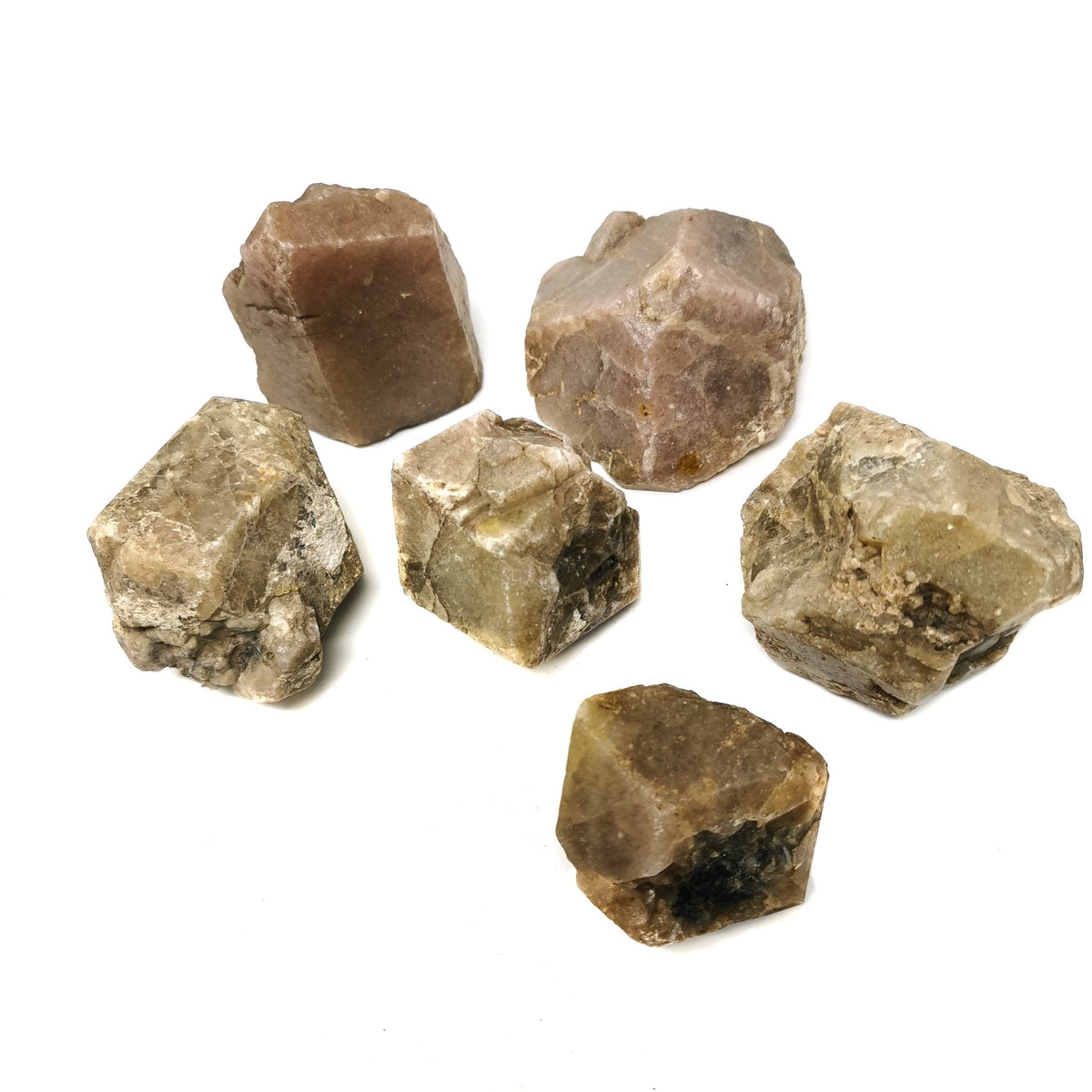
In the shop you'll find rhodolite specimens, grossular from Coahuila, andradite and andradite with epidote from Imilchil, melanite from Mali, tsavorite facets, and Idaho star garnet rough.
See what's new: browse our newest arrivals for the latest pieces added to the shop.
Sources
- Grew, E.S., Locock, A.J., Mills, S.J., Galuskina, I.O., Galuskin, E.V. & Hålenius, U. 2013. Nomenclature of the garnet supergroup. American Mineralogist 98(4): 785–811.
- Stockton, C.M. & Manson, D.V. 1985. A Proposed New Classification for Gem-Quality Garnets. Gems & Gemology.
- GIA. Garnet (facts and quality factors).
- USGS. Gemstones: Garnet (Special Publication 14-95).
- Schmetzer, K. & Bernhardt, H.-J. 1999. Garnets from Madagascar with a Color Change of Blue-Green to Purple. Gems & Gemology, Winter 1999.
- The origin of asterism in almandine-pyrope garnets from Idaho. Journal of Materials Science, 2006.
- Geology.com. Idaho Gemstones.
- Idaho State Department of Education. Star Garnet.
- USDA Forest Service. Emerald Creek Garnet Area, Idaho Panhandle National Forests (page updated 9 July 2026).