


By Adam Kelliher
Updated October 18, 2026
Ammolite is the one gem that makes even jaded rock people stop and tilt their heads. Red flips to green, green to blue, and it looks almost electric. It also comes with more nonsense attached than almost any stone I sell, so this post sticks to what the gemmologists actually measured. No feng shui, no "energy," just shell, time and physics.
What ammolite actually is
Ammolite is a trade name for the iridescent, nacreous shell layer of fossil ammonites from southern Alberta. It's a form of aragonite. Commercial gem material comes from just two extinct species, Placenticeras meeki and P. intercalare, and only from certain horizons of the Late Cretaceous Bearpaw Formation, about 70 to 75 million years old.[1]
Ammonites turn up in Bearpaw outcrops all over southern Alberta, but commercial quantities come from the St. Mary River area southwest of Lethbridge.[1][2] The miners recognise two main gem horizons, the K Zone and Zone 4, and they produce two looks: fractured ammolite, where the shell was crushed and the cracks healed naturally with carbonate or clay into a stained-glass pattern, and sheet ammolite, with bigger, calmer panes of colour.[1][2]

Why it didn't turn into plain white calcite
This is the part I find wild. Aragonite is the less stable form of calcium carbonate. Give it tens of millions of years and you'd expect it to turn into calcite. In the weathered top few metres of the Bearpaw, where it meets glacial or river deposits, that's exactly what happened: the shells became white "calcified ammonite," which has no gem value.[1]
Deeper down, the aragonite never converted, which is the only reason ammolite exists at all. Earlier researchers suggested that iron and magnesium in the Bearpaw may have helped block the conversion, but that's an explanation they proposed, not a settled fact.[1] For scale, the Bearpaw at the St. Mary River mine sites is 232 metres of dark marine shale with numerous volcanic-ash (bentonite) layers.[1]
Where the colour comes from
For years people argued whether ammolite colour was interference (like a soap bubble) or diffraction (like the grooves on a CD), without much evidence either way. Mychaluk and co-authors measured the light reflected from yellow-green sheet ammolite and found a band centred at about 568 nanometres. That fits interference from multiple aragonite layers of uniform thickness, and their electron images showed those uniform layers, with no diffraction-grating grooves.[1]
Thicker or thinner layers shift the colour. That's why one piece can run through the spectrum as you tilt it.
Gem facts worth knowing before you buy
- It's soft. Hardness about 3.5. Red ammolite is relatively tough, but blue and purple are brittle.[1]
- Colour rarity: red and green are most common, blue is rare, and purple is extremely rare.[1]
- It's thin. The iridescent layer is 0.5–8 mm in the rough and often just 0.1–3 mm after polishing.[1]
- Most finished ammolite is assembled. Because the layer is so thin and fragile, most stones are sold as triplets (a thin ammolite layer with a dark backing and a clear cap of synthetic spinel or quartz) or doublets (backing, no cap). Solid pieces exist too.[1]
- Stabilisation is common for some types. Impregnating sheet ammolite with epoxy or a similar material is usually required to make it into solids or doublets, while fractured K Zone material rarely needs it.[1]
So my honest advice: ask whether a piece is solid, doublet, triplet or stabilised. A good seller will tell you without flinching, and none of those is a scam as long as it's disclosed.
A young gem with a short paper trail
Alberta ammonites that yield ammolite were recognised from samples as far back as 1908, but the first recorded use of the shell as a gem was in 1962, by amateur lapidaries at a gem show in Nanton, Alberta. Calgary jeweller Marcel Charbonneau introduced the name "Ammolite," and in 1981 the CIBJO Coloured Stones Commission recognised Ammolite as a permitted name for a variety of aragonite.[1] By 2009, Mychaluk's update listed Korite and the Aurora Ammolite mine as the two fully mechanised open-pit operations, with Blood Tribe members also collecting rough from cliffs on reserve land along the St. Mary River.[2]
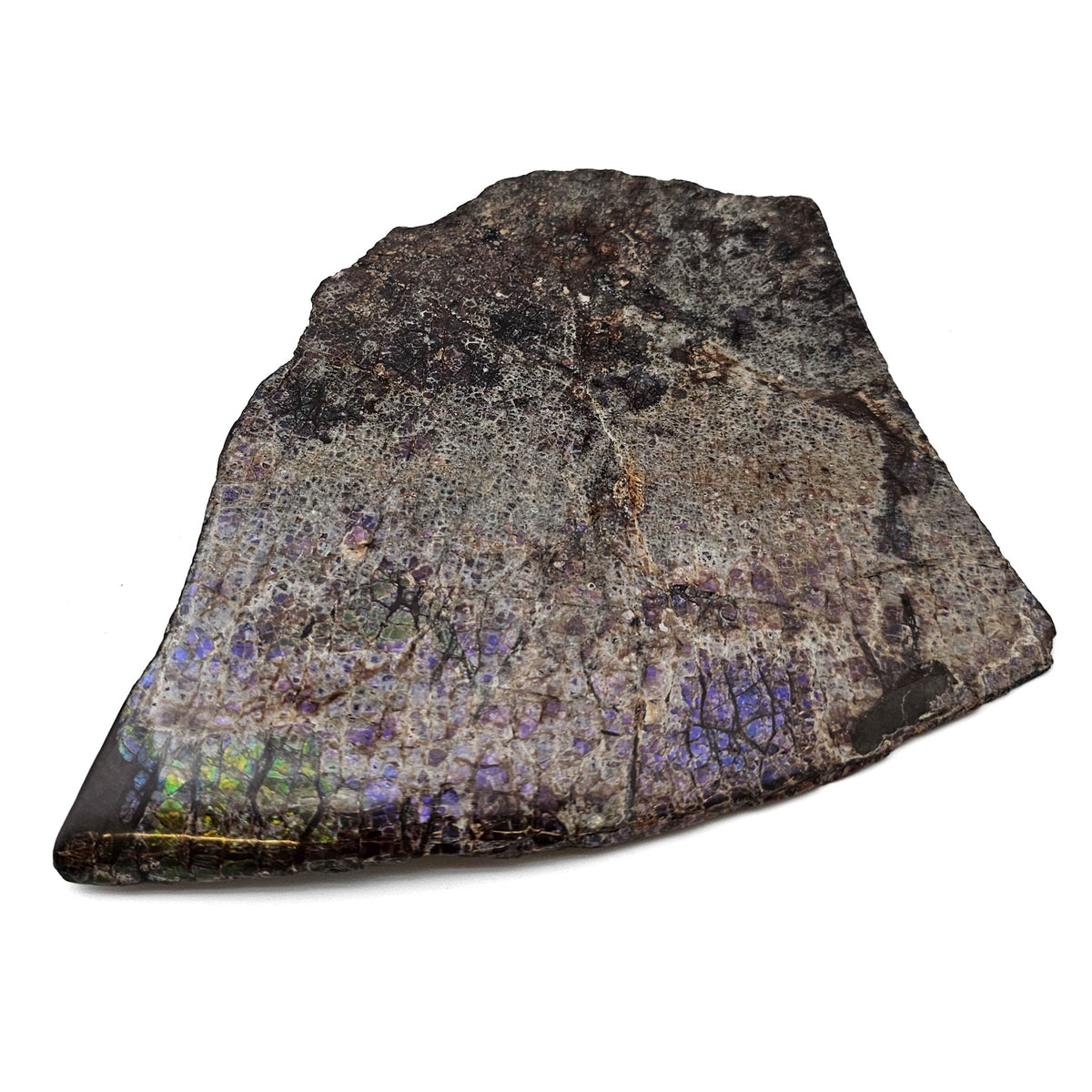
Want to see the real thing in the matrix it came from? We have a Bearpaw Formation ammolite specimen from the Lethbridge area.
References
- Mychaluk, K.A., Levinson, A.A. and Hall, R.L. 2001. Ammolite: Iridescent fossilized ammonite from southern Alberta, Canada. Gems & Gemology 37(1): 4–25. doi:10.5741/GEMS.37.1.4 (PDF)
- Mychaluk, K.A. 2009. Update on Ammolite production from southern Alberta, Canada. Gems & Gemology 45(3): 192–196. GIA (PDF)