


By Adam Kelliher
Updated October 18, 2026
Driving through Kamloops country in August, it's hard to picture a damp forest with palms in it. But the fossil leaves at McAbee, east of Cache Creek, say that's roughly what was here about 53 million years ago. I love this site because it shows how much a pile of old leaves can tell you, as long as you know exactly where each one came from.
Quick note up front: McAbee is a protected provincial heritage site. We don't sell McAbee fossils, and you can't collect there. More on that below.
The Okanagan Highlands, 53 million years ago
McAbee is one of a string of Early Eocene fossil lake beds in the BC Interior and Washington that researchers group as the Okanagan Highlands. These sites are reconstructed as upland forests at elevations of roughly 0.8–1.3 km or higher, which sets them apart from the warmer lowland floras of the same age on the coast.[1] Most BC Eocene lake deposits are now thought to be about 50–52 million years old.[2]
McAbee itself is a roughly half-kilometre outcrop of lake shale layered with volcanic ash. Argon dating of that ash gave an age of 52.9 ± 0.83 million years.[1] A 2009 survey for the Province described "a diverse and abundant warm temperate flora and fauna of modern aspect" living around an ancient lake there.[3]
Reading climate from leaf shape
Here's the clever bit. Leaf shape tracks climate: in warm places, more tree species have smooth leaf edges, and in cooler places more have toothed edges. Botanists have turned that into statistical methods. Gushulak, West and Greenwood ran two of them on 43 types of flowering-plant leaves from two older McAbee collections.[1]
Their combined results point to a mean annual temperature of about 8–13 °C, a cold-month mean around 5 °C, and more than 100 cm of rain a year.[1] For comparison, the same paper cites modern normals of 28 cm a year at Kamloops, 32 cm at Merritt and 35 cm at Princeton.[1] So: milder winters and three or four times the rain.
Wet, but not monsoonal
A big question for the Eocene is whether places like this had monsoons, with most of the rain in one season. At McAbee the answer looks like no. The wettest part of the year got about 50% of the total precipitation, under the 70% threshold the authors use for a monsoon climate. They describe it as summer-wet but non-monsoonal.[1]
There's a friendly argument about winters, too. Palms and palm-seed beetles have been reported from McAbee, and an earlier study used them to argue for cold-month temperatures above 8 °C. Gushulak and co-authors say revised palm cold limits allow a cold-month range of 4.3–8.5 °C, which fits their own ~5 °C estimate.[1]
Why provenance matters (a lesson for every collector)
The researchers point out that neither old McAbee collection was gathered layer by layer. Some came from scree and small benches, and later material came from cut faces above a bulldozed road. Because the plants change from layer to layer, they recommend future climate work use samples "collected within a stratigraphically constrained quarry area" so you get a snapshot in time rather than a blur.[1]
That's the same reason I harp on labels in the shop. A fossil with no locality or layer information has lost most of its story.
McAbee is protected: look, don't take
The Province designated the McAbee fossil beds as Provincial heritage property on July 19, 2012, after the 2009 survey. The government says the designation was to prevent further scientific loss of specimens through commercial extraction. The heritage site covers 376 ha, and research or educational groups need authorization to go off-trail.[4][5] If you visit, check the site's current access rules first, stay on the trails, and leave everything where it is.
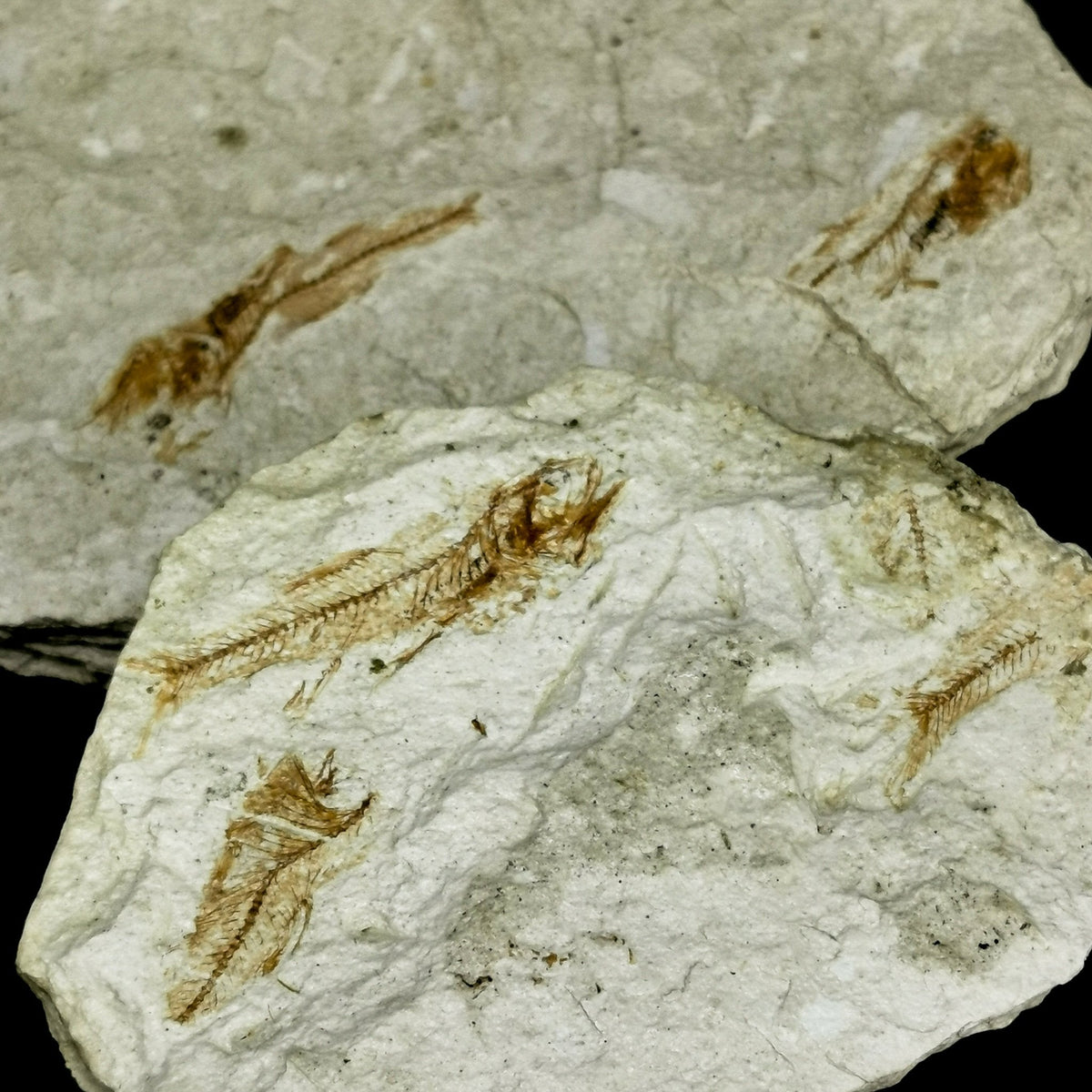
Elsewhere in BC, the Province's fossil page says recreational surface collecting of small amounts of common fossils with hand tools is allowed on Crown land (access is authorized under the Land Act permission policy), for personal use only, and not in parks or on private land. Significant fossils, like vertebrates, must not be collected, and fossils can't be sold or taken out of BC.[6] If you want a lake-bed fossil for your shelf, ours come from outside BC, like this stickleback fish fossil from Nevada.
References
- Gushulak, C.A.C., West, C.K. and Greenwood, D.R. 2016. Paleoclimate and precipitation seasonality of the Early Eocene McAbee megaflora, Kamloops Group, British Columbia. Canadian Journal of Earth Sciences 53. Accepted manuscript via University of Toronto TSpace. PDF
- Wilson, M.V.H. 2010. Three views of Eocene life in British Columbia. GeoCanada 2010 extended abstract. PDF
- Read, P.B. and Hebda, R. 2009. Geological Setting and Paleontology of the Fossiliferous Eocene Beds near McAbee, Southwestern British Columbia. Report for the BC Ministry of Agriculture and Lands, p. v. PDF
- Government of BC. McAbee Fossil Beds Heritage Site (last updated February 27, 2025). gov.bc.ca
- B.C. Reg. 219/2012 (Heritage Conservation Act, s. 23). BC Laws
- Government of BC. Fossil collection and use. gov.bc.ca