


By Adam Kelliher
Belemnites look like stone bullets, and for centuries people thought they were thunderbolts thrown from the sky. They're actually the back end of an extinct relative of squid.
The animal
Belemnites were cephalopods, closest to today's squid and cuttlefish. They had a squid-like body but, unlike squid, a hard internal skeleton. They lived through the Jurassic and Cretaceous and went extinct at the end of the Cretaceous, at about the same time as the dinosaurs.[1]

The bullet
The fossil you usually find is the rostrum, sometimes called the guard. It's made of fibrous calcite and probably acted as a counterbalance for the head and arms while swimming.[1] Rare finds show arm hooks and even ink sacs.[1]
Why geologists use them
- Tough: rostra survive where other fossils don't, even in metamorphic rock.[1]
- Current direction: lots of belemnites lined up in one direction show which way the old sea current flowed.[1]
- Ancient sea temperature: oxygen isotopes in the calcite are used to estimate how warm the water was.[1]
Battlefields
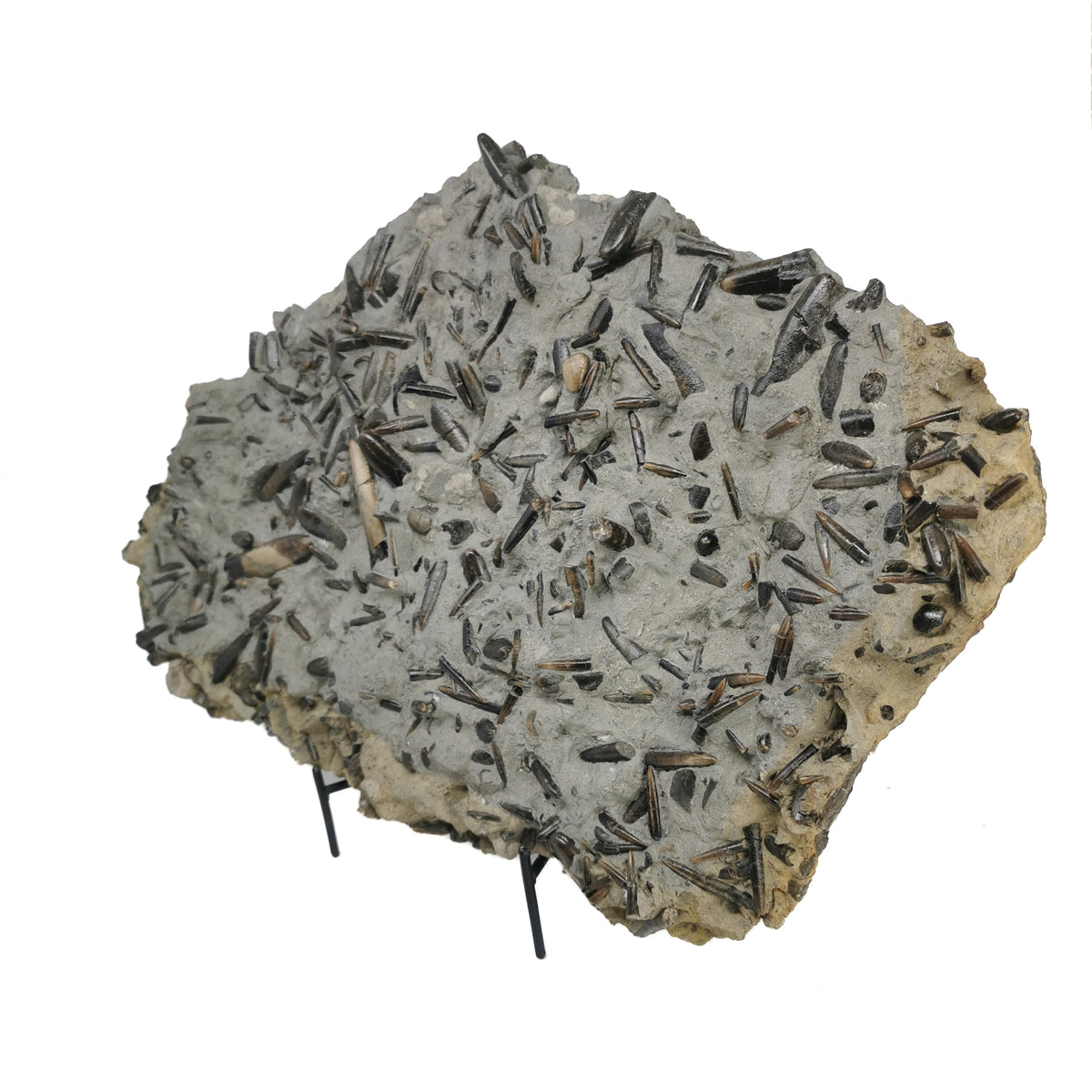
Mass accumulations are called belemnite battlefields. Some may be the result of mass death after mating, as happens in living squid.[1] Our belemnite plate from Germany is a nice example of a crowded bed.
For how belemnites fit with their shelled cousins, read Shell Evolution: From Orthoceras to Ammonites.
See what's new: browse our newest arrivals for the latest pieces added to the shop.
Sources
- British Geological Survey. Belemnites.
- Wilkin, J. 2022. Fossils explained 82: Belemnites. Geology Today.