


By Adam Kelliher
The short answer: chalcedony is the umbrella term for quartz made of microscopic crystals. Agate is translucent chalcedony, usually banded or patterned. Jasper is opaque, coloured by enough impurities that light can't get through.[1][2][3]
These three names cause more confusion at the counter than almost anything else, partly because people who should know better use them differently. Here's how it fits together, including where the experts disagree.
Chalcedony: the family name
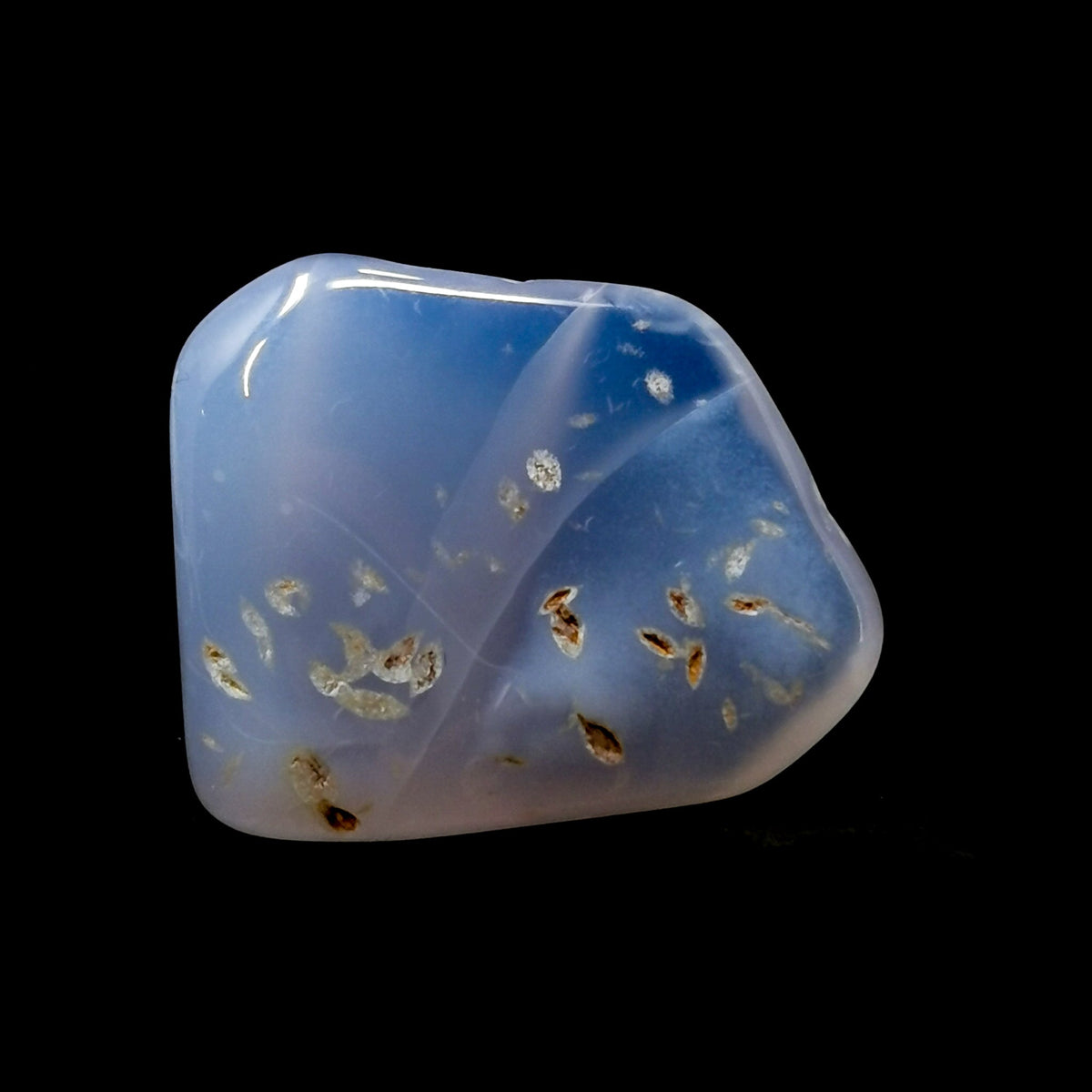
Quartz usually brings to mind clear six-sided crystals. Chalcedony is the same silicon dioxide, but as crystals too small to see without a microscope. GIA describes agate and jasper as varieties of chalcedony made of tiny quartz crystals invisible to the eye.[1] In the trade, plain translucent single-colour material, often white, grey or blue, is the stuff that gets sold simply as "chalcedony".[3]

Agate: translucent and patterned
Agate is translucent to semi-transparent chalcedony. Hold a thin piece to the light and light passes through.[2] It's usually banded, and the trade also calls patterned translucent material agate: moss, plume, dendritic.[2][3] More on that in how to identify agate.
Jasper: opaque
Jasper is opaque. Pure microcrystalline quartz lets some light through, and as impurities and other minerals build up, colour increases and translucency drops. Jasper has enough of them that no light passes.[2]

Where the definitions argue
Not everyone files jasper under chalcedony. In the strict scientific sense, chalcedony means fibrous microcrystalline quartz, and some mineralogists keep jasper and chert separate on that basis.[4] In the gem and lapidary trade, jasper is usually treated as part of the chalcedony family.[1][3] Both views are in use, so don't be surprised to see either. Where one stone has translucent and opaque zones, you'll also hear the trade name "jaspagate".[2]
The quick test
- Light passes through a thin edge, with bands or patterns: agate.
- Light passes through, even colour, no pattern: sold as chalcedony.
- No light at all: jasper.
Chalcedony and agate are both about 7 in hardness, so a scratch test won't separate them.[2][5] They all tumble and cab well, which is why they fill our opaque rough and tumbled stones.

See what's new: browse our newest arrivals for the latest pieces added to the shop.
Sources
- GIA: Gem Cutters Reveal the Beauty of Chalcedony.
- RockTumbler.com (Hobart M. King): The Difference Between Agate, Jasper and Chalcedony.
- International Gem Society: Chalcedony Value, Price, and Jewelry Information.
- The Quartz Page (quartzpage.de): Chalcedony.
- Mindat.org: Agate.