


By Adam Kelliher
The short answer: you can narrow down most rocks and minerals at home with seven simple tests: lustre, streak, hardness, cleavage or fracture, heft, magnetism and a vinegar fizz test. Colour is the least reliable clue, so use it last.[1][2]
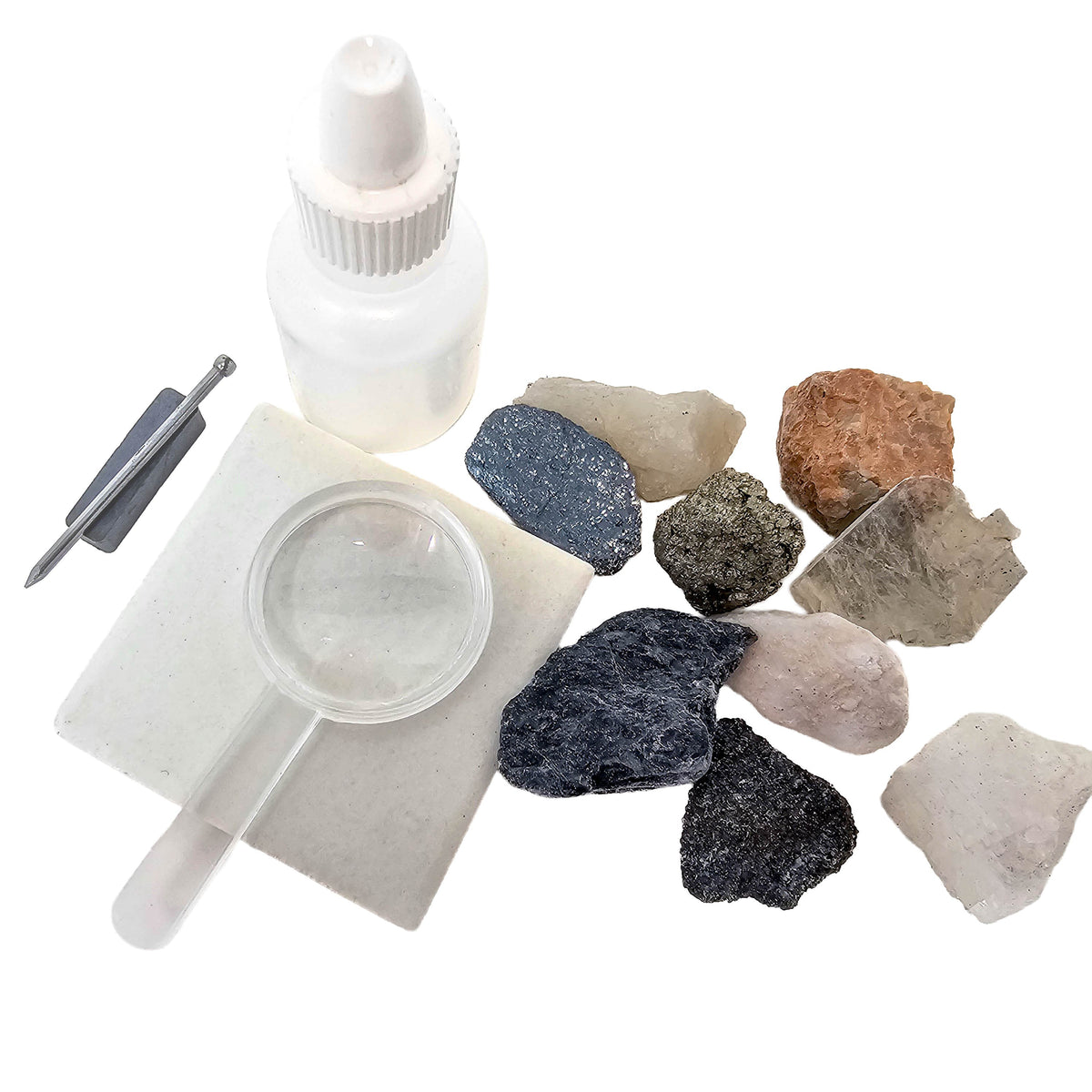
You'll need a white unglazed tile (the back of a bathroom tile works), a steel nail, a piece of glass, a copper coin, a fridge magnet or a small neodymium magnet, some white vinegar and a 10x loupe. Or grab a mineral test kit.
1. Lustre: how does it shine?
Look at a fresh surface in good light. Metallic (like pyrite or galena), glassy (quartz), pearly, greasy, silky or dull. Metallic versus non-metallic alone cuts the list in half.[1]
2. Streak: what colour is the powder?
Rub the rock firmly across the unglazed tile. The powder's colour is often more consistent than the rock's colour. Hematite can look black or silver but always leaves a red-brown streak. Pyrite leaves a greenish-black to brownish-black streak, and real gold a gold-yellow one.[1] Minerals harder than the tile (most are about 6.5 to 7) won't leave a streak.[1]
3. Hardness: what scratches it?
Mohs hardness runs from talc at 1 to diamond at 10. A fingernail is about 2 to 2.5 and a real piece of copper about 3. Don't rely on a modern penny, because most are now mostly zinc. Glass and steel nails are less predictable than people think: Geology.com measured them anywhere from about 4 to 7, so check yours against a piece of quartz (a reliable 7) first.[1] Try to scratch the rock with each, softest first, and check that it's a real scratch and not a streak you can wipe off. Quartz, at 7, will scratch most glass. For more, see our post on Mohs and true hardness.

4. Cleavage or fracture: how does it break?
Some minerals split along flat planes (cleavage). Mica peels into sheets, and calcite breaks into rhombs. Others fracture irregularly. Quartz and obsidian break with curved, shell-like conchoidal fractures.[1] Look at broken edges with your loupe.

5. Heft: is it heavy for its size?
This is specific gravity, judged by hand. Most common rock-forming minerals feel "normal". Galena, hematite and barite feel surprisingly heavy for their size.[1]
6. Magnetism
Magnetite is strongly magnetic, so a magnet will grab it. Some other iron-bearing minerals respond weakly.[1] Many meteorites contain iron metal and will attract a magnet too, but so do plenty of ordinary earth rocks, so a magnet alone doesn't prove a meteorite.[2]
7. The vinegar fizz
Put a drop of white vinegar on the rock. Calcite fizzes in acid, so limestone and marble bubble slowly in vinegar. Geologists use dilute hydrochloric acid, but vinegar is safer at home and works for this.[1]
Why colour comes last
Many minerals come in lots of colours, and different minerals can share the same one. Quartz alone can be clear, purple, yellow, pink, smoky or milky.[2] Our quartz colour post explains why.

Putting it together
Write down your results, then compare them with a mineral reference. Two or three tests usually narrow it to a few candidates. Rocks (mixtures of minerals) are harder than single minerals, so look at the grains with a loupe and test them one at a time. Practice on known samples, such as our rock and mineral sets, and it gets much easier. You'll find testing tools in gemology tools.
See what's new: browse our newest arrivals for the latest pieces added to the shop.
Sources
- Geology.com (Hobart M. King): The Streak Test for Minerals; Mohs Hardness Scale (including Hardness of Common Objects).
- Mindat.org (Hudson Institute of Mineralogy): mineral data pages for magnetite, galena, barite, calcite and quartz.