


By Adam Kelliher
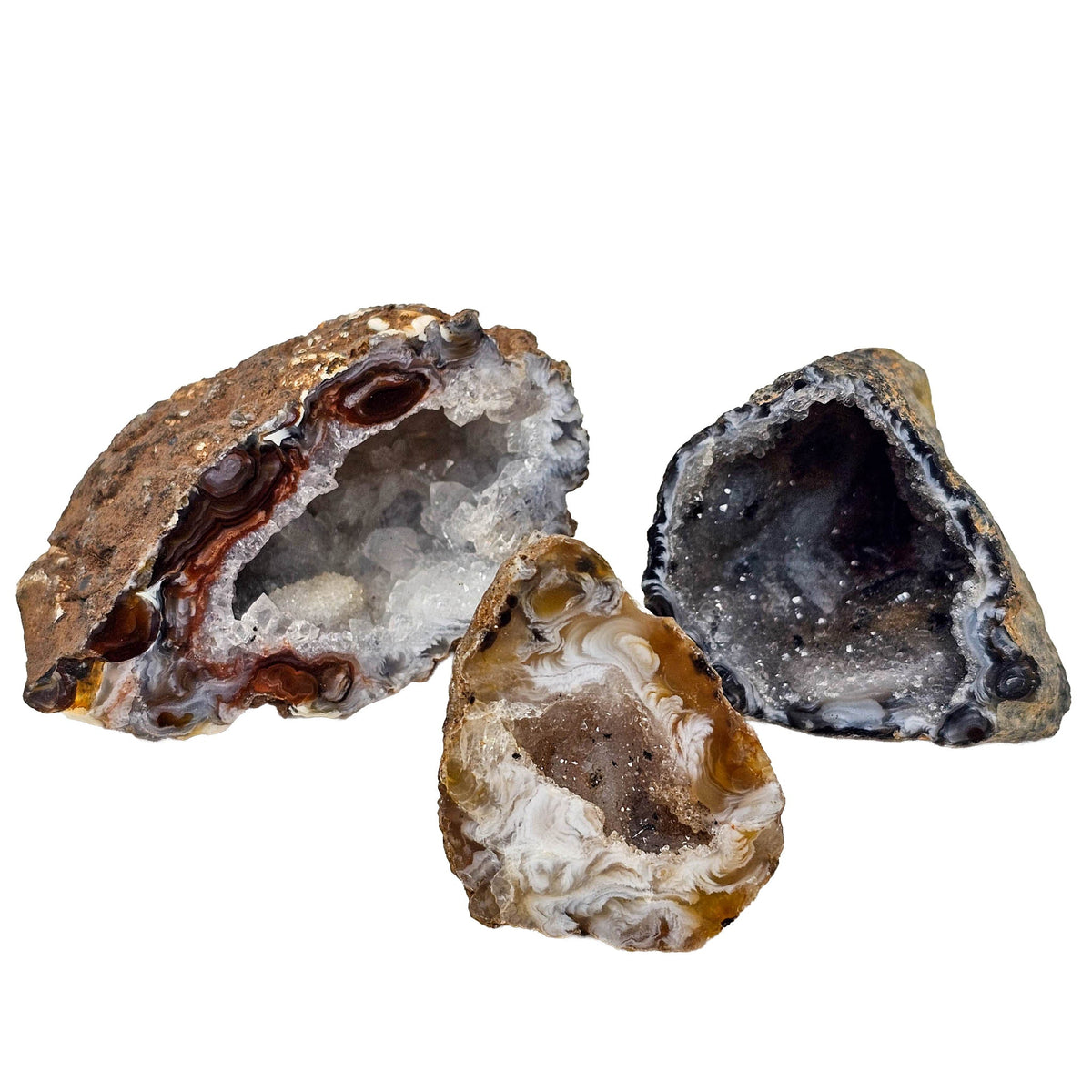
The short answer: a geode is a hollow rock with a mineral lining. It starts as a cavity, such as a gas bubble in lava or a pocket in limestone. Over a long time, mineral-rich groundwater seeps in. It usually leaves a tough chalcedony shell first, then quartz or other crystals that grow inward toward the empty centre.[1][2]
Geodes get the same two questions: how did the crystals get in there, and how do I open one without wrecking it? Here's what I tell people at the counter.
How a geode forms
You need a hole first. In volcanic rock, that's a gas bubble left behind as the lava cooled. In sedimentary rock like limestone, it can be a pocket where material dissolved or rotted away.[1][2] Groundwater carrying dissolved silica and other minerals moves through the rock and deposits them on the walls of the cavity. The outer layer is commonly chalcedony, a fine-grained quartz, which is why geodes are so much tougher than the rock around them. Later fluids grow crystals on that lining, pointing inward, because that's where the open space is.[1][2]

Not every cavity fills the same way. If the hollow fills completely, you get a solid nodule instead of a geode. That's why some "geodes" crack open with no hollow at all.[1]
What's inside
Clear quartz is the most common lining. Amethyst, calcite and other minerals turn up too, depending on what was in the water. Our quartz colour post explains why the same mineral can come out clear, purple or yellow, and crystal habits covers why the crystals take the shapes they do.

A word on colour
If a geode's colour looks too bright to be natural, ask whether it's dyed. A fair seller labels dyed pieces, like the pink pair below. There's nothing wrong with buying one if you like it, as long as you know what you're paying for.

How to open a geode
Put on safety glasses first. Chips fly.
- Pipe cutter (the best way). A soil-pipe cutter has a chain with cutting wheels. You wrap it around the middle of the geode and tighten it slowly until the rock cracks. It gives the most controlled break. You can sometimes rent one from a home improvement store.[3]
- Hammer and chisel. Put the geode in a sock or wrap it in a towel. Tap a line around the middle with a cold chisel, turning as you go, until it splits. The edge will be rougher than with a cutter. A plain hammer blow tends to break a geode into lots of small pieces.[3]
- Saw. A rock saw gives the flat face you see on cut halves, and it's the way to go if you want to polish it afterwards.[3]
If you'd rather skip the gamble, we sell uncracked Moroccan geodes to open yourself, and mini geodes already cracked so you can see what's inside. There are more cut and polished pieces in slabs and geode halves and mineral specimens.
See what's new: browse our newest arrivals for the latest pieces added to the shop.
Sources
- Australian Museum: Concretions, Thunder Eggs and Geodes.
- Texas Parks and Wildlife Department, Young Naturalist: Geodes.
- US Bureau of Land Management: Dugway Geode Beds, Utah (visitor guidance on opening geodes).