


By Adam Kelliher
The short answer: real moldavite is a natural green glass formed when a meteorite struck what is now southern Germany about 14.7 million years ago. Under a 10x loupe, genuine pieces usually show lots of gas bubbles (often stretched), swirly flow lines, and tiny wormy threads of lechatelierite, a silica glass. Those threads are the most reliable sign you can check at home.[1][2]
Moldavite prices have climbed, and imitations have followed. GIA has reported on increasingly realistic fakes.[1][3] Here's how to look at a piece before you buy it.
What moldavite is
Moldavite is a tektite, a glass made when an impact melts the ground and throws the melt out. The impact that made moldavite formed the Ries crater in Bavaria. Most moldavite is found in southern Bohemia in the Czech Republic, a few hundred kilometres away.[1] Its green colour comes from a very small amount of iron. Most other tektites contain more iron and are black.[1] For how tektites differ from meteorites, see Tektites vs Meteorites.
What to look for with a loupe
- Bubbles. Real moldavite usually has lots of them, round or stretched, and far more than typical man-made glass.[1][2]
- Flow lines. Irregular swirls in the glass. Imitations can have flow lines too, but GIA described fake ones as straight and evenly spaced.[3]
- Lechatelierite. Fine wire-like, curly or zig-zag inclusions. They're molten quartz grains, and a gemmological study of moldavite reported they aren't found in imitations.[1][4] On a polished stone they're the best single clue.[1]

Rough pieces are harder
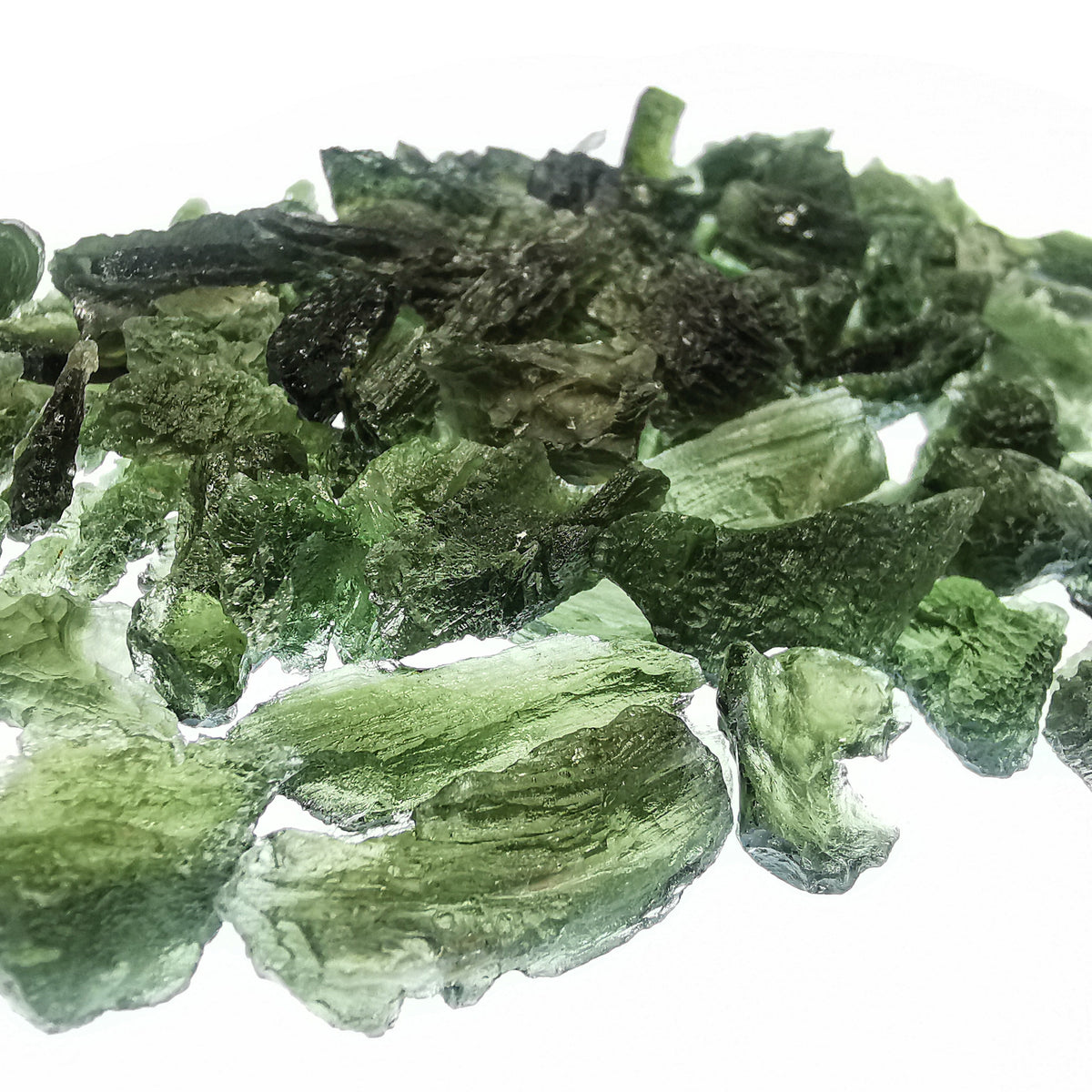
Natural moldavite has an etched, sculpted skin, but GIA notes that a near-identical surface can be made with acid.[1] Signs that help on rough include sharp natural protrusions, open-ended bubbles and channels, and bits of clay or sand from the deposit.[5] Putting the piece in water, or better in oil, makes the inside easier to see.[1]
What a lab checks
Gem labs use refractive index, specific gravity, fluorescence, absorption spectra and infrared spectroscopy. Natural moldavite's refractive index and density are low, but some glasses overlap, so no single number settles it.[1][2][5] Some imitations glow chalky under shortwave UV, while natural moldavite is inert.[5] If you have a UV torch, here's how to use it.
Buying sensibly
- A price far below the going rate is a warning sign.
- Ask where it came from and whether the seller stands behind it.
- Uniform colour, perfect clarity and very few bubbles are all reasons to look harder.
Everything we sell in meteorites and tektites is natural material, and you're welcome to put a loupe on it.
If you want to compare against the real thing, see our genuine moldavite specimens from the Czech Republic.
See what's new: browse our newest arrivals for the latest pieces added to the shop.
Sources
- GIA, Gems & Gemology (Spring 2015): Moldavites: Natural or Fake?
- Geology.com (Hobart M. King): Moldavite.
- GIA, Gems & Gemology Lab Notes (Summer 2021): Imitation Moldavite.
- The Journal of Gemmology 38(7), 2023: Moldavite from the Czech Republic: Mining and Gem Properties.
- GIA: Book Review, Real or Fake? Moldavites (František Funda).