


By Adam Kelliher
The short answer: kyanite is aluminium silicate, Al2SiO5, the same recipe as andalusite and sillimanite but a different structure. It typically grows as long, often bent blades. Hardness is directional: about 5.5 along the blade and 7 across it. In mica schists, kyanite is a high-pressure mineral. British Columbia has it in several metamorphic belts, including the pelitic schists around Harrison Lake.[1][2][6]
One mineral, two hardnesses, depending on which way you scratch it. That's the fact that surprises people at the counter.
A blade with a grain
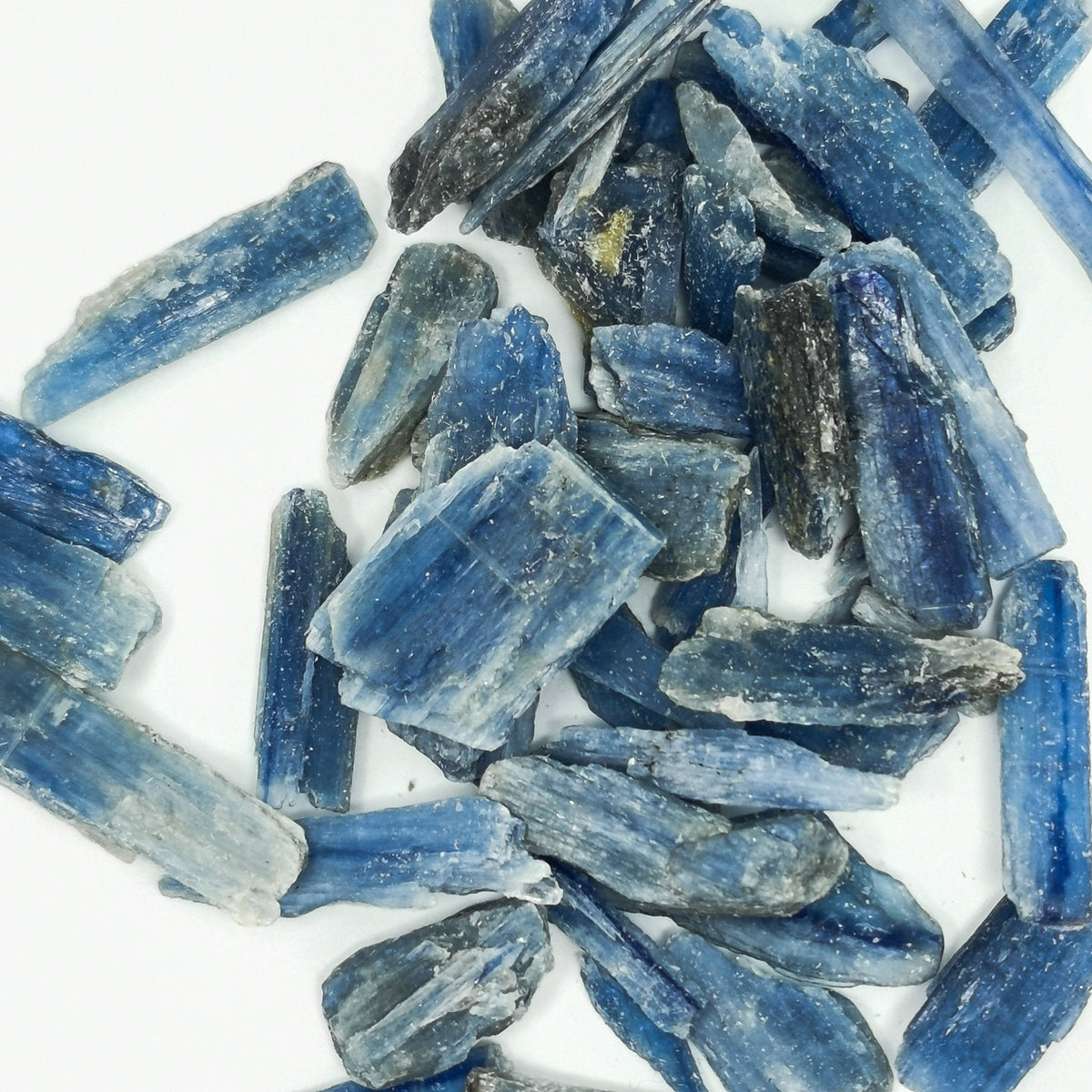
Handbook of Mineralogy describes kyanite as triclinic, with bladed, tabular crystals elongated and typically bent or twisted, perfect cleavage one way and good cleavage another. Density is 3.53–3.65. Colour is usually blue, also white, and more rarely green, grey, yellow, pink or black; the name is from the Greek for blue.[1]
Hardness is 5.5 parallel to the long direction and 7 across the blade.[1] Combined with that perfect cleavage, that's why beads and cabs can chip if they're knocked on the weak direction.
Kyanite forms in gneisses, schists and quartz veins by moderately high-pressure regional metamorphism of aluminium-rich sedimentary rocks, and it also turns up as detrital grains. Large crystals are well known from Minas Gerais, Brazil.[1]
The three Al2SiO5 minerals meet at a triple point somewhere around 3.8–4.5 kbar and 500–550 °C, "arguably the most important invariant point in metamorphic petrology."[2] In common mica schists, kyanite indicates the higher-pressure side of that system.[2] Blue colour in studied Nepalese gem kyanite is tied to iron and titanium; vanadium didn't appear to control the colour.[4] I don't have a sourced cause for green or black kyanite, so I won't invent one.

Kyanite in British Columbia
The BC Geological Survey's kyanite deposit profile places the mineral in high-pressure metamorphic terrains, as porphyroblasts or masses in schists, gneisses and quartzites derived from aluminous sedimentary rocks. Documented occurrences include Trail Bay and Dudevoir Passage on the Tsimpsean Peninsula, Yellow Creek, and Hawkesbury Island.[5]
Around Harrison Lake, Reamsbottom's Mount Breakenridge mapping describes rusty-weathering pelitic schists and gneisses distinguished by bladed blue-grey kyanite, coarse garnet and twinned brown staurolite, in a classic Barrovian sequence through chlorite, biotite, garnet, staurolite, kyanite and sillimanite.[6] In the western Cariboo Mountains, at Niagara Peak, staurolite and kyanite grew during a second deformation, with later sillimanite.[7] Mica Creek is one of the classic sequences plotted in the wider metamorphic literature.[2]
Those are rock-forming crystals in metamorphic belts, not a collecting invitation. Land status still applies; start with BC Rockhounding Rules.
In the shop we carry blue kyanite blades, including Brazilian pieces and Namibian specimens, plus green kyanite. Ruby in kyanite is a rock — corundum and kyanite together — not a single mineral.
See what's new: browse our newest arrivals for the latest pieces added to the shop.
Sources
- Anthony, J.W. et al. Handbook of Mineralogy: Kyanite.
- Pattison, D.R.M. 2001. Instability of Al2SiO5 "triple-point" assemblages in muscovite+biotite+quartz-bearing metapelites. American Mineralogist 86: 1414–1422.
- Bohlen, S.R., Montana, A. & Kerrick, D.M. 1991. Precise determinations of the equilibria kyanite ↔ sillimanite and kyanite ↔ andalusite. American Mineralogist 76: 677–680.
- Tatje, R. 2013. Study helps identify Nepalese kyanite (abstract of Henn & Schollenbruch). Gems & Gemology 49(3).
- Simandl, G.J., Paradis, S., McCracken, W.H. & Hancock, K.D. 1999. P02 Kyanite, muscovite, garnet in metasediments. In BC mineral deposit profiles, BCGS GeoFile 2020-11 (BCG-202).
- Reamsbottom, S.B. 1974. Geology and metamorphism of the Mount Breakenridge area, Harrison Lake, British Columbia. PhD thesis, UBC (BCG-818).
- Garwin, S.L. 1987. Structure and metamorphism in the Niagara Peak area, western Cariboo Mountains, British Columbia. MSc thesis, UBC (BCG-387).