




Specifications
Description
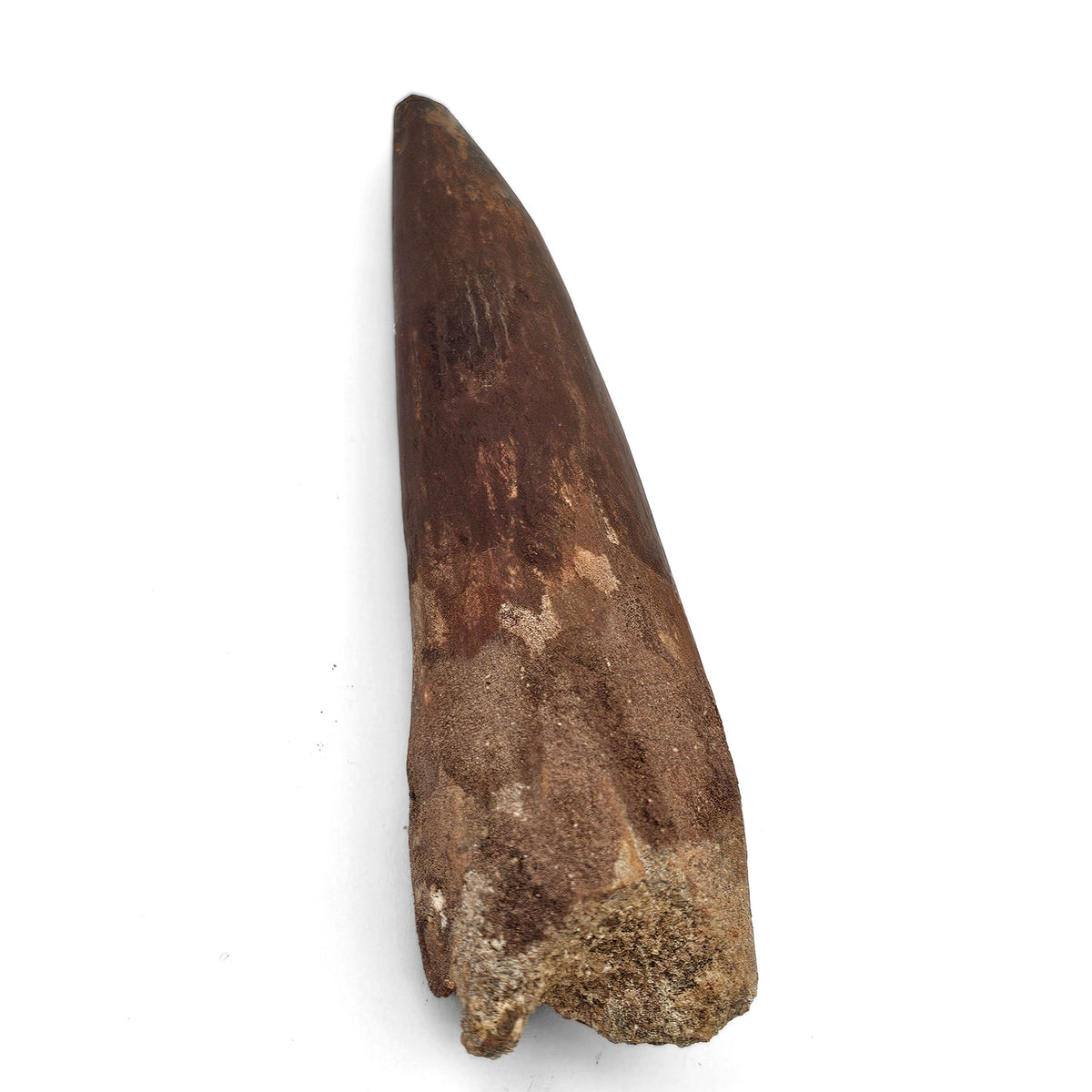
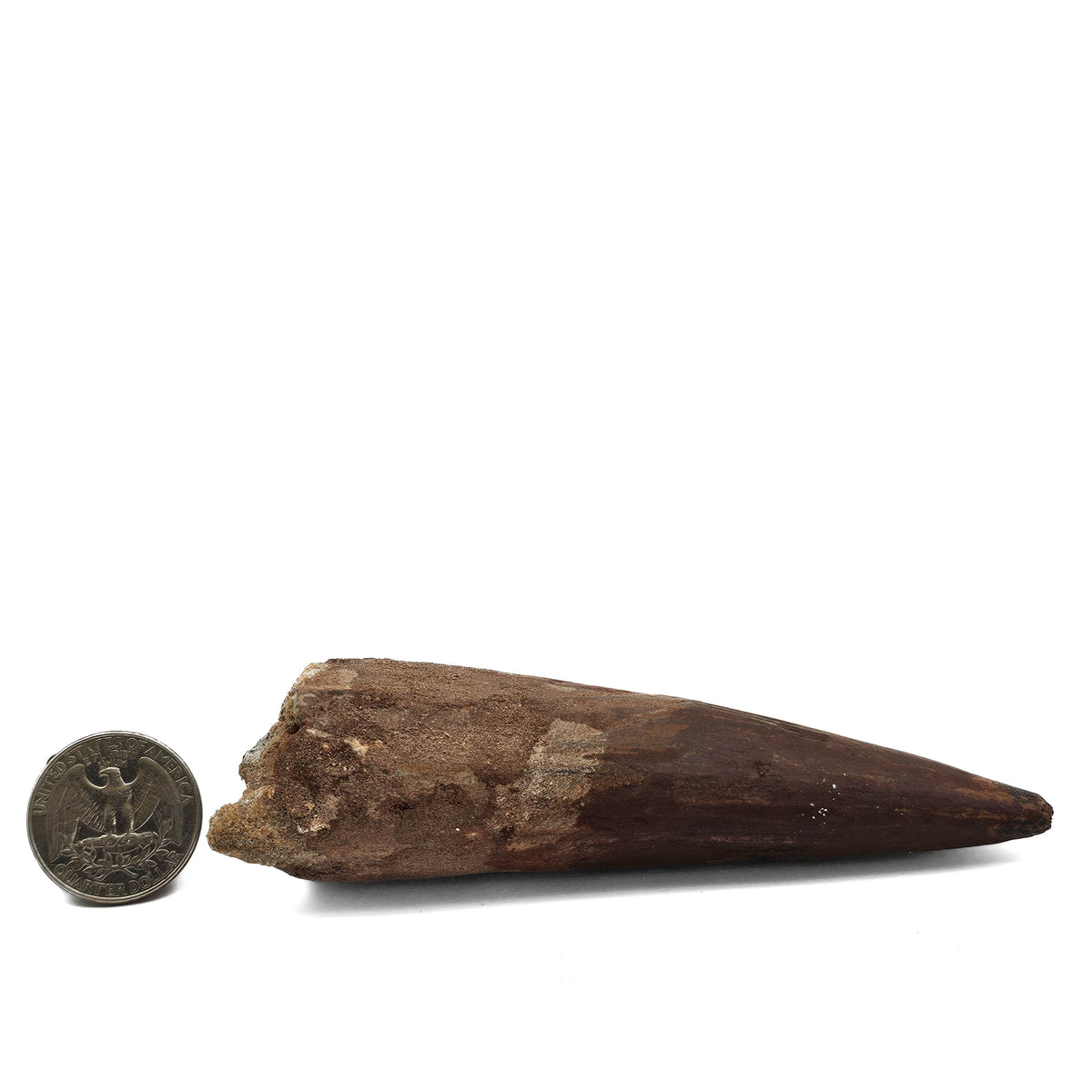
Fossil Spinosaurus Tooth, Cretaceous period.
Locality: Kem Kem Beds, near Taouz, Errachidia Province, Drâa-Tafilalet Region, Sahara Desert, Morocco
Era: Mesozoic
Geological Age: Late Cretaceous, Cenomanian 100.5 to 93.9 mya
The Kem Kem beds form desert cliffs in the Moroccan Sahara. In the Cretaceous the area was part of a large river system, home to large sharks, coelacanths, lungfish and crocodile-like animals, along with giant flying reptiles and predatory dinosaurs.
Spinosaurus aegyptiacus was named in 1915 by the German palaeontologist Ernst Stromer, from a partial skeleton that the collector Richard Markgraf found in 1912 in the Bahariya Oasis of western Egypt. That skeleton was the only indisputable specimen of the species. It was destroyed on the night of 24–25 April 1944, when a bombing raid on Munich hit the museum that housed it, and only Stromer's notes, drawings and photographs survived.
Nearly a century later, Nizar Ibrahim and colleagues described a new partial Spinosaurus skeleton from the Kem Kem beds of southeastern Morocco, published in Science in September 2014. Comparing it with Stromer's surviving records, they concluded that Spinosaurus was at least partly aquatic, the first dinosaur known with such adaptations. Its nostrils sat far back on the skull, its hindlimbs were short, and its limb bones were solid, which would have helped with buoyancy control in water.
This one of a kind Spinosaurus tooth fossil specimen has a thick, tapering form with a dark brown crown that narrows to a sharp point and a broader, lighter brown base with visible natural texture. The surface shows a mix of smooth enamel preservation and rougher fossilized areas where the tooth transitions toward the root. The broken base is natural and gives the piece a solid, excavated look, while the crown remains well defined and visually strong.
This specimen has a heavier, more robust profile than many smaller Moroccan dinosaur teeth, with a clear difference between the darker enamel and the more weathered root area. The shape fits the conical tooth form associated with Spinosaurus, a large predatory dinosaur whose teeth were better suited to gripping prey than slicing it. Teeth like this are commonly recovered from the fossil-bearing beds of southeastern Morocco, where river and floodplain deposits preserved a wide range of Cretaceous animals.
Collectors are often drawn to Spinosaurus teeth because they carry an immediate sense of age, survival, and prehistoric power. This piece has that appeal in a very direct way: it looks ancient, substantial, and unmistakably real.
Quantity: 1pc
With this product, you will get the actual stone in the photograph. We do what we can to buy good quality products and price them honestly. The rocks may differ from the photos, but we hope we do them justice.