


By Adam Kelliher
The short answer: "jade" is two different minerals, nephrite and jadeite. Many green stones are sold as jade, including serpentine, aventurine quartz, chalcedony, prehnite and glass. Home checks can rule some out, but proving something is jade takes a refractometer and other gem tests.[1][2]
BC is nephrite country, so we hear "is my jade real?" a lot. Here's what separates jade from its look-alikes, and what you can and can't check yourself.
Two jades
- Nephrite: refractive index about 1.61 to 1.63, specific gravity about 2.95, hardness 6 to 6.5.[1]
- Jadeite: refractive index about 1.66 to 1.68, specific gravity about 3.34, hardness 6.5 to 7.[1]
The two are hard to tell apart by eye. See Nephrite vs Jadeite.

The usual look-alikes
GIA's study of jade simulants found most have a lower refractive index than either jade. That includes quartz, chalcedony, serpentine, talc, and most glass and plastic.[2] Serpentine is the big one in BC, and it's softer than jade: about 3 to 5 against nephrite's 6 to 6.5.[3] We cover it in Jade vs Serpentine.

What you can check at home
- Hardness. Serpentine (3 to 5) is softer than nephrite (6 to 6.5) and jadeite (6.5 to 7).[3] With a Mohs set, a stone that apatite (5) scratches easily isn't jade. Test only a hidden spot, because a scratch test marks the stone.
- Heft. Jadeite feels heavy for its size. But GIA warns specific gravity overlaps for several simulants and should only back up other tests. Prehnite, for example, can match nephrite.[2]
- Look closely. Glass often shows round bubbles and swirls.[4]
What needs a lab
A refractometer reading identifies jadeite and nephrite. For jadeite, a spectroscope can confirm the green is from chromium.[2] Treatments are the other trap. Jade is sometimes dyed. Dyed green jadeite can usually be caught with a spectroscope, but some other colours of dye may not be detectable.[5] For an expensive piece, buy with a report from a gem lab.
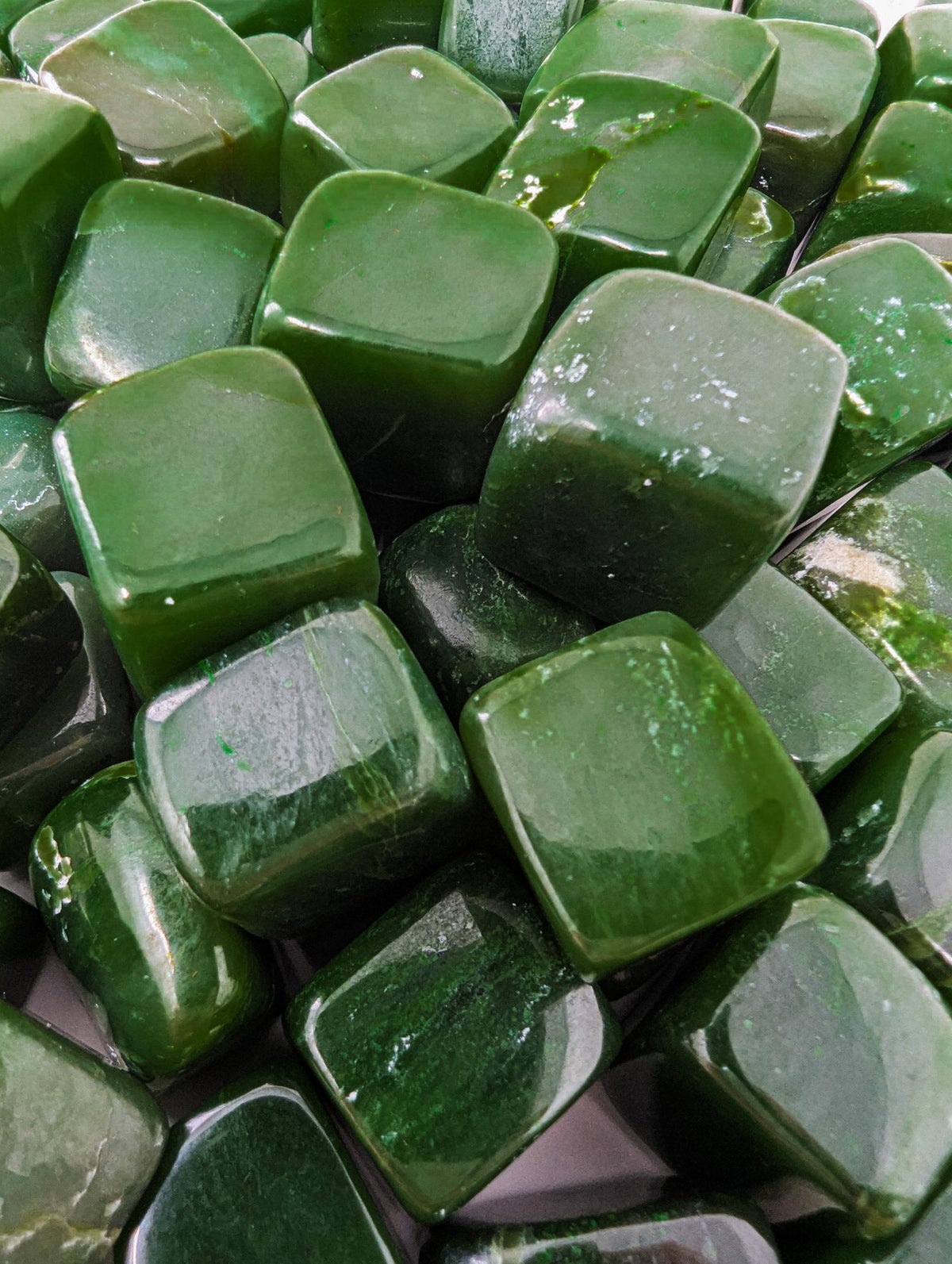
Browse BC nephrite in tumbled stones and BC stone jewellery in BC stone jewelry.
See what's new: browse our newest arrivals for the latest pieces added to the shop.
Sources
- GIA: Jade, Gem Encyclopedia.
- Gems & Gemology (GIA), Spring 1982: The Jade Enigma.
- Geology.com (Hobart M. King): Mohs Hardness Scale (hardness of common minerals).
- International Gem Society: Opal (identifying glass simulants).
- GIA: Chart of Commercially Available Gem Treatments.