




Specifications
Description
Locality: Mahajanga Basin, Mahajanga Province, Madagascar
Era: Mesozoic
Geological Age: Early Cretaceous (Early Albian), about 113 to 110 million years ago
Cleoniceras besairiei was named by Collignon in 1949. It is very abundant in the southern Mahajanga Basin of northwestern Madagascar, and it gives its name to an early Albian ammonite zone there, the Cleoniceras besairiei Zone.
Ammonites were marine cephalopods with a coiled outer shell, like the modern nautilus. The shell was divided into chambers by walls called septa. The animal lived only in the last chamber and could regulate gas or fluid in the earlier ones to control its buoyancy, much like a submarine. Ammonites died out at the end of the Cretaceous, at about the same time as the dinosaurs.
The name comes from the Egyptian god Amun, known to the Greeks as Zeus Ammon and shown with curling ram's horns. Early naturalists compared the coiled shells to serpents, and ammonites became widely known as snakestones. The town of Whitby in North Yorkshire still has three snakestones on its coat of arms.
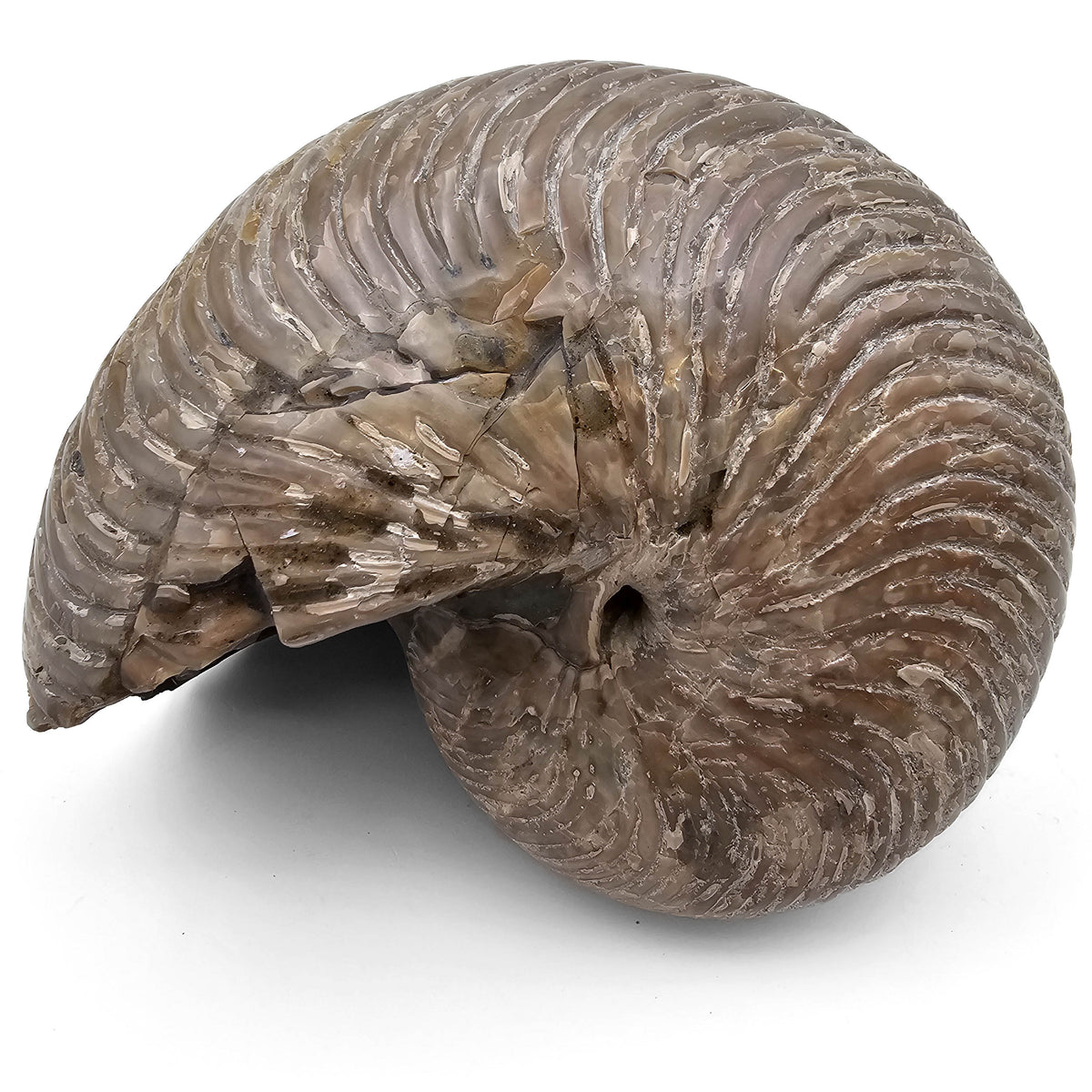
This one of a kind Cleoniceras Besairiei ammonite fossil specimen from Madagascar has a tight natural spiral, strong ribbed growth lines, and a solid, full-bodied shape that gives it real shelf presence. The color sits in a range of soft grey, beige, taupe, and light brown, with darker mineralization visible in the exposed opening and along a few fracture lines. It has natural breakage and old repair or stabilization lines, but the overall form still reads clearly as a complete ammonite and keeps that classic curled profile people look for in a display piece.
Ammonites were extinct marine cephalopods, related to modern squid, octopus, and nautilus. This specimen comes from sedimentary deposits in Madagascar, where shells like this were buried in seafloor mud, compacted over time, and gradually fossilized as the original shell material was preserved or replaced by carbonate minerals. That is why pieces like this often keep such clean ribbing and shell detail. Even without a species call, this is a strong example of the kind of ammonite fossil Madagascar is well known for.
People are often drawn to ammonites because the spiral feels steady and ordered. This kind of fossil is commonly associated with continuity, grounding, and the idea of growth through cycles. It has a calm, old-world feel to it, and works well as a piece for anyone who likes fossils that look substantial, natural, and unmistakably ancient.
Quantity: 1pc
With this product, you will get the actual stone in the photograph. We do what we can to buy good quality products and price them honestly. The rocks may differ from the photos, but we hope we do them justice.