


By Adam Kelliher
Updated October 18, 2026
If you've only met Jade City through television, you've seen the boulders, the saws and the weather. What you mostly haven't seen is the geology, and that's the part that explains why a tiny roadside stop on Highway 37 is sitting on one of the best nephrite belts on the planet. So here's the Cassiar story the way the government geologists tell it, with the receipts at the bottom.
Where Jade City actually is
Jade City is an official place name: an unincorporated locality in the Cassiar Land District, on NTS map sheet 104P/05, at about 59°15′ N, 129°37′ W. The name was made official in November 1990.[1] The old asbestos town of Cassiar is about 12 km to the northwest, roughly 120 km north of Dease Lake and 150 km south of Watson Lake.[2]
That asbestos mine matters more to the jade story than most people realise. Hold that thought.
Why the jade is here: serpentinite meets chert
BC jade is nephrite, never jadeite. All of the province's known jade deposits are nephrite, a rock made of tiny tremolite-actinolite amphibole fibres matted together like felt.[3] That felted texture is why nephrite is so absurdly tough: its fracture strength is roughly 200 MN/m², about double jadeite's, even though jadeite is a touch harder on the Mohs scale (7 versus 6.5).[4]
BC has more than fifty known nephrite occurrences, in the Cassiar, Cry Lake and Dease Lake, and Mount Ogden areas plus southern BC.[4] They aren't random. Most sit at or near faulted contacts between serpentinite (altered mantle rock from old ocean floor) and chert or other silica-rich rocks, in oceanic terranes like Cache Creek and Slide Mountain. The working idea is metasomatism: fluids swapping elements between the magnesium-rich serpentinite and the silica-rich rock until a lens of nephrite grows along the seam.[4][5]
Leaming's 1978 survey for the Geological Survey of Canada traced this as one long belt of faults and serpentinites running northwest from the US border near Hope to the Yukon border north of Dease Lake, split into a Lillooet segment in the south, an Omineca segment in the middle, and a Cassiar segment in the north.[6] One radiometric age reported for Ogden Mountain nephrite was about 315 million years, though Leaming cautioned that serpentinite and its jade were later dragged along faults, so a deposit rarely sits where it first formed.[6]

The Cassiar segment, deposit by deposit
Leaming walked the northern camps in the 1970s, and his notes still read like a field guide:[7]
- Wheaton (Boulder) Creek: where W.J. Storie found nephrite in 1938. Alluvial boulders up to about 15 tonnes, with intermittent production of cut blocks since 1965.
- Cry Lake map-area and King Mountain: nephrite strung along fault-bounded serpentinite bodies. Plenty of it was low grade, some "best described as tremolite rock," which is a polite way of saying not everything green is worth a saw blade.
- Provencher Lake and Kutcho Creek: A. Jensen found jade near Provencher Lake in 1969. Leaming called it a major source, with hundreds of boulders on the valley floor and at least twenty in situ deposits in the mountains to the east. Boulders were drill-tested, marked, then hauled out by tractor train on a winter road.
- Dease Lake: Ben Seywerd found jade in place at the north end of Dease Lake in 1965 after years of tracking boulders along Thibert Creek.
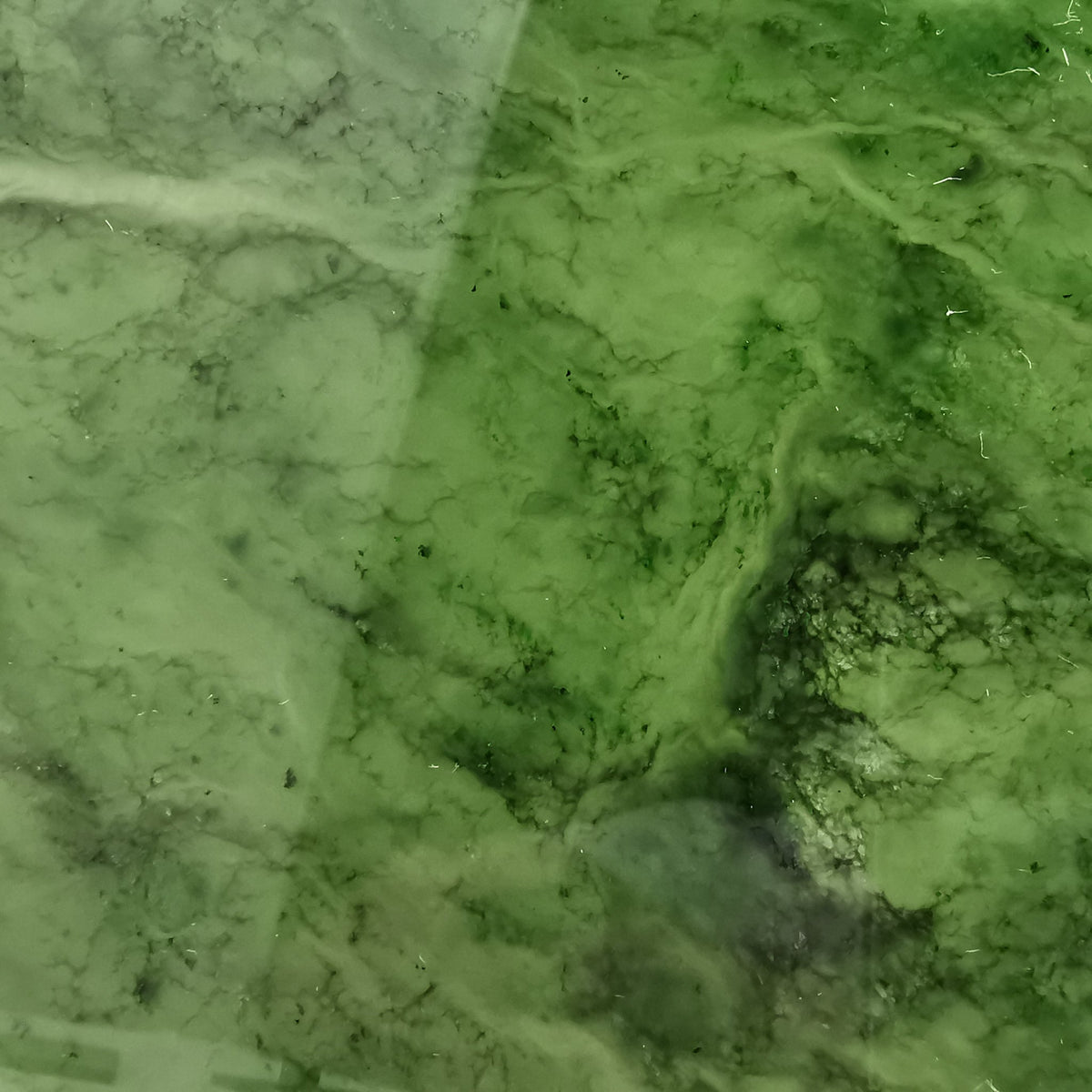
Then there's the Cassiar asbestos mine. In 1967 Clancy Hubbell recognised nephrite in the serpentinite being mined there. Before that, an unknown amount had gone out with the waste rock. Leaming reports about 300 tonnes salvaged and stockpiled at the mill site after Hubbell's find. Cassiar nephrite is a bit of an oddball: darker green than most BC material and loaded with chrome garnet (possibly uvarovite) specks that can make up 5% of a piece, and often heavily fractured.[7]
The province's MINFILE record for the mine lists jade/nephrite among its commodities and notes that "large, unknown quantities of jade were also produced over the years." It also records 50 tonnes of jade recovered from the old asbestos dumps in 1998.[8] A 2017 provincial reclamation inspection describes surface jade mining of the old waste piles, permitted since December 1991, running May through September.[2] In other words: a good chunk of modern Cassiar jade comes out of what an asbestos mine threw away.
How it's mined (no, you can't just blast it)
Here's the part I can speak to from the yard side. I've spent days digging through and washing a pile of BC jade boulders, and the first thing you learn is that a hammer barely marks the stuff. The surveys say the same thing more formally: explosives damage jade, ordinary rock splitting is "virtually useless" on those locked fibres, so miners use two-metre circular diamond saws, diamond wire saws, and high-pressure hydraulic splitters where they can find an existing fracture.[4]
Glacial boulders are the easy deposits: drill or saw a test window, and only haul the commercial-grade material. In situ lenses have since overtaken alluvial boulders as Canada's main source. Up north, the season runs only from mid-June to late September.[4]
Grade is everything. The surveys single out the Polar Mine's gem-grade find as what made Canadian jade famous.[4] I can tell you from a deal that went sideways that "Polar" and general pile jade are not priced in the same universe.

What the TV doesn't show
Reality TV is built for drama: big rocks, broken machines, deadlines. The geological record is quieter, and frankly more interesting. Nephrite here is the product of ocean floor being shoved onto the continent and cooked along faults. It's found by following serpentinite belts and the pale "white rock" alteration zones that often wrap the jade.[5][6] And much of what gets sold depends on a saw cut, not a glance.
One caution about numbers: the production and export figures in these papers (for example, exports of about 200 tonnes a year over the 25 years before 2004) are historical, not today's market share.[4]
If you want a piece of the real thing to look at under a loupe, our high-grade BC nephrite offcuts are northern BC material.
References
- Natural Resources Canada, Canadian Geographical Names Database. "Jade City" (key JDCWP), decision date 1990-11-02. geonames.nrcan.gc.ca
- BC Ministry of Energy, Mines and Petroleum Resources. Report of Inspector of Mines, Reclamation and Permitting, Inspection No. 80236, Cassiar (Permit M-18), dated October 2, 2017. PDF
- BC Geological Survey. 2012. Jade in British Columbia: B.C.'s Provincial Gemstone. Information Circular 2012-3. PDF
- Makepeace, K. and Simandl, G.J. 2004. Jade (Nephrite) in British Columbia, Canada. In Industrial Minerals with emphasis on Western North America, BC Ministry of Energy and Mines Paper 2004-2, pp. 287–288. PDF
- Simandl, G.J., Riveros, C.P. and Schiarizza, P. 2000. Nephrite (Jade) Deposits, Mount Ogden Area, Central British Columbia (NTS 093N 13W). In Geological Fieldwork 1999, BC Ministry of Energy and Mines Paper 2000-1, pp. 339–347. PDF
- Leaming, S.F. 1978. Jade in Canada. Geological Survey of Canada Paper 78-19, 59 p., pp. 2, 18. doi:10.4095/105214
- Leaming 1978, pp. 2, 31–36 (Cassiar segment, Wheaton Creek, Cry Lake, King Mountain, Provencher Lake, Dease Lake, McDame area and Cassiar Asbestos Mine).
- BC Geological Survey. MINFILE 104P 005, Cassiar (Cassiar Asbestos, Cassiar Jade, Cassiar Tailings). MINFILE record