


By Adam Kelliher
Updated October 18, 2026
Ask around the shop and you'll hear a tidy story about BC jade: Chinese miners found it in 1886, nobody else cared, and the rest is history. It's a good story. The trouble is that when you go to the actual geological reports, most of it is either unproven or a little sideways from what the record says. So let's do it properly: what we can show with documents, what is only reported, and where the legends live.
Quick note on terms: in British Columbia, "jade" means nephrite, a tough, felted mass of tremolite–actinolite amphibole fibres. The BC Geological Survey states there are no known deposits of jadeite in the province (BC Geological Survey, Information Circular 1992-27). If you want the side-by-side, see our post on nephrite vs. jadeite.
Long Before Anyone Wrote It Down: Indigenous Jade on the Fraser
The first people to use BC jade were the Salish peoples of the Fraser River country, and this part rests on archaeology, not guesswork. Geologist S.F. Leaming's Geological Survey of Canada paper Jade in Canada (1978) summarizes radiocarbon-dated sites: nephrite adze blades at the St. Mungo cannery site on the south arm of the Fraser, above a level dated 2360 ± 110 B.C., and ground nephrite artifacts near Lillooet provisionally dated to roughly 2000–1500 B.C. Leaming puts the use of nephrite in Canada at a history "that must approach 4000 years," with the Lillooet–Lytton area as the main centre of manufacture, where river boulders of handy shapes and sizes were plentiful on the Fraser and Bridge River bars.
Stuart Holland of the BC Department of Mines described the same picture in 1961: Fraser River jade was used mostly for cutting tools because it held an edge, and finished pieces travelled to coastal, Vancouver Island and Interior peoples (Holland, in the BC Minister of Mines Annual Report for 1961).

The First Written Records: Richardson and Dawson
Here's where the "1886" date gets interesting. Leaming credits the first reference to jade in Canada to the Arctic explorer Sir John Richardson in 1851. For British Columbia specifically, the first proper scientific account I can document is George M. Dawson's Note on the Occurrence of Jade in British Columbia, and Its Employment by the Natives, printed in the Canadian Record of Science, volume II, number 6, in April 1887. Volume II covers 1886–87, which may be where the popular "1886" date comes from, but that's my guess, not a documented fact.
What Dawson actually reported is worth knowing:
- Jade adzes and celts turned up all along the coast and were "notably abundant" in Indian graves along the lower Fraser and Thompson rivers.
- Two partly worked jade boulders had been found on the lower Fraser, one at Lytton and one at Yale, and 1877 finds in old graves near Lytton showed adzes had been made right there.
- A Fraser River specimen from near Lytton, examined by Dr. B.J. Harrington, "proves to be a true nephrite."
- And the kicker: as far as Dawson knew, jade had "not yet been found in situ in any part of British Columbia."
So the earliest documented "discovery" of BC jade in the written record wasn't a prospector striking a green vein. It was a geologist recognizing that Indigenous tools were made of nephrite from Fraser River boulders, with the jade's bedrock source still unknown.
Jade That Rode the Glaciers South
One more documented twist. Not all BC nephrite stayed in BC. Geologist George Mustoe (Western Washington University) showed in 2024 that Late Pleistocene ice sheets carried nephrite, along with plenty of other BC rock, south into the glacial deposits along the Salish Sea coast in Whatcom and Island counties, Washington. That "black jade" from the beaches is an impure nephrite, ferro-actinolite crystals in a feldspar-rich matrix, and Mustoe notes it was little used by Indigenous people, who favoured Fraser River stone. The pale beach stone some collectors call "muttonfat jade" turned out to be a quartz–sillimanite mix, not jade at all.
Mustoe's reference list is also a handy map of the early written record: Richardson (1851), Dawson (1887), and George T. Emmons's 1923 monograph Jade in British Columbia and Alaska, and Its Use by the Natives.
Chinese Miners and the Gold Rush: Documented vs. Legend
This is the part that gets retold most, so let's be careful with it.
What's documented: after the 1858 rush of placer miners from California, many bars on the Fraser and Bridge rivers were reworked by Chinese miners in the following years (Holland, Annual Report 1961). That's the setting, and it's solid.
What's only reported: the story that those Chinese miners recognized jade among the boulders and shipped it home before 1900. Holland wrote that "the story is current" and then, in the next breath, that "it has not been possible to substantiate this rather interesting incident." Leaming (1978), citing Holland, calls the quantity shipped "unknown and, in fact, unsubstantiated." A later BC Geological Survey brochure (Information Circular 1992-27) says Chinese miners "are reported to have been the first exporters of jade from Canada, hiding boulders in the coffins of dead colleagues being returned to China."
My take: the coffin story is a legend. It's in a government brochure, but it's worded as a report, and the more detailed geological sources say outright that it couldn't be verified. It's plausible, and it's a great campfire story, but I can't find the evidence behind it, so I'm not going to tell it to you as fact.
The same 1992 circular says the Chinese miners' interest baffled the other gold miners, "who did not see the value of the green mineral." There was no local jade market. Everyone was there for gold.
Rediscovery: Rockhounds Bring Jade Back (1930s–1960s)
After that, BC jade mostly sat in the rivers. According to Leaming, the next chapter was W.J. Storie's discovery of nephrite on Wheaton (Boulder) Creek in the Cassiar District in 1938, though little came out of there until about 1957.
Down south, Holland credited the renewed interest in Fraser River jade to C.J. Hallesey, a long-time Lytton resident who started collecting it as a pastime, and to the late Captain Duncan (Leaming spells the first name Halsey). By 1961 Holland was writing that demand from collectors and "rock hounds" had "increased tremendously" over the previous five years, with a price range that made jade hunting worthwhile for local residents, "Indian and white alike." Leaming adds that some Fraser and Bridge River boulders weighed 10 tonnes or more, far more than any rockhound or club could use, so a commercial trade grew up with buyers from Germany, Hong Kong and the United States.
Going North: Cassiar, Dease Lake and Kutcho
Once people knew jade had value, they went looking for where the river boulders came from, and they found bedrock sources. Leaming's history lists the key northern finds:
- Dease Lake: Ben Seywerd found jade in situ at the north end of Dease Lake in 1965, after several years of finding boulders along the tributaries of Thibert Creek.
- Cassiar: in 1967 Clancy Hubbell recognized nephrite in the serpentine being mined at the Cassiar asbestos mine. Before that, an unknown amount had gone out with the waste rock and is "now lost in the waste dump."
- Provencher Lake / Kutcho Creek: Andy Jensen found jade near Provencher Lake in 1969, a major source with many hundreds of boulders on the valley floor and at least twenty in situ deposits in the mountains east of the lake. Leaming also describes claims staked in 1976 on the southeastern Provencher Mountains overlooking Kutcho Creek, with boulders hauled out by winter tractor train to Dease Lake, trucked to Vancouver, cut into blocks and shipped "mainly to Taiwan."
In the same years, deposits turned up in central BC too, including Mount Ogden, where L. Owen and S. Porayko followed boulders up Ogden Creek to in situ deposits in 1968 (Leaming 1978). Leaming notes that the Cassiar district didn't overtake Lillooet as "the jade capital of British Columbia" until about 1974.

1968: The Province Makes It Official
By the late 1960s jade fever was real enough that the government stepped in twice:
- January 1968: a Crown Reserve for jade was set up along the Fraser between Hope and Lillooet, where anyone could collect jade for personal use without a Free Miner's Certificate (BC Geological Survey, IC 1992-27).
- April 6, 1968: jade was adopted as British Columbia's official gemstone (Legislative Assembly of British Columbia). The province's symbols page says jade "became B.C.'s official mineral emblem in 1968," and the 1992 circular gives the same April 6, 1968 date.
BC Jade Today
Production has since moved from river boulders to hard-rock lenses. Makepeace and Simandl (BC Geological Survey, 2004) count more than fifty known nephrite occurrences in BC, in the Cassiar, Cry and Dease Lake, and Mount Ogden areas and in southern BC. They note that in situ deposits have overtaken alluvial mining as the main source, and that roughly 200 tonnes a year over the previous 25 years was more jade than had been produced at any other time in history. Most of it goes to traditional carvings and jewellery.
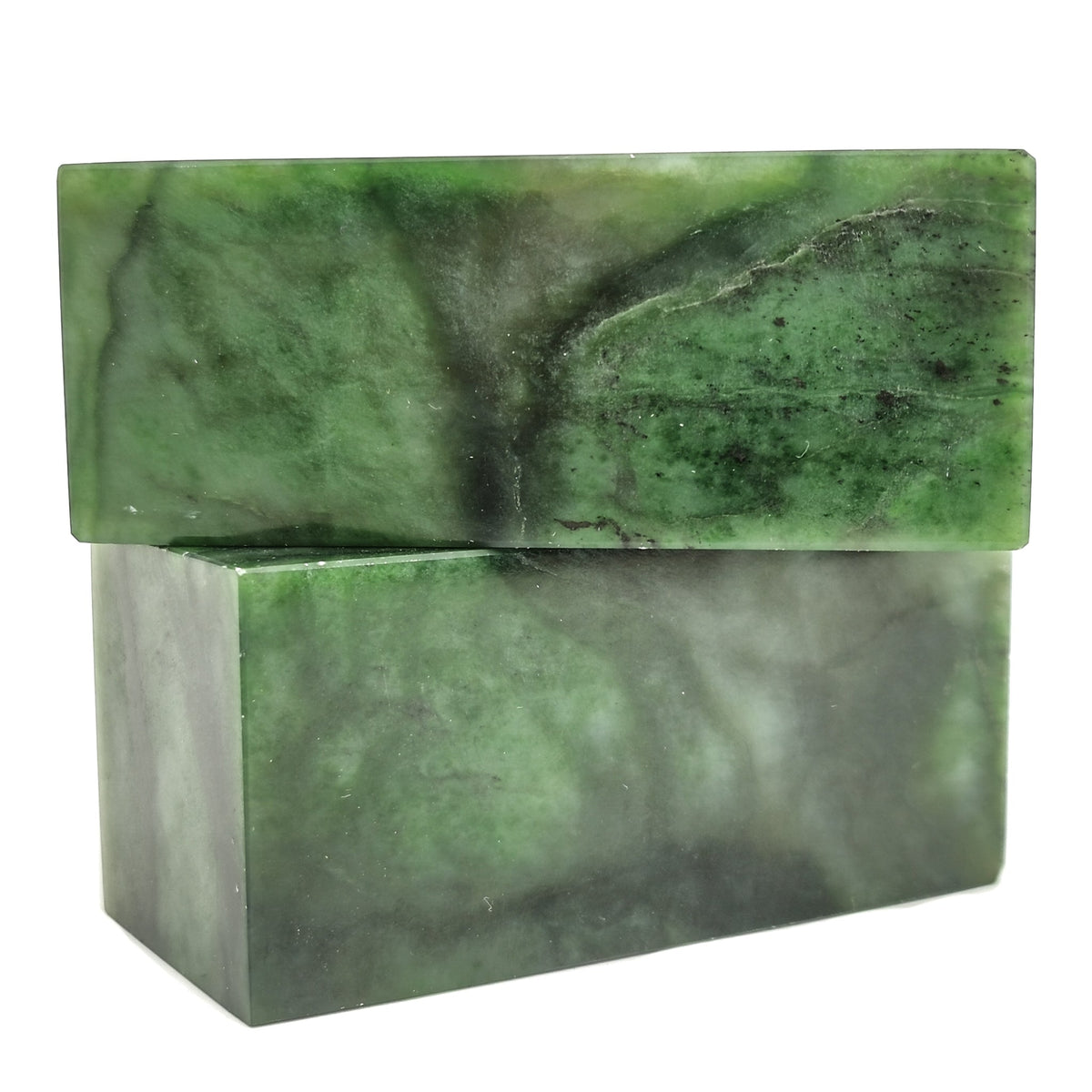
If you'd like to hold a piece of this story, we carry polished BC nephrite blocks and BC jade rough for carvers and cabbers. And if you've found a green rock and are hoping it's part of the story, start with our guide to telling nephrite from serpentine.
What's Still Unverified
- "Jade was first identified in Canada by Chinese settlers in 1886." I couldn't find a primary or government source for this date or claim. The earliest BC record I can document is Dawson's paper of April 1887 (volume dated 1886–87).
- Chinese miners shipping jade to China, and the coffin story. Reported, but called unsubstantiated by Holland (1961) and Leaming (1978). Treat it as legend.
- Cariboo connection. The sources tie Chinese placer mining and jade to the Fraser and Bridge river bars. I found nothing specific about jade in the Cariboo rush.
References
- Dawson, G.M. (1887). Note on the Occurrence of Jade in British Columbia, and Its Employment by the Natives. Canadian Record of Science, v. II, no. 6 (April 1887), pp. 364–378. Canadiana scan.
- Holland, S.S. (1962). Jade in British Columbia. In: Annual Report of the Minister of Mines and Petroleum Resources, British Columbia, for 1961, pp. 119–126.
- Leaming, S.F. (1978). Jade in Canada. Geological Survey of Canada, Paper 78-19, 59 pp. doi:10.4095/105214
- BC Ministry of Energy, Mines and Petroleum Resources, Geological Survey Branch (1992). Jade in British Columbia: British Columbia's Mineral Emblem. Information Circular 1992-27 (research by S.F. Leaming).
- Makepeace, K. and Simandl, G.J. (2004). Jade (Nephrite) in British Columbia, Canada. In: Industrial Minerals with Emphasis on North America, 37th Forum on the Geology of Industrial Minerals; BC Ministry of Energy and Mines (BC Geological Survey), Paper 2004-2, pp. 287–288.
- Legislative Assembly of British Columbia. Provincial and Parliamentary Symbols.
- Government of British Columbia. B.C. Symbols.
- Mustoe, G.E. (2024). Pleistocene Glacial Transport of Nephrite Jade from British Columbia, Canada, to Coastal Washington State, USA. Geosciences 14: 242.
- Emmons, G.T. (1923). Jade in British Columbia and Alaska, and Its Use by the Natives. Indian Notes and Monographs 35, Museum of the American Indian, Heye Foundation, pp. 9–53. (Cited via Mustoe 2024; not read directly.)