


By Adam Kelliher
The short answer: fossils are dated two ways. Relative dating puts them in order using rock layers and index fossils. Numerical dating uses radioactive decay, usually measured in volcanic layers above and below the fossil, to put years on that order.[1][2][3]
You'll often see a fossil labelled with an age like "Jurassic, about 180 million years". Here's where numbers like that come from.
Relative dating: putting layers in order
In the late 1700s James Hutton set out the basic rule: in layers that haven't been folded or overturned, the bottom layer was laid down first and is the oldest. Each layer above is younger.[1] This tells you order, not years. USGS points out that most layers have no known rate of deposition, so a layer's thickness doesn't tell you how long it took.[1]
Index fossils
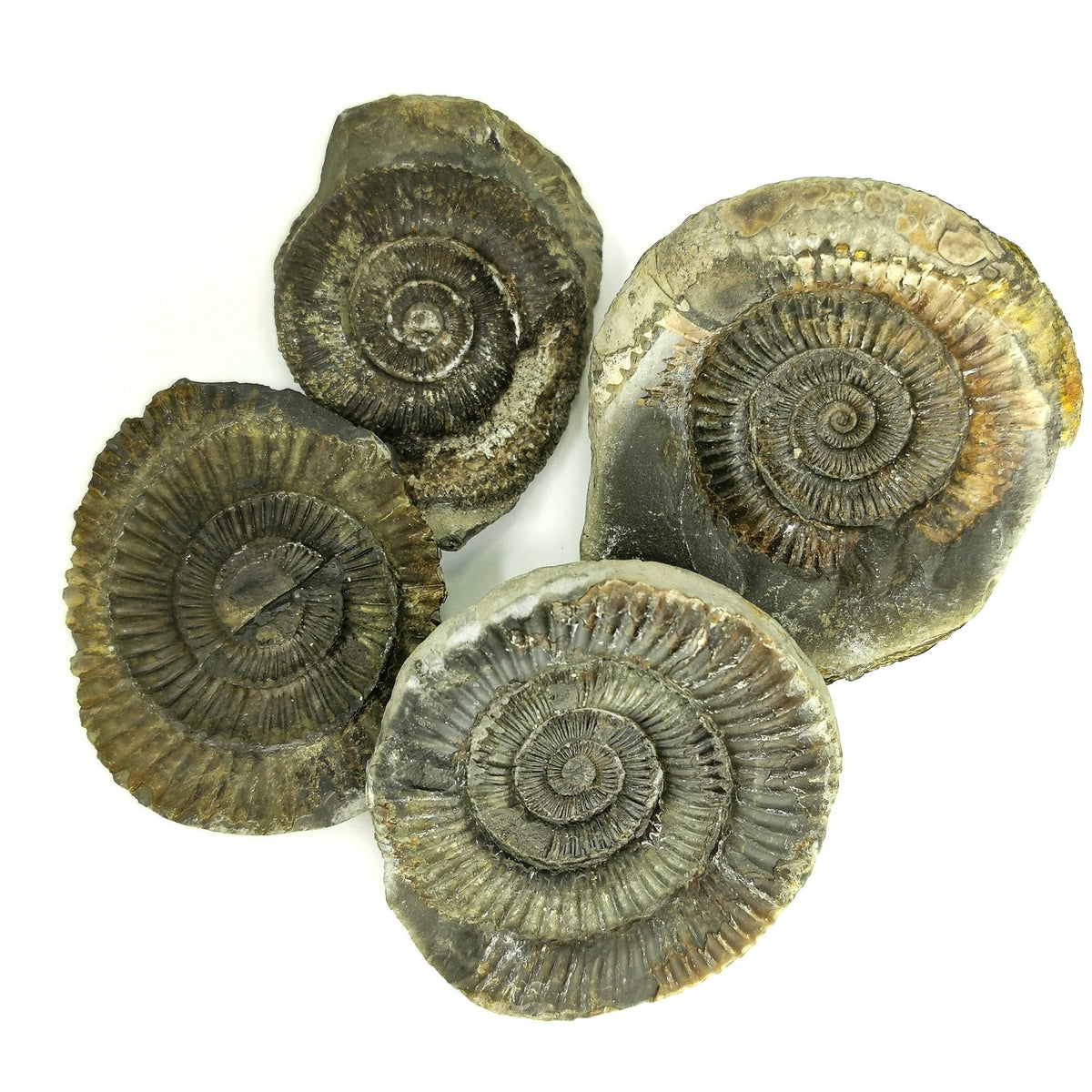
William "Strata" Smith, a surveyor in southern England, noticed that certain layers held fossils not found in others. Using those index fossils as markers, he could recognise the same layer wherever it showed up.[1] Index fossils are species that lived only during a limited stretch of time, so finding one tells you roughly how old the rock is.[2] Ammonites are a classic example. Much of Europe's Mesozoic rock is divided into ammonite zones.[4]

Numerical dating: radioactive clocks
Some isotopes decay at steady, known rates, measured as half-lives. Comparing how much of the parent isotope is left with how much of its daughter product has built up gives an age.[3] USGS lists the main geologic clocks, including uranium-238 to lead-206 (half-life 4.5 billion years) and potassium-40 to argon-40 (1.25 billion years). Potassium-argon works on rocks from a few thousand years old to the oldest known.[3]
Why volcanic layers matter
Radioactive clocks mostly date igneous rock, not the sediment a fossil sits in. So geologists date ash or lava layers above and below the fossil and bracket its age. USGS gives the example of volcanic ash layers in Olduvai Gorge, East Africa, that sandwich early human fossils and date to about 1.75 million years.[3]
Carbon-14 is for young material
Carbon-14 has a half-life of 5,730 years and only works on material from about the last 50,000 years.[3] It's useful for Ice Age bones and wood, but it can't date a dinosaur or an ammonite. If someone says a trilobite was carbon dated, be suspicious. More on the age question in When Does Something Become a Fossil?, and see all our fossils.
See what's new: browse our newest arrivals for the latest pieces added to the shop.
Sources
- USGS (US Geological Survey): Geologic Time: Relative Time Scale.
- USGS: Geologic Time: Index Fossils.
- USGS: Geologic Time: Radiometric Time Scale.
- Natural History Museum, London: What Is an Ammonite?