


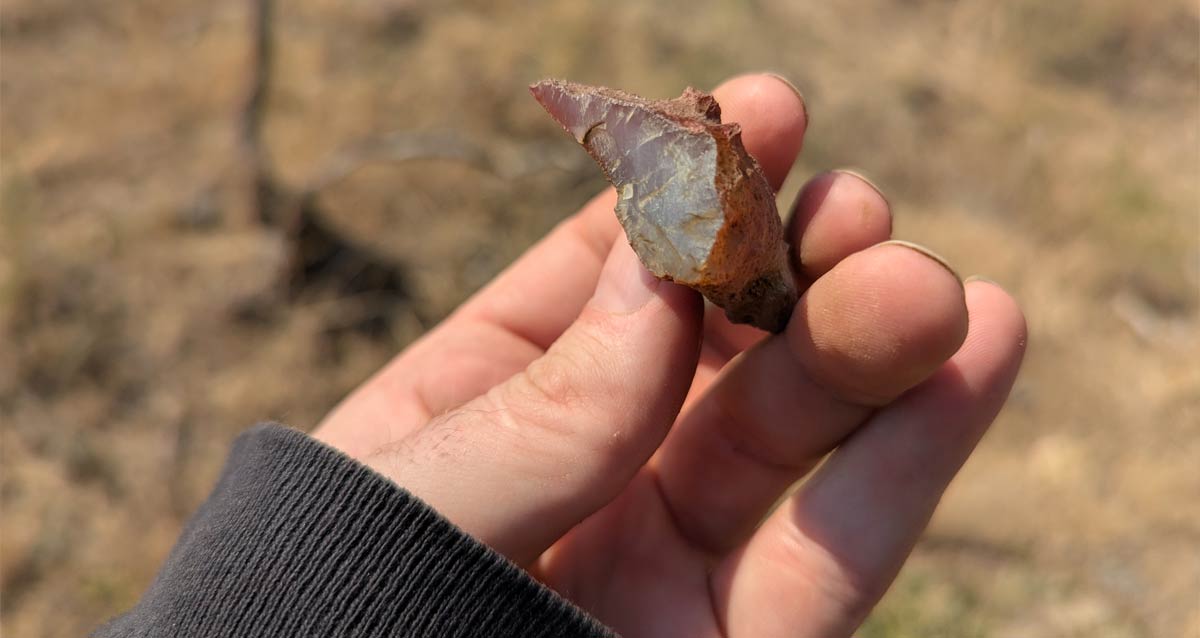

The Okanagan is good agate country because it has the right geological recipe.
You need volcanic rocks. You need cavities. You need silica-rich fluids. You need time. Then you need weathering, glaciers, rivers, creeks, lake shores, and erosion to break the agates out and concentrate them where people can actually find them.
The Okanagan has all of that.
That is why agates show up in gravel bars, lake shores, road cuts, dry washes, creek beds, fields, and old glacial deposits. They are not evenly scattered everywhere, and they did not all form in one neat layer. They are the durable leftovers of a much larger volcanic and glacial story.
Agates are not common in the Okanagan because the valley is magic.
They are common because the geology cooperated.
Agate Starts With Silica
Agate is mostly chalcedony, a very fine-grained form of quartz.
Quartz is silicon dioxide. Chalcedony is the same basic chemistry, but instead of forming large visible crystals, it forms as microscopic quartz fibres and layers. When those layers build up inside a cavity, fracture, or open space, you can get agate.
That is the simple version.
The more useful version is this:
Agate forms when silica-rich water moves through rock and deposits silica in open spaces.
Those open spaces might be gas bubbles in lava, cracks in volcanic rock, spaces between broken fragments, or cavities created by weathering and alteration.
The silica does not usually fill the space all at once. It comes in pulses. Chemistry changes. Water flow changes. Iron content changes. Temperature changes. The cavity may partly fill, dry out, refill, crack, seal, and reopen. Each event can leave a new layer, stain, crystal lining, opal patch, or internal pattern.
That is why a good agate can look like a little geological diary.
The Okanagan Is Volcanic Country
The Okanagan is famous today for lakes, orchards, wineries, cliffs, sagebrush, and summer heat.
Underneath that modern surface is a much older volcanic landscape.
Parts of the southern Interior, including the Okanagan and nearby highlands, contain volcanic and sedimentary rocks from ancient volcanic basins. Around places like White Lake, Okanagan Falls, Skaha Lake, Twin Lakes, Keremeos, and Penticton, the geology includes volcanic flows, volcanic breccias, tuffs, lahars, conglomerates, sandstones, and related basin deposits.
That mix matters.
Volcanic regions are especially good for agate because they provide three things at once:
|
Ingredient |
Why it matters |
|
Cavities |
Gas bubbles, fractures, breccias, and open spaces give silica somewhere to deposit. |
|
Silica |
Volcanic glass, ash, feldspar-rich rocks, and hydrothermal fluids can supply silica. |
|
Fluid pathways |
Cracks, porous layers, broken lava, and basin sediments allow mineral-rich water to move. |
Without cavities, silica has nowhere to collect.
Without silica-rich fluids, cavities stay empty or fill with something else.
Without erosion, the agates remain locked in bedrock.
The Okanagan has the full chain.
Gas Bubbles in Lava Become Agate Pockets

One of the most important words for understanding agate is vesicle.
A vesicle is a gas bubble trapped in volcanic rock.
When lava erupts, gases try to escape. If the lava cools before the bubbles disappear, those bubbles are frozen into the rock as small rounded cavities. Later, mineral-rich water can move through the rock and fill those cavities.
When a cavity fills with minerals, it is called an amygdule.
So when you see an agate nodule, quartz-lined pocket, or chalcedony-filled bubble in volcanic rock, you are often looking at an old gas bubble that became a mineral pocket.
This is one of the reasons volcanic rocks produce so many interesting lapidary materials. A boring-looking lava flow may be full of tiny spaces. If later fluids move through those spaces, the rock becomes a factory for chalcedony, quartz, calcite, zeolites, opal, and sometimes agate.
In the White Lake Basin area, volcanic rocks include vesicular basaltic andesite, where vesicles are filled with minerals such as chlorite, chalcedony, and calcite. That is almost the agate-forming process written directly into the local geology.
Why Agate Forms in Layers
Agate banding forms because silica is deposited in stages.
A cavity may first receive a thin coating of chalcedony. Later, another pulse of silica enters and deposits a slightly different layer. Then another. Then another.
Each layer may differ slightly in colour, texture, impurity content, or translucency.
The bands can be controlled by changes in:
-
iron content
-
water chemistry
-
acidity
-
oxidation
-
silica concentration
-
temperature
-
drying and refilling
-
trace minerals
-
how quickly silica was deposited
That is why agate bands are often irregular but still organized. They are not random paint stripes. They are growth layers.
The bands record changes in the cavity over time.
Fortification Agate: Bands That Follow the Walls
A lot of classic agate is called fortification agate.
This is the type where the bands follow the shape of the cavity, like a map contour or the walls of an old fortress. The silica coats the inside of the cavity and grows inward, layer by layer.
If the original cavity was round, the bands may be rounded. If the cavity was jagged, the bands may zigzag. If the cavity was stretched or cracked, the bands follow that shape.
This is why fortification agate often looks architectural.
The pattern is not decoration added later. It is the shape of the original opening being repeated inward by silica deposition.
Waterline Agate: Flat Layers in a Hollow Space
Some Okanagan agates show flat, level-looking bands. These are often called waterline, water-level, or water-table agates.
They form differently from fortification agate.
Instead of silica coating all walls evenly, silica-rich gel or fluid partly fills a cavity and settles under gravity. Each layer forms along the bottom of the open space. Later, another layer settles on top. The result looks like stacked sediment inside the agate.
Waterline agates can look almost too neat, as if someone poured layers into the rock and let them harden.
That is not far from the truth.
The key difference is:
Fortification bands follow the cavity walls. Waterline bands settle flat under gravity.
In a good waterline agate, the layers can look like tiny lake beds trapped inside a stone.

Eye Agates: Why Some Have Circles
Some agates have rounded “eyes” or orb-like features. These are called eye agates.
An eye agate forms when chalcedony grows around small points inside the cavity instead of only coating the outer wall.
Those points might be:
-
tiny mineral grains
-
bumps on the cavity wall
-
small droplets or silica gel structures
-
tiny internal bubbles
-
tubes or branching forms cut in cross-section
-
earlier mineral growths later coated by chalcedony
Layer after layer grows around these centres. When the agate is cut through them, the rounded growths appear as eyes.
So an eye agate is not a fossil, and it is not a biological structure.
It is concentric mineral growth around a small centre.
The saw cut matters. The same internal structure can look like a dot, an eye, a ring, a tube, or a plume depending on the angle of the cut.
Why Some Agates Have Opal
Some Okanagan agates contain opal, opal-like zones, common opal, or silica that looks softer, milkier, or more glassy than typical chalcedony.
That makes sense.
Agate and opal are both silica-based, but they are not identical.
Agate is mostly chalcedony, a microcrystalline form of quartz.
Opal is hydrated amorphous silica. It contains water in its structure and lacks the same crystal structure as quartz.
In volcanic settings, silica-rich fluids do not always deposit the same type of silica. Depending on water content, temperature, chemistry, pH, evaporation, and timing, silica may deposit first as opal or silica gel. Later, some of it may change into chalcedony or quartz. In other cases, opal remains preserved.
That is why a single Okanagan stone can contain:
-
chalcedony
-
agate banding
-
common opal
-
quartz crystals
-
jaspery zones
-
calcite
-
chlorite
-
iron staining
The cavity did not necessarily fill in one clean event. It may have filled in stages, with different silica phases and other minerals entering at different times.
A good agate is not always one material.
It can be a sequence.
Why Some Agates Have Quartz Crystal Pockets
Sometimes the outside of a nodule is chalcedony or agate, but the centre is lined with quartz crystals.
This usually means the cavity did not fill completely with chalcedony.
Early silica coated the walls as chalcedony. Then an open space remained in the centre. Later, conditions allowed larger quartz crystals to grow into that open space.
This is common in geodes and agate nodules.
The rule is simple:
Chalcedony often forms tight layers along the walls. Quartz crystals grow where open space remains.
That open space is important. Crystals need room. If the cavity fills too quickly or too completely with chalcedony, there may be no open centre left for crystals.
Why Some Okanagan Agates Have Red Skin

Many Okanagan agates have red, orange, rusty, brown, or yellowish skins.
That outer colour usually comes from iron oxides.
Iron is common in volcanic rocks. When iron-bearing minerals weather near the surface, they oxidize. That can produce red, orange, yellow, and brown staining.
The same general process that turns metal rusty can stain rock.
Red skins are commonly linked to minerals and coatings such as:
-
hematite
-
goethite
-
limonite-like iron oxides
-
iron-rich clay
-
oxidized volcanic host rock
-
iron-stained groundwater films
Sometimes the red colour is only a thin rind on the outside. Sometimes iron penetrates fractures and stains deeper into the agate. Sometimes it colours entire bands.
A rusty outside does not always mean the inside will be red. Many nodules have ugly iron-stained skins and clean grey, white, clear, orange, or banded interiors.
The outside tells you about weathering.
The inside tells you what happened inside the cavity.
Why Some Agates Have Green Skin
Green skins usually tell a different story.
In volcanic rocks, green colour is often tied to alteration minerals such as chlorite and epidote, or to altered basaltic and andesitic host rock still stuck to the outside of the nodule.
This is especially relevant in the Okanagan because volcanic rocks in the White Lake Basin include vesicles filled with chlorite, chalcedony, and calcite. Chlorite is commonly green. Epidote is commonly yellow-green to pistachio green. Altered volcanic rock can also weather greenish, grey-green, or olive.
So when an agate has a green rind, it may not be the agate itself that is green. It may be a skin of altered volcanic host rock, chlorite-rich material, epidote-bearing alteration, or green secondary minerals around the silica.
In plain language:
Red skins usually point to iron oxidation. Green skins usually point to volcanic alteration minerals.
That is not a perfect rule, but it is a useful one.
Agate, Jasper, Chalcedony, and Opal: Where the Names Blur
Collectors love clean names.
Nature does not cooperate.
In the Okanagan, many silica stones sit between categories. You may find agate with jaspery zones, jasper cut by agate veins, chalcedony with opal patches, quartz-lined nodules, or silica-rich volcanic rock stained by iron.
A practical breakdown:
|
Name |
Basic meaning |
|
Chalcedony |
Fine-grained silica; often waxy, translucent to opaque. |
|
Agate |
Banded or patterned chalcedony, often forming in cavities. |
|
Jasper |
Opaque, impure silica-rich rock, commonly coloured by iron. |
|
Opal |
Hydrated amorphous silica; often waxy, glassy, or milky. |
|
Quartz |
Crystalline silica; may form visible crystals in open cavities. |
In the field and lapidary trade, people often use these terms loosely.
That is fine to a point. But if you want to understand the geology, the differences matter.
Agate is about silica filling spaces in layers.
Jasper is about opaque silica-rich material, often full of impurities.
Opal is about hydrated, less crystalline silica.
Quartz crystals need open space to grow.
A single rock can contain more than one of these.
Why Okanagan Agates Often Look Boring Outside
A good agate can look ugly before it is cut.
The outside may be weathered, dull, chalky, rusty, greenish, pitted, coated in host rock, or rounded by transport. It may not show banding at all.
That is normal.
Agates often form inside cavities. The best pattern is inside the stone, not on the weathered surface. The outside may be a rind, a host-rock remnant, an iron-stained skin, or a surface beaten up by water and ice.
Useful field clues include:
-
waxy texture
-
unusual density
-
conchoidal fracture
-
translucent edges
-
rounded nodule shape
-
red, orange, white, grey, or green rind
-
quartz or chalcedony patches
-
hardness greater than steel
-
pattern visible when wet
-
banding on a broken edge
But even with experience, the saw tells the truth.
Some ugly nodules cut beautifully. Some promising ones are plain inside.
That is part of the deal.

Glaciers Turned the Okanagan Into a Sorting Machine
Agates do not only need to form.
They also need to be exposed.
This is where the Okanagan’s glacial history matters.
During the late Pleistocene, the Okanagan Valley was occupied by glacial ice. As the ice melted, the valley did not simply become ice-free overnight. Ice lobes stagnated. Meltwater channels formed. Outwash terraces were deposited. Glacial lakes developed. Kettled outwash, kame terraces, deltas, fans, silts, sands, and gravels accumulated throughout the valley.
That history is essential for understanding why agates turn up loose in so many places.
Glaciers and meltwater broke, moved, buried, sorted, and reworked rock. Softer volcanic host rocks broke down. Durable silica nodules survived. Streams then carried those hard pieces into gravels, terraces, lake margins, and creek deposits.
Agate is tough.
A lot of the rock around it is not.
That difference helps concentrate agates.
A Loose Agate May Not Have Formed Where You Found It
This is one of the most important points.
Finding an agate in a gravel bar does not prove it formed in that gravel bar. Finding one on a lake shore does not prove the bedrock under that beach is full of agates. Finding one in a field does not mean there is an agate vein under the farm.
It might be local.
It might also have been moved.
In the Okanagan, rock can be transported by:
-
glaciers
-
meltwater streams
-
creeks
-
rivers
-
lake waves
-
alluvial fans
-
landslides
-
road building
-
gravel extraction
-
human fill
The valley’s late-glacial history includes meltwater channels, outwash terraces, glacial-lake sediments, kame terraces, kettled outwash, fans, deltas, and river terraces. These are exactly the kinds of deposits that can move and concentrate durable stones.
So the better question is not only:
Where did I find this?
The better question is:
What process put it there?
That is the difference between collecting and understanding.
Why Agates Survive Transport
Agate survives because silica is hard and chemically resistant.
On the Mohs hardness scale, quartz is about 7. That is harder than steel. Chalcedony is similarly tough. It can break, but it resists abrasion better than many volcanic host rocks, clay-rich sediments, and weathered minerals.
So as rock is broken down by freezing, thawing, water, ice, and stream transport, agate nodules often remain intact longer than the rock they formed in.
That is why agates can become concentrated in gravels.
The host rock rots away.
The agate remains.
Why Okanagan Agates Have Warm Colours

Many Okanagan agates, jaspers, and chalcedony pieces show warm colours: red, orange, yellow, brown, cream, honey, and rust.
Iron is the main reason.
Iron can enter silica during deposition, stain it later, or coat cracks and surfaces during weathering. Hematite tends to produce red tones. Goethite and limonite-style iron oxides tend to produce yellows, oranges, and browns.
This is also why agate and jasper often blend visually.
A clean silica cavity fill may look like agate. Add enough iron and impurities, and parts may become jaspery. Brecciate the rock and heal it with silica, and you can get patterns that look halfway between jasper, agate, and volcanic breccia.
The colours are not random.
They are chemistry.
Why One Okanagan Agate Can Contain So Many Textures
One nodule can show several features because it may have had several mineral events.
A simplified sequence might look like this:
-
Lava erupts and traps gas bubbles.
-
The lava cools into vesicular volcanic rock.
-
Groundwater or hydrothermal fluid moves through the rock.
-
Early silica gel or opal coats part of the cavity.
-
Chalcedony forms bands of agate.
-
Iron stains some layers red, orange, or brown.
-
Chlorite or epidote leaves greenish alteration.
-
Quartz crystals grow into remaining open space.
-
Calcite fills late cracks.
-
Weathering stains the outside.
-
Glaciers, streams, or waves break the nodule free and move it.
That is why a single stone can have fortification banding, waterlines, eyes, opal, jaspery zones, quartz pockets, red skin, and green rind.
It is not one event.
It is a sequence of small events preserved in silica.
Why the Okanagan Has So Many Agates
The Okanagan has many agates because several good conditions overlap.
First, the region has volcanic rocks with vesicles, fractures, breccias, and porous zones.
Second, volcanic alteration and groundwater movement supplied silica and other minerals.
Third, cavities were filled by chalcedony, quartz, calcite, opal, chlorite, and related minerals.
Fourth, iron and other impurities created colour.
Fifth, erosion and glaciation released the hard silica from its softer host rock.
Sixth, meltwater, creeks, rivers, lake waves, and gravel deposits concentrated the durable pieces.
That is the whole system.
Volcanoes made the spaces.
Silica filled them.
Iron and alteration coloured them.
Glaciers and water scattered them.
Collectors find what survived.
Okanagan Agate in One Sentence
Okanagan agates are mostly silica-filled volcanic cavities and fractures, later coloured by iron and alteration minerals, then released and concentrated by weathering, glaciers, meltwater, streams, and lake-shore erosion.
That is why the Okanagan is such productive agate country.
Not because every hill is full of treasure.
Because the region had the right rock, the right fluids, the right cavities, and the right landscape history to bring those stones back to the surface.
By Adam Kelliher