


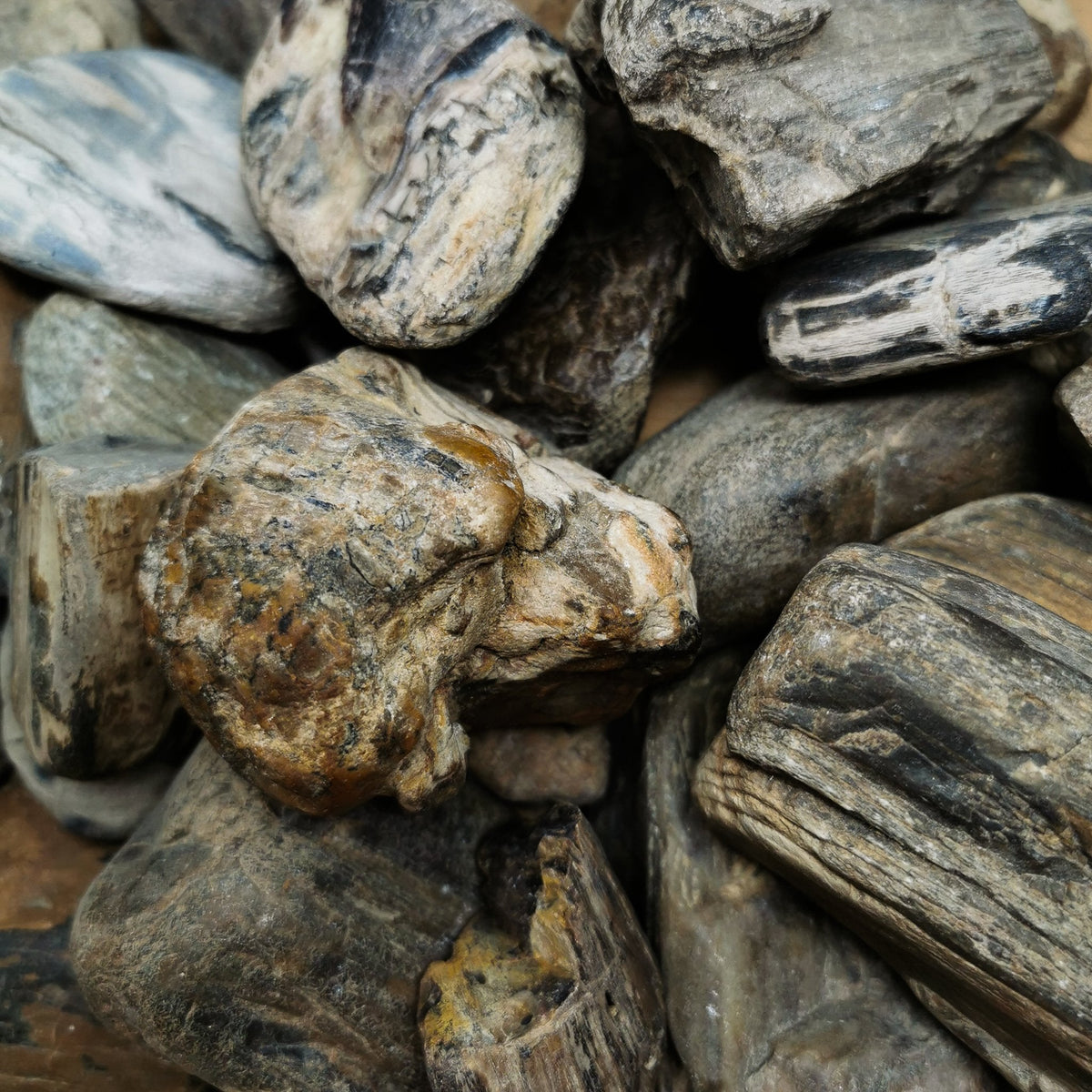
People are always surprised when I tell them BC has petrified wood. Everybody thinks Arizona, and fair enough, Arizona has the famous logs. But some of the best-studied fossil wood anywhere in the world comes from a riverbank south of Princeton, and there are whole tree trunks sitting in old volcanic rock near Cache Creek. Here's how wood turns to stone, where BC's best documented examples are, and what the rules say about picking it up.
How a tree turns into rock
Petrified wood isn't wood that "hardened." It's wood that got buried fast enough that it didn't rot, then had minerals fill it in from the inside. Groundwater carrying dissolved silica moves through the tiny pores and cell walls, and the silica drops out of solution in there. That's called permineralization. It can copy the original wood right down to the cell level, and a permineralized fossil ends up a lot heavier than the wood it started as because all those empty spaces are now full of stone.[1]
Volcanic ash is the key ingredient. Ash is mostly shattered volcanic glass, and the silica in glass isn't locked up in a crystal like it is in quartz or feldspar, so groundwater picks it up easily. The US Park Service points out that ash-rich rock holds some of the biggest petrified wood deposits they manage, and that petrified wood is the most common fossil you find in lahars, the volcanic mudflows that bury forests.[1][2] In Arizona's Petrified Forest the silica started out as opal and slowly recrystallized into quartz over millions of years, and the colours come from impurities like iron, manganese and carbon.[3]
Keep the ash part in mind, because BC has had plenty of volcanoes.

The Princeton chert: wood preserved down to the cells
On the east bank of the Similkameen River, south of Princeton, there's a layer in the Allenby Formation called the Princeton chert. It's an Eocene marsh soil that got soaked in silica, and the plants inside are what paleobotanists call anatomically preserved. That means you can slice it and see the cells.[4][5]
The silica most likely came from mineral springs or geysers flooding the marsh over and over.[4] A 2016 review counts more than 30 plant species described in detail from the chert, plus a pile of fungi, and puts its age at the very end of the early Eocene or start of the middle Eocene.[5] The star is Metasequoia milleri, an extinct dawn redwood. Its wood is preserved well enough that Basinger could compare the tracheid pitting and resin cysts with the living dawn redwood, and the rays on the fossil turn out to be much taller.[4]
I love this one because it's the opposite of the Arizona look. It's not big rainbow logs. It's dark, fine, almost boring chert, until you put it under a microscope.
Logs in the volcanic rock near Cache Creek
Everyone knows McAbee for its fossil leaves and fish. But in Read and Hebda's 2009 report on the area, there's a line I always point people to. In the Perry Ranch beds, at a locality they call F9, there's petrified wood sitting in volcanic breccia under the lake beds. They describe pieces of wood several metres long and tens of centimetres across, lying flat, one still with roots attached, all pointing south. They read that as burial in a cataclysmic volcanic event or the debris flow that came with it.[6] In the same report they also note petrified tree trunks exposed in a cut face at the old Kitty Litter quarry.[6]
That fits the lahar story to a tee: a volcano lets go, a slurry of ash and rock flattens a forest, and the silica-rich ash goes to work on the logs.

Younger wood: the Miocene of the Interior Plateau
Jump forward about 35 million years. The Chilcotin Group basalts poured out over much of the Interior Plateau, mostly during the Miocene.[7] At the Red Lake diatomite mine north of Kamloops, the Miocene Deadman River Formation has carbonaceous layers with minor lignite and wood, including tree trunks.[7] I'm being careful here: the paper describes wood and lignite in those beds, not gem-grade agatized logs, so don't go thinking Red Lake is a cutting-wood locality.
Is it legal to collect petrified wood in BC?
Petrified wood is a fossil, so BC's fossil rules apply. On Crown land you can collect small amounts of fossils that are common at the site, from the surface only, with hand tools, for your own personal use. You're a caretaker, not an owner. Common fossils you collect can't be sold or taken out of BC. Anything significant, including sites with exceptional preservation, has to be reported, and there's no fossil collecting in parks.[8][9] McAbee itself is a designated Provincial heritage site, so you don't dig there.[10]
Want the full breakdown on claims, parks and private land? My BC rockhounding rules post, coming out this weekend, goes into it.
The petrified wood we sell is imported material from outside BC with its locality on the listing. Browse our petrified wood, amber and plant fossils or, if you cut, the petrified river wood and rainbow wood rough.
References
- US National Park Service. Permineralization and Replacement. nps.gov
- US National Park Service. Volcanoes and Fossils. nps.gov
- US National Park Service. Trees to Stone (Petrified Forest National Park brochure, 2019), and Petrified Wood. nps.gov
- Basinger, J.F. 1981. The vegetative body of Metasequoia milleri from the Middle Eocene of southern British Columbia. Canadian Journal of Botany 59: 2379–2410. doi:10.1139/b81-291
- Pigg, K.B. and DeVore, M.L. 2016. A review of the plants of the Princeton chert (Eocene, British Columbia, Canada). Botany 94: 661–681. doi:10.1139/cjb-2016-0079
- Read, P.B. and Hebda, R. 2009. Geological Setting and Paleontology of the Fossiliferous Eocene Beds near McAbee, Southwestern British Columbia. Report for the BC Ministry of Agriculture and Lands, pp. 43, 49. PDF
- Greenwood, D.R., West, C.K. and Basinger, J.F. 2020. The Miocene Red Lake macroflora of the Deadman River Formation (Chilcotin Group), Interior Plateau, British Columbia, Canada. Acta Palaeobotanica 60: 213–250. doi:10.35535/acpa-2020-0011
- Province of British Columbia. Fossil management: Collection and use. gov.bc.ca
- Province of British Columbia. Guidelines for Recreational Fossil Collection. PDF
- Province of British Columbia. McAbee Fossil Beds Heritage Site; B.C. Reg. 219/2012.
By Adam Kelliher