






Specifications
Description
Locality: Baia Mare mining district, Maramureș County, Romania
Smoky quartz gets its colour from aluminium. In all smoky quartz a little aluminium takes the place of silicon, but the colour only appears once the crystal has been irradiated. Natural radiation over geological time removes an electron from an oxygen atom next to an aluminium ion, creating a colour centre that absorbs light and gives the typical smoky brown. With enough aluminium and intense radiation the quartz turns completely black, the variety called morion, and heating removes the colour.
The Baia Mare district lies in the Gutâi Mountains of northern Romania, part of the volcanic arc on the inner side of the Carpathians. Volcanic activity built these mountains between about 15.4 and 7 million years ago, and the hydrothermal fluids linked to it left hundreds of gold-silver and lead-zinc veins. The Main Vein of the Baia Sprie mine, 8 km long, is the longest ore vein in Europe.
Mining around Baia Mare is documented with certainty from the 13th and 14th centuries, and the late 15th century brought a first boom in gold and silver mining. More than 20 mines were still working the district's veins until 2007, and two of its deposits, Cavnic and Baia Sprie, are classed as world-class.
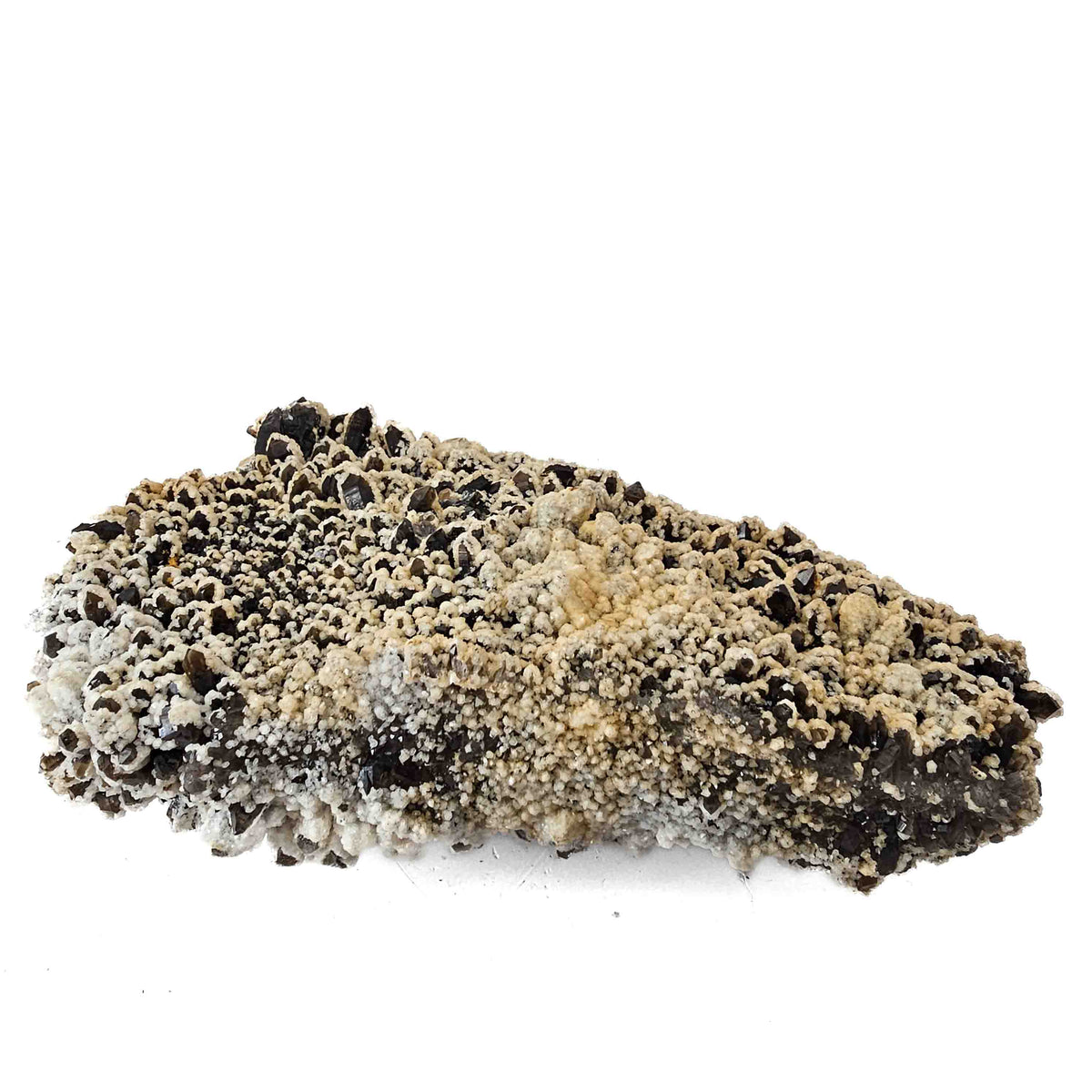
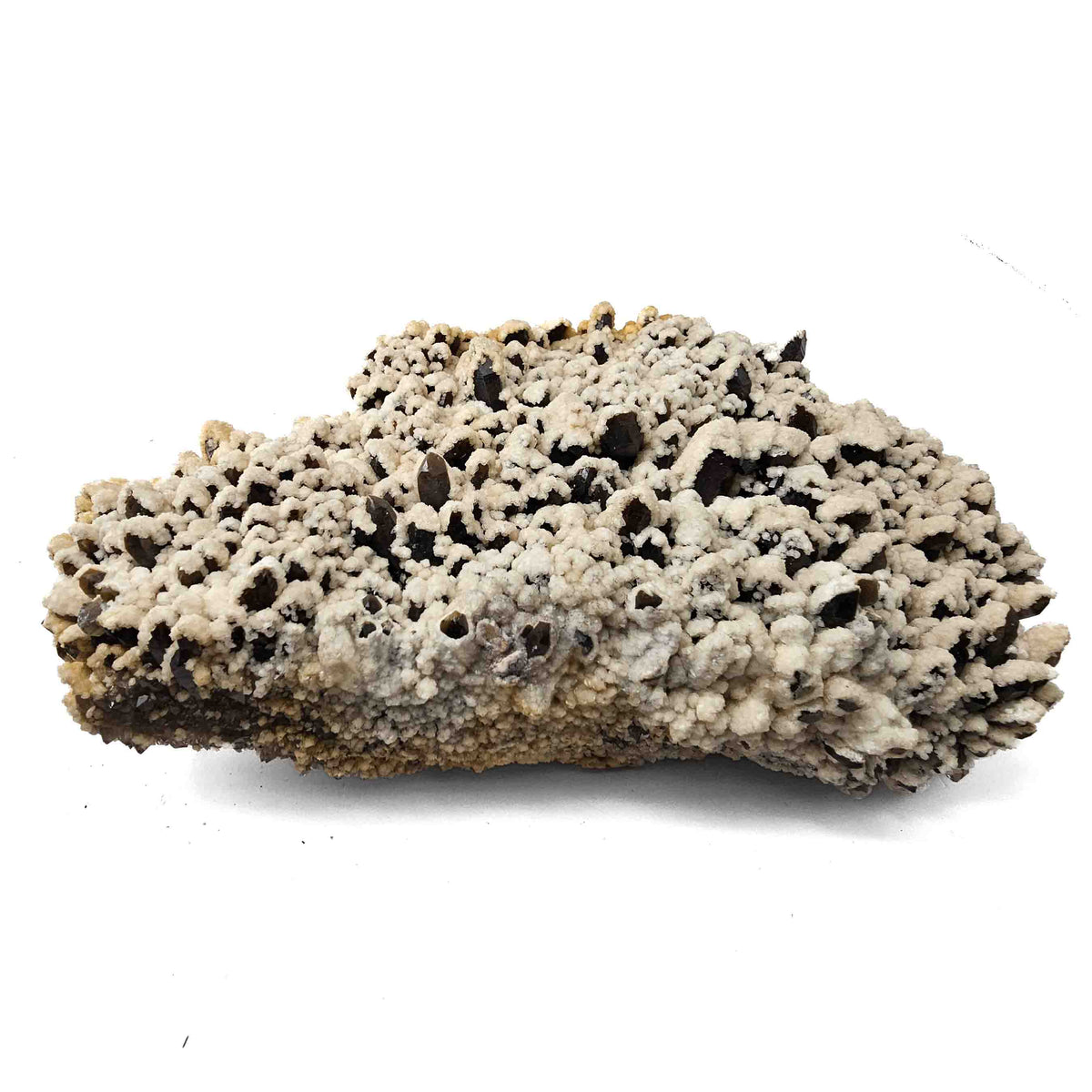
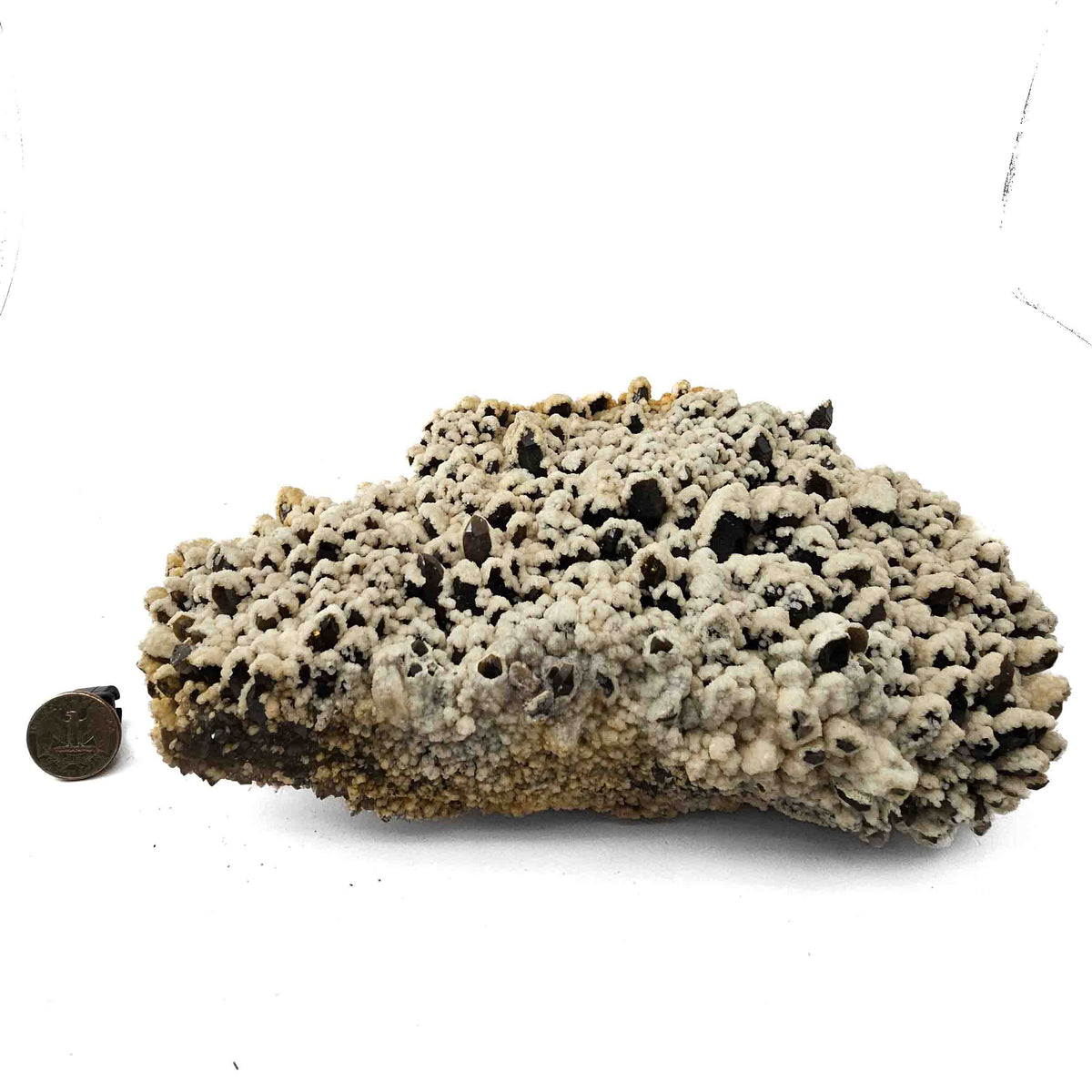
This one of a kind Calcite on Smokey Quartz specimen from Romania features a long, sculptural plate of dark smoky brown Quartz crystals heavily coated with cream to off-white Calcite. The Calcite forms a bubbly, botryoidal-looking crust across much of the surface, wrapping around the Quartz points and leaving dark crystal tips and pockets visible throughout. The contrast between the soft, snowy Calcite texture and the deep glossy Smokey Quartz underneath gives this specimen a dramatic layered appearance, with warm beige staining along the edges adding natural earthy character.
Smokey Quartz is a dark variety of Quartz, with its smoky coloration caused by natural irradiation and trace aluminum within the crystal structure. Quartz has been collected, carved, and used decoratively for thousands of years, while Romanian Smokey Quartz specimens are commonly associated with the country’s historic hydrothermal mining regions. Calcite, a calcium carbonate mineral, is one of the most common and diverse minerals in the world, known for forming in many habits including rhombohedral crystals, scalenohedrons, crusts, coatings, and drusy clustered growths.
In crystal traditions, smoky quartz is associated with grounding and protection, and calcite with cleansing and clarity.
Chemical Composition: Calcite: CaCO3, Quartz: SiO2
Quantity: 1pc
With this product, you will get the actual stone in the photograph.